Do you ever wonder how old is
Lebanon, it is surely older than the Bible. Lebanon is mentioned 65 times in
the Bible.
Search words: "Lebanon" 65 results.
Deuteronomy 1:7
Break camp and advance into the hill country of the Amorites; go to all the
neighboring peoples in the Arabah, in the mountains, in the western
foothills, in the Negev and along the coast, to the land of the Canaanites
and to Lebanon, as far as the great river, the Euphrates.
Deuteronomy 3:25
Let me go over and see the good land beyond the Jordan-that fine hill
country and Lebanon."
Deuteronomy 11:24
Every place where you set your foot will be yours: Your territory will
extend from the desert to Lebanon, and from the Euphrates River to
the western sea. [ 11:24 That is, the Mediterranean ]
Joshua 1:4
Your territory will extend from the desert to Lebanon, and from the
great river, the Euphrates-all the Hittite country-to the Great Sea [ 1:4
That is, the Mediterranean ] on the west.
Joshua 9:1
Now when all the kings west of the Jordan heard about these things-those in
the hill country, in the western foothills, and along the entire coast of
the Great Sea [ 9:1 That is, the Mediterranean ] as far as Lebanon
(the kings of the Hittites, Amorites, Canaanites, Perizzites, Hivites and
Jebusites)-
Joshua 11:17
from Mount Halak, which rises toward Seir, to Baal Gad in the Valley of
Lebanon below Mount Hermon. He captured all their kings and struck them
down, putting them to death.
Joshua 12:7
These are the kings of the land that Joshua and the Israelites conquered on
the west side of the Jordan, from Baal Gad in the Valley of Lebanon
to Mount Halak, which rises toward Seir (their lands Joshua gave as an
inheritance to the tribes of Israel according to their tribal divisions-
Joshua 13:5
the area of the Gebalites [ 13:5 That is, the area of Byblos ] ; and
all Lebanon to the east, from Baal Gad below Mount Hermon to Lebo [
13:5 Or [ to the entrance to ] ] Hamath.
Joshua 13:6
"As for all the inhabitants of the mountain regions from Lebanon to
Misrephoth Maim, that is, all the Sidonians, I myself will drive them out
before the Israelites. Be sure to allocate this land to Israel for an
inheritance, as I have instructed you,
Judges 3:3
the five rulers of the Philistines, all the Canaanites, the Sidonians, and
the Hivites living in the Lebanon mountains from Mount Baal Hermon to
Lebo [ 3:3 Or [ to the entrance to ] ] Hamath.
Judges 9:15
"The thornbush said to the trees, 'If you really want to anoint me king over
you, come and take refuge in my shade; but if not, then let fire come out of
the thornbush and consume the cedars of Lebanon!'
1 Kings 4:33
He described plant life, from the cedar of Lebanon to the hyssop that
grows out of walls. He also taught about animals and birds, reptiles and
fish.
1 Kings 5:6
"So give orders that cedars of Lebanon be cut for me. My men will
work with yours, and I will pay you for your men whatever wages you set. You
know that we have no one so skilled in felling timber as the Sidonians."
1 Kings 5:9
My men will haul them down from Lebanon to the sea, and I will float
them in rafts by sea to the place you specify. There I will separate them
and you can take them away. And you are to grant my wish by providing food
for my royal household."
1 Kings 5:14
He sent them off to Lebanon in shifts of ten thousand a month, so
that they spent one month in Lebanon and two months at home. Adoniram
was in charge of the forced labor.
1 Kings 7:2
He built the Palace of the Forest of Lebanon a hundred cubits long,
fifty wide and thirty high, [ 7:2 That is, about 150 feet (about 46
meters) long, 75 feet (about 23 meters) wide and 45 feet (about 13.5 meters)
high ] with four rows of cedar columns supporting trimmed cedar beams.
1 Kings 9:19
as well as all his store cities and the towns for his chariots and for his
horses [ 9:19 Or [ charioteers ] ] -whatever he desired to build in
Jerusalem, in Lebanon and throughout all the territory he ruled.
1 Kings 10:17
He also made three hundred small shields of hammered gold, with three minas
[ 10:17 That is, about 3 3/4 pounds (about 1.7 kilograms) ] of gold
in each shield. The king put them in the Palace of the Forest of
Lebanon.
1 Kings 10:21
All King Solomon's goblets were gold, and all the household articles in the
Palace of the Forest of Lebanon were pure gold. Nothing was made of
silver, because silver was considered of little value in Solomon's days.
2 Kings 14:9
But Jehoash king of Israel replied to Amaziah king of Judah: "A thistle in
Lebanon sent a message to a cedar in Lebanon, 'Give your
daughter to my son in marriage.' Then a wild beast in Lebanon came
along and trampled the thistle underfoot.
2 Kings 19:23
By your messengers you have heaped insults on the Lord. And you have said,
"With my many chariots I have ascended the heights of the mountains, the
utmost heights of Lebanon. I have cut down its tallest cedars, the
choicest of its pines. I have reached its remotest parts, the finest of its
forests.
2 Chronicles 2:8
"Send me also cedar, pine and algum [ 2:8 Probably a variant of [
almug ] ; possibly juniper ] logs from Lebanon, for I know that your
men are skilled in cutting timber there. My men will work with yours
2 Chronicles 2:16
and we will cut all the logs from Lebanon that you need and will
float them in rafts by sea down to Joppa. You can then take them up to
Jerusalem."
2 Chronicles 8:6
as well as Baalath and all his store cities, and all the cities for his
chariots and for his horses [ 8:6 Or [ charioteers ] ] -whatever he
desired to build in Jerusalem, in Lebanon and throughout all the
territory he ruled.
2 Chronicles 9:16
He also made three hundred small shields of hammered gold, with three
hundred bekas [ 9:16 That is, about 3 3/4 pounds (about 1.7
kilograms) ] of gold in each shield. The king put them in the Palace of the
Forest of Lebanon.
2 Chronicles 9:20
All King Solomon's goblets were gold, and all the household articles in
the Palace of the Forest of Lebanon were pure gold. Nothing was
made of silver, because silver was considered of little value in
Solomon's day.
(Whole Chapter:
2 Chronicles 9 In context:
2 Chronicles 9:19-21)
2 Chronicles 25:18
But Jehoash king of Israel replied to Amaziah king of Judah: "A thistle
in Lebanon sent a message to a cedar in Lebanon, 'Give
your daughter to my son in marriage.' Then a wild beast in Lebanon
came along and trampled the thistle underfoot.
(Whole Chapter:
2 Chronicles 25 In context:
2 Chronicles 25:17-19)
Ezra 3:7
Then they gave money to the masons and carpenters, and gave food and
drink and oil to the people of Sidon and Tyre, so that they would bring
cedar logs by sea from Lebanon to Joppa, as authorized by Cyrus
king of Persia.
(Whole Chapter:
Ezra 3 In context:
Ezra 3:6-8)
Psalm 29:5
The voice of the LORD breaks the cedars; the LORD breaks in pieces the
cedars of Lebanon.
(Whole Chapter:
Psalm 29 In context:
Psalm 29:4-6)
Psalm 29:6
He makes Lebanon skip like a calf, Sirion [ 29:6 That is,
Mount Hermon ] like a young wild ox.
(Whole Chapter:
Psalm 29 In context:
Psalm 29:5-7)
Psalm 72:16
Let grain abound throughout the land; on the tops of the hills may it
sway. Let its fruit flourish like Lebanon; let it thrive like the
grass of the field.
(Whole Chapter:
Psalm 72 In context:
Psalm 72:15-17)
Psalm 92:12
The righteous will flourish like a palm tree, they will grow like a
cedar of Lebanon;
(Whole Chapter:
Psalm 92 In context:
Psalm 92:11-13)
Psalm 104:16
The trees of the LORD are well watered, the cedars of Lebanon
that he planted.
(Whole Chapter:
Psalm 104 In context:
Psalm 104:15-17)
Song of Solomon 4:8
Come with me from Lebanon, my bride, come with me from Lebanon.
Descend from the crest of Amana, from the top of Senir, the summit of
Hermon, from the lions' dens and the mountain haunts of the leopards.
(Whole Chapter:
Song of Solomon 4 In context:
Song of Solomon 4:7-9)
Song of Solomon 7:4
Your neck is like an ivory tower. Your eyes are the pools of Heshbon by
the gate of Bath Rabbim. Your nose is like the tower of Lebanon
looking toward Damascus.
(Whole Chapter:
Song of Solomon 7 In context:
Song of Solomon 7:3-5)
Isaiah 2:13
for all the cedars of Lebanon, tall and lofty, and all the oaks
of Bashan,
(Whole Chapter:
Isaiah 2 In context:
Isaiah 2:12-14)
Isaiah 10:34
He will cut down the forest thickets with an ax; Lebanon will
fall before the Mighty One.
(Whole Chapter:
Isaiah 10 In context:
Isaiah 10:33-35)
Isaiah 14:8
Even the pine trees and the cedars of Lebanon exult over you and
say, "Now that you have been laid low, no woodsman comes to cut us
down."
(Whole Chapter:
Isaiah 14 In context:
Isaiah 14:7-9)
Isaiah 29:17
In a very short time, will not Lebanon be turned into a fertile
field and the fertile field seem like a forest?
(Whole Chapter:
Isaiah 29 In context:
Isaiah 29:16-18)
Isaiah 33:9
The land mourns [ 33:9 Or [ dries up ] ] and wastes away,
Lebanon is ashamed and withers; Sharon is like the Arabah, and
Bashan and Carmel drop their leaves.
(Whole Chapter:
Isaiah 33 In context:
Isaiah 33:8-10)
Isaiah 35:2
it will burst into bloom; it will rejoice greatly and shout for joy. The
glory of Lebanon will be given to it, the splendor of Carmel and
Sharon; they will see the glory of the LORD , the splendor of our God.
(Whole Chapter:
Isaiah 35 In context:
Isaiah 35:1-3)
Isaiah 37:24
By your messengers you have heaped insults on the Lord. And you have
said, 'With my many chariots I have ascended the heights of the
mountains, the utmost heights of Lebanon. I have cut down its
tallest cedars, the choicest of its pines. I have reached its remotest
heights, the finest of its forests.
(Whole Chapter:
Isaiah 37 In context:
Isaiah 37:23-25)
Isaiah 40:16 Lebanon is not sufficient for altar fires, nor its animals enough
for burnt offerings.
(Whole Chapter:
Isaiah 40 In context:
Isaiah 40:15-17)
Isaiah 60:13
"The glory of Lebanon will come to you, the pine, the fir and the
cypress together, to adorn the place of my sanctuary; and I will glorify
the place of my feet.
(Whole Chapter:
Isaiah 60 In context:
Isaiah 60:12-14)
Jeremiah 18:14
Does the snow of Lebanon ever vanish from its rocky slopes? Do
its cool waters from distant sources ever cease to flow? [ 18:14
The meaning of the Hebrew for this sentence is uncertain. ]
(Whole Chapter:
Jeremiah 18 In context:
Jeremiah 18:13-15)
Jeremiah 22:6
For this is what the LORD says about the palace of the king of Judah:
"Though you are like Gilead to me, like the summit of Lebanon, I
will surely make you like a desert, like towns not inhabited.
(Whole Chapter:
Jeremiah 22 In context:
Jeremiah 22:5-7)
Beirut office space among world’s most
expensiveCapital is No. 1
in Middle East
Beirut has been ranked as the world’s 23rd most expensive city for office
locations, according to a 2003 survey conducted by property consultants Cushman
& Wakefield Healy & Baker.
The ranking, which was released by Saradar Weekly Monitor, surveyed 46 cities
around the world.
Beirut, once the “Pearl of the Orient,” was also ranked as the most expensive
city in the Middle East and Africa, right before Tel Aviv, Dubai, Istanbul and
Johannesburg. In last year’s survey, Beirut was the 28th most expensive city
worldwide and the second most expensive in the region.
It also ranked immediately behind Singapore, Oslo and Bucharest and was
considered more expensive than “hip” cities such as Taipei, Vienna and Sydney,
with average rent for offices reaching a staggering 361 euros ($446) per square
meter. Ironically for a country experiencing sluggish economic growth, Dubai’s
average rent price did not exceed 264 euros per square meter, while the regional
average was at 253.6 euros per square meter.
London, Tokyo and Paris kept their respective positions as the world’s three
most expensive cities for office space.
Approximately 58 percent of the Beirut Central District’s (BCD’s) 342,589 square
meters of office space is occupied, according to a survey released in December
by RAMCO real estate consultants. The Beirut-based group said that there are 119
office buildings in the BCD, with 30 of them, (or 25 percent) fully occupied and
44 buildings, (or 37 percent) completely vacant.
The survey, conducted by Cushman & Wakefield Healy & Baker, also covered the
world’s most expensive shopping destinations. BCD ranked as the 34th most
expensive shopping location behind Stockholm and Budapest and before Warsaw
and Mexico City and the fourth most expensive in the region behind Kuwait
City, Tel Aviv and Istanbul and before Dubai and Johannesburg.
According to the property consultants, the cost of retail space in the BCD was
$1,000 per square meter, “slightly higher than the regional average of $991.2
per square meter,” said Saradar Weekly Monitor. BCD also posted a surprising
14.8 percent increase in price in just under a year, from $871 per square meter
in 2002.
However, even after September 11, New York City remained the world’s most
expensive shopping destination, with average price for retail space on Fifth
Avenue reaching an unbelievable $9,149 per square meter.
Cushman & Wakefield Healy & Baker is part of the world’s largest commercial real
estate consultancy. Founded in London in 1820, the firm is an international
partnership and part of Cushman & Wakefield, with a staff of over 11,000 in 49
countries
Country profile: Lebanon
One of the most complex and divided countries in the region, for the
past three decades Lebanon has been on the fringes, and at times at the heart,
of the Middle East conflict surrounding the creation of Israel.
A small, mountainous country, Lebanon was under French mandate until
independence in 1943. Its population is a mixture of various Christian sects,
Sunni Muslims, Shi'i Muslims, Druze and others, having been a refuge for the
region's persecuted minorities.
Government structures are divided between the various groups. The country
has also seen several large influxes of Palestinian refugees, most of whom
still have limited legal status.
OVERVIEW
OVERVIEW | FACTS | LEADERS | MEDIA
From 1975 until the early 1990s Lebanon suffered a bloody civil war in
which regional powers - particularly Israel, Syria and the Palestine
Liberation Organisation - used the country as a battlefield for their own
conflicts. Israeli troops invaded in 1982 before pulling back to a
self-declared "security zone" in 1985 from which they withdrew in May 2000.
Syria is currently the major power in the country, but with the Israeli
withdrawal there are growing calls for its troops to pull out too. Peace for
Lebanon is still fragile, but a high literacy rate and traditional mercantile
culture means it remains an important commercial centre for the Middle East.
FACTS
OVERVIEW | FACTS | LEADERS | MEDIA
LEBANON FACTS Population: 3.6 million (UN, 2003) Capital: Beirut
Major language: Arabic
Major religions: Islam, Christianity
Life expectancy: 72 years (men), 75 years (women) (UN)
Monetary unit: 1 Lebanese pound (£L) = 100 piastres
Main exports: Foodstuffs and tobacco
Average annual income: US $4,010 (World Bank, 2001)
Internet domain: .lb International dialling code: +961
LEADERS ] OVERVIEW | FACTS | LEADERS | MEDIA
President: General Emile Lahoud
Emile Lahoud was born on 12 January 1936, the son of General Jamil Lahoud,
who played a role in the creation of the Lebanese army and in Lebanon's
struggle for independence.
He became commander of the First Fleet in 1968 and held various posts in
the army between 1970 and 1983, when he was appointed head of the Military
Office in the Ministry of Defence. As army commander-in-chief from 1989-98, he
rebuilt the force, which had been weakened by the civil war, into a well-organised
non-sectarian body.
When he became president in November 1998 he met with general approval,
being regarded as a nationalist and an enemy of corruption.
Prime minister: Rafik Hariri
Finance minister: Fu'ad Sinyurah
Defence minister: Mahmud Hammud
Economics and trade minister: Marwan Hamadah
Foreign minister: Jean Obeid
Interior minister: Ilyas al-Murr
MEDIA
OVERVIEW | FACTS | LEADERS | MEDIA
Lebanon's broadcasting scene is well-developed, lively and diverse,
reflecting the country's pluralism and divisions.
Lebanon was the first Arab country to permit private radio and television
stations. But the government has a say over who may operate stations and
whether or not they can broadcast news. Several stations are owned by leading
politicians.
Commercial stations kicked off TV broadcasting in Lebanon. Compagnie
Libanaise de Télévision launched in 1959 and was followed in 1962 by Télé
Orient, backed by the US network ABC.
Most stations currently on the air were set up after the civil war by
Muslim and Christian factions. Tele-Liban is the state TV service, and
broadcasts a large proportion of home-grown programming. Take-up of cable TV
is widespread.
During the civil war the radio market was unregulated, with more than 100
stations on the air. With a 1996 law the government reined in the media and
licensed a smaller number of private radio stations.
Criticism of officials and policies is carried daily in dozens of
newspapers and hundreds of periodicals.
The press: An-Nahar Al-Safir Al-Anwar Daily Star - English-language
L'Orient-Le Jour - French-language
Television: Tele-Liban - state-run Lebanese Broadcasting Corporation
(LBC) - commercial, market leader and pan-regional broadcaster Al-Manar TV -
pro-Hezbollah Future TV - commercial, part-owned by prime minister
Radio: Voice of Lebanon - established commercial station Radio Liban
- state-run Radio Delta - commercial
Internet:
By the end of 2000 there were some 300,000 internet users.
Story from BBC NEWS:
http://news.bbc.co.uk/go/pr/fr/-/2/hi/middle_east/country_profiles/791071.stm
Published: 2003/09/11 11:16:22 GMT
Lebanon's turning ex-pat tide
By Kim Ghattas
BBC correspondent in Beirut
Walid Atayah wakes up every morning at 0500 to start baking bread.
Not the typical Lebanese flat, thin pita bread but big round loaves of
pumpernickel bread and Italian-style ciabattas.
Originally an architect, Mr Atayah started the Bread Republic bakery two
months ago and it is now the talk of the town.
Like many Lebanese, Mr Atayah has lived abroad for many years and like many
Lebanese he has come back with new ideas to try out in Beirut.
"The Lebanese are adventurous and ready to try something new. Just look at
the sushi craze here in Beirut - you would think we're part of the rising sun
empire," said Mr Atayah.
"This is a country of emigration and this is what keeps Lebanon going - the
openness of Lebanon - people go and come back with new ideas."
Family recall
After 14 years in Los Angeles, Mr Atayah, 41-years-old and a father of two,
returned for the same reason many Lebanese return - family life.
"It is much easier to raise kids in Lebanon than anywhere else. Family ties
are strong, there are always grandmothers or grandparents to help out with the
kids and you want your kids to have the same that you had," said the baker,
wearing a t-shirt and trainers.
"This was part of the reason, but in the end we thought that either we move
now or we stay in LA for ever and die there, and we were not ready for that."
Since the mid-1800s, hundreds of thousands of Lebanese have fled wars,
famine and dire economic conditions.
Today, you can be guaranteed to find a Lebanese community big or small,
wherever you go, whether it is West Africa, the US, Europe, Australia or Latin
American.
Even if they are third generation emigrants, Lebanese still consider
themselves from Lebanon and return often to spend their summers here and look
up family.
Brain drain
About 150,000 Lebanese left during the civil war, but the real brain drain
came after the war, around the mid-1990s when the economy went into a slump.
Today, hundreds of young Lebanese emigrate every year to find better job
opportunities abroad or to continue their studies at universities in the US or
Europe.
Lebanon's highly-skilled, highly-educated expatriate community remains
an untapped resource
Steve Harakeh, 41, returned to Lebanon a few years ago, having left in the
mid-1980s at the height of the Lebanese civil war.
A professor in microbiology, he is now teaching at the American University
of Beirut where his skills and experience are much needed.
"I feel a little contribution towards my country. I love teaching, my
students love me. I'm using the latest technologies and teaching materials
from Stanford for my courses," said Mr Harakeh.
"It's very important, it's an obligation. It's pay-back time now."
Unfortunately, not much is being done to reverse the brain drain, and the
highly-skilled, highly-educated Lebanese expatriate community remains an
untapped resource.
"The Lebanese diasporas is very well known abroad, like the Armenian or
Jewish diasporas, they excelled in so many fields," said Hoda Moawad.
"Everybody in Lebanon is aware of the human capital we have abroad, the
Lebanese expatriates represent a human and financial reserve, but they are not
being used, there is no specific project to attract the Lebanese expatriates."
Turning tide
Despite the difficulties they encounter when they return, many Lebanese are
willing to give up life in the West to return to a country with nice weather,
great restaurants and an easy-going life that revolves not around work but
friends and family.
This is what Tania Khair opted for when she gave up a well-paid job at a
bank in Paris.
Totally burnt out from seven years of studying and working in the French
capital, Ms Khair returned a year ago to Lebanon and enjoyed the warmth of
friends and family... but not for long.
It's not good for a girl to live on her own here, so I'm thinking of
going back to Europe
Tania Khair
"After six months of being back, I started missing Europe,"
"When I was there, I never felt any pressure, especially pressure to get
married. I was a lot more independent there," she said, sipping an espresso in
a chic cafe in central Beirut.
"Now I live with my parents again and they ask questions all the time.
Living on my own here is not easy because of the mentality. It's not good for
a girl to live on her own here, so I'm thinking of going back to Europe in a
year, after two years here, because of the pressure and mentality."
And so Lebanon remains a land of many contradictions, somewhere between the
East and the West, traditional and modern at the same time.
For Lebanese who have lived abroad, it is not always easy to adapt to the
Lebanese lifestyle again with all its social expectations.
Many like Ms Khair will leave again and others will return, injecting some
new ideas before perhaps leaving again.
This is all probably what makes Lebanon what it is.
OFFICIAL NAME: Republic of Lebanon CAPITAL: Beirut SYSTEM OF GOVERNMENT: Unitary Multiparty Republic AREA: 10,452 Sq Km (4,036 Sq Mi) ESTIMATED 2000 POPULATION: 3,319,800
LOCATION & GEOGRAPHY: Lebanon is located on the eastern coast of the
Mediterranean Sea in the Middle East. It is bound by Syria to the north and
east, Israel to the south and the Mediterranean Sea to the west. The country
can be divided into four topographical regions (1.) The coastal plain which is
a narrow strip in the north. (2.) The coastal mountain range or Lebanon
Mountains which are a series of crests and ridges. (3.) The Central Plateau
which consists of the Syrian Plain and part of the Biqa valley. (4.) The
eastern mountain range which comprises the remainder of the Biqa Valley and
rises to form the Jabal ash Sharqi or Anti-Lebanon Mountains as well as the
Jabal ash Shaikh or Mt. Hermon, which forms the eastern border with Syria. The
two principal rivers are the Orontes and the Litani or Leontes. Major Cities
(pop. est.); Beirut 1,100,000, Tripoli 240,000, Zahlah 48,000, Sayda (Sidon)
40,500 (1991). Land Use; forested 8%, pastures 1%, agricultural-cultivated
30%, other 61% (1993).
CLIMATE: Lebanon has a Mediterranean climate with a wide variation
in climatic conditions. Summers are generally hot and dry while winters are
warm and moist. Temperatures and precipitation vary depending on altitude,
while winters are cooler on the central plateau region and on the coast.
Precipitation, in general, decreases from west to east, with most rainfall
occurring in the winter months. Average annual precipitation in Beirut is 920
mm (36 inches) and average temperature ranges are from 11 to 17 degrees
Celsius (52 to 63 degrees Fahrenheit) in January to 23 to 32 degrees Celsius
(73 to 90 degrees Fahrenheit) in August.
PEOPLE: The principal ethnic majority are the Lebanese Arabs who
account for 83% of the population while Palestinian Arabs account for 10%. The
remainder are comprised of other ethnic minorities and include Armenians, the
largest ethnic minority accounting for 5% of the population, Assyrians, Kurds,
Jews, Turks and Greeks.
DEMOGRAPHIC/VITAL STATISTICS: Density; 268 persons per sq km (695
persons per sq mi) (1991). Urban-Rural; 83.7% urban, 16.3% rural (1990). Sex
Distribution; 48.6% male, 51.4% female (1990). Life Expectancy at Birth; 61.5
years male, 69.0 years female (1990). Age Breakdown; 35% under 15, 31% 15 to
29, 15% 30 to 44, 10% 45 to 59, 7% 60 to 74, 2% 75 and over (1990). Birth
Rate; 31.7 per 1,000 (1990). Death Rate; 8.7 per 1,000 (1990). Increase Rate;
23.0 per 1,000 (1990). Infant Mortality Rate; 44.0 per 1,000 live births
(1990).
RELIGIONS: Around 40% of the population are Christians mainly
Maronite or Greek Orthodox, Assyrian Catholic, Roman Catholic and Protestant.
While around 60% of the population are either Sunni, Shiite or Druze Muslims.
LANGUAGES: The official language is Arabic, although French and
English are used for government and diplomatic purposes. Other minority
languages include Armenian, Kurdish, Assyrian and Syriac.
EDUCATION: Aged 25 or over and having attained: no formal schooling
45.6%, incomplete primary 28.5%, primary 10.8%, incomplete secondary 7.1%,
secondary 4.9%, higher 3.1% (1970). Literacy; literate population aged 15 or
over 80.0% (1990).
MODERN HISTORY - WWII TO 1993: On Jan. 1, 1944 Lebanon gained full
independence from France. Christian and Muslim leaders agreed to share power
in the government and retained strong ties with the West after independence.
From 1948 to 1949 Lebanon participated in the Arab League's war against
Israel, however, the country remained peaceful until 1958 when some Nasserist
Muslims rebelled against the government. At the request of Pres. Camille
Chamoun, the US sent thousands of Marines to restore peace. As a result Fuad
Chebab replaced Chamoun as President until 1964 when Charles Helou replaced
Chebab. Until 1970 the Muslims and Christians shared power peacefully when in
1969 the activities of the Palestine Liberation Organization (PLO) led to
fighting in Lebanon. During the 1970's conflict between Lebanese Christian and
Muslim groups flared up, as the Christians opposed the PLO while the Muslims
supported them. In Apr. 1975 after a series of clashes between the PLO and the
Maronites' armed militia ended in the massacre of a bus load of Palestinians,
a full scale civil war broke out between Christians and the Muslim-PLO
alliance. In Apr. 1976 Syria sent thousands of troops to the country in an
effort to restore order at the President's request and full scale fighting in
Lebanon ended in late 1976. However, tension continued between the Christians
and Muslim-PLO alliance with continual conflict resulting in the UN sending a
peace keeping force to Lebanon in 1978. In Mar. 1978 Israeli forces responded
to PLO attacks by invading Lebanon and driving the PLO forces out of the
southern part of the country. In June 1982 Israeli troops launched a further
invasion and in Aug. after heavy bombing of Beirut the PLO withdrew to other
Arab countries. In Sept. 1982 President elect Bashir Gemayel was assassinated
and two days later Israeli backed Phalangists massacred Palestinian civilians.
In 1983 foreign troops in Lebanon became victims of terrorist bombings and in
May 1983 Israel withdrew to southern Lebanon but came under heavy attack from
the Druze Muslim militia. In May 1984 Pres. Amin Gemayel formed a national
unity government headed by Rashid Karami, a Sunni Muslim, who was later
assassinated in June 1987. By mid-1985 Israel had completely withdrawn from
Lebanon but remained in control of a security corridor along their border to
eliminate further PLO attacks from Lebanon. During the late 1980's Muslim
militia resorted to kidnapping Westerners and after the end of Gemayel's
presidential term in Sept. 1988 he appointed a transitional military
government headed by Gen. Michel Aoun, a Maronite army commander. In Mar. 1989
Aoun launched a "war of liberation" against the Syrian occupants and their
Muslim allies. In Nov. 1989 Rene Mouawad was elected President and 17 days
later was assassinated in a bomb attack. Elias Hrawi, a moderate Maronite, was
elected President. In Oct. 1990 at Hrawi's request Syrian warplanes attacked
the Presidential Palace where Gen. Aoun had held up since refusing to hand
over power. Aoun escaped to the French Embassy and pledged his alliance to
Hrawi's government while his 15,000 strong force stopped retaliating. In Jan.
1991 Pres. Hrawi declared Lebanon's 15 year old civil war over, although the
Lebanese Army still had to regain control of the ports and economic centers as
well as disarm the private militia. On Mar. 15, 1991 the Beirut Airport was
reopened and in June 1991 the first western commercial air flight since 1985
landed at the airport. On June 7, 1991 some forty new members of the Chamber
of Deputies (Parliament) replaced the 1972-elected members that had died since
then. On June 14, 1991 the government appointed Council for Development and
Reconstruction signed an venture agreement with a US engineering firm to work
and oversee local engineers redevelopment of Beirut. By July 11, 1991 the
Lebanese army had control of PLO strongholds in southern Lebanon. Following
which Pres. Hrawi requested the US to help in getting Israel to withdraw its
troops from their border territory. On Aug. 8, 1991 John McCarthy was released
after being held hostage by pro-Iranian militants for 5 years followed by
Terry Anderson, the longest-held hostage on Dec. 4, 1991. On Dec. 20, 1991 a
car bomb killed 20 people in Beirut. Also during 1991 Gen. Aoun left for exile
in Paris after the government announced a general amnesty for "offenses"
committed in the civil war that also resulted in the resignation of two
leading Shiite politicians. In Feb. 1992 the government introduced an economic
austerity program and on March 6, 1992 in response to the austerity measures
the General Confederation of Lebanese Workers began a series of strikes. On
May 6, 1992 Prime Minister Omar Karami resigned and Rashid as-Solh was elected
caretaker Prime Minister that led to political infighting between the Druze
and Maronite factions. On June 17, 1992 the last two Western hostages, German
aid workers, were released by Shiite militia that enabled a US $212 million
grant in EU aid to proceed. On Aug. 23, 1992 the first elections held since
May 1972 began although most of the Christians boycotted the polls. The
elections resulted in new National Assembly consisting of mostly of pro-Syrian
members as well as pro-Iranian Hezbollah fundamentalists. On Sept. 11, 1992
Pres. Hrawi met with the Syrian President, Hafez al-Assad and agreed to
continue with the US-sponsored Arab-Israeli peace talks, although no progress
was made regarding the withdrawal of some 40,000 Syrian troops still stationed
in Lebanon. On Oct. 22, 1992 Pres. Hrawi appointed Rafiq al-Hariri, a business
entrepreneur, as Prime Minister. In Dec. 1992 after Israel had deported some
415 Palestinian men to Lebanon's border territory, the government announced it
would not assist the men with aid declaring that they were Israel's
responsibility. In March 1993 Prime Minister al-Hariri announced plans of a
10-year US $10 billion reconstruction and revival plan for Beirut. In April
1993 the government order the suspension of two of the country's leading
newspaper and on television station as well as the prosecution of a third
newspaper. In the same month a military court ruled that the persons
responsible for the 1983 truck-bombing of the US Embassy were covered by the
1991 amnesty. In response the US government ordered the US offices of
Lebanon's Middle East Airlines to close. In May 1993 there was further
political strain between the Christian and Muslim factions over Cabinet
reshuffles and the appointment of 72 civil servant posts by Prime Minister al-Hariri
without the consultation of his Cabinet. In June 1993 an escalation of
Hezbollah guerrilla attacks on Israel from southern Lebanon positions led to
Israel launching on July 25, 1993 its largest naval, air and artillery attacks
on Lebanon since 1982. On July 31, 1993 a cease-fire was implemented after the
Lebanese government revoked all gun permits in the south and deployed an army
battalion to quell the situation. The six days of fighting resulted in some
130 dead, 500 wounded and 300,000 displaced villagers. On Aug. 18, 1993
Lebanon and Syrian agreed to establish a permanent secretariat for the Higher
Council in terms with a bilateral treaty signed in May 1991 and on Sept. 16,
1993 Lebanon and Syrian entered into accords on transport, agriculture and
other socio-economic affairs.
CURRENCY: The official currency is the Pound (LP) divided into 100
Piastres.
ECONOMY: Gross Domestic Product; USD $15,800,000,000 (1994). Public
Debt; USD $1,169,200,000 (1995). Imports; USD $6,101,000,000 (1994). Exports;
USD $737,000,000 (1994). Tourism Receipts; N/A. Balance of Trade; USD
-$5,364,000,000 (1994). Economically Active Population; 938,000 or 32.2% of
total population (1994). Unemployed; 7.5% (1993 est.).
MAIN TRADING PARTNERS: Its main trading partners are Saudi Arabia,
Syria, Kuwait and Iraq.
MAJOR INDUSTRIES: Agriculture, Cement, Cotton, Fertilizers, Food
Processing, Oil Refining, Trade and Banking, Textiles, Tobacco Processing,
Yarn.
MAIN EXPORTS: Cement, Chemicals, Clothing, Fruit and Vegetables,
Machinery, Metal, Textiles, Tobacco.
TRANSPORT: Railroads; route length 417 km (259 mi) (1982),
passenger-km 8,570,000 (5,325,000 passenger-mi) (1982), cargo ton-km
42,010,000 (28,773,000,000 short ton-mi) (1982). Roads; length 7,370 km (4,580
mi) (1987). Vehicles; cars 473,372 (1982), trucks and buses 49,560 (1982).
Merchant Marine; vessels 175 (1990), deadweight tonnage 473,189 (1990). Air
Transport; passenger-km 1,503,227,00 (934,062,000 passenger-mi) (1990), cargo
ton-km 24,037,000 (16,463,000 short ton-mi) (1990).
COMMUNICATIONS: Daily Newspapers; total of 16 with a total
circulation of 500,000 (1992). Radio; receivers 2,247,000 (1994). Television;
receivers 1,100,000 (1994). Telephones; units 350,000 (1993).
MILITARY: 44,300 (1995) total active duty personnel with 97.1% army,
1.1% navy and 1.8% air force while military expenditure accounts for 4.4%
(1994) of the Gross National Product (GNP).
courtesy of Grace Halabi
Please take into consideration the tiny dimension of this country while
reading the following... (10452 km2)
SHOCKING NUMBERS:
17 religious communities
40 daily newspapers
42 universities
Over 100 banks
70% of the students are in private schools
40% of the Lebanese people are Christians (this is the highest % in all the Arab
countries)
There's 1 doctor / 10 people (in Europe & America there's 1 doctor / 100 people)
The name LEBANON appears 75 times in the Old Testament
The name CEDAR appears 75 times too in the Old Testament!!
Beirut was destroyed and rebuilt 7 times (This is why it's compared to the
phoenix)
There's 3.500.000 Lebanese in Lebanon
There's 5.630.000 Lebanese outside Lebanon!!
OTHER INTERESTING FACTS:
Lebanon was occupied by over 16 countries: (Egyptians - Hittites - Assyrians -
Babylonians - Persians - Alexander the great - The Roman Empire - Byzantine -
The Arabian Peninsula - The Crusaders - The Ottoman Empire - Britain - France -
Israel)
Byblos is the oldest city in the world
Lebanon's name has been around for 4.000 years non-stop (it's the oldest
nation's name in the world!)
There are 15 rivers in Lebanon (All of them coming from it's mountains)
Lebanon is one of the most populated countries in it's archeological sites in
the world
The only temple of Jupiter (The Main Greek God) is in Baalbeck (The city of the
sun)
Lebanon is the country that has the most books written about it
Lebanon is the only non-doctoral country in the Arab world
Jesus Christ made his 1st miracle in Lebanon
The Phoenicians created the 1st boat ever
The 1st alphabet was created by Cadmus in Byblos
The Dye was created in Lebanon
Phoenicians reached America long before Christopher Columbus
The 1st law school was built in Lebanon
People say that the cedars were planted by God's own hands (this is why they're
called god's trees)
-----Original
Message----- From: Grace H. Sent: Sunday, March 02, 2003 11:41 AM Subject: pls read and note bolded areas :)
From the
Sudan to Medford: A Teacher's GuideFAWAZ:
Thank you Dean Whelan. It's a pleasure to be here. You will get used to my
accent within a few minutes, and I apologize if it creates a problem for you,
but if Dr. Ruth can have an accent, I can have one. (laughter) A
new
academic fashion, in the disciplines of history, anthropology, cultural
criticism and others, is to foreground authors in works of scholarship. They
talk about themselves. It's become very fashionable. In fact, ACLS, the American
Council of Learned Societies, has a very important annual lecture called "A Life
of Learning" where you talk about yourself.
Listen to the Audio
Help
But it is not in imitation of what is currently fashionable that I have chosen
to make my talk today autobiographical. I'm a historian who enjoys narrative
history, and who elsewhere has argued that the narrative, the story telling, has
conceptual implications and remains as valuable and as legitimate in modern
scholarship as theory, which is far more fashionable. So here I wish to tell you
a story that may hold some lessons for those scholars and others who seek
freedom from the constraints imposed by the norms of many societies, and
certainly by the rules of academia.
In our postmodern, post-structural, post-colonial, these are the fashionable
terms, world, all the certitudes have been shaken, and the narrative may well be
the only kind of story that we can relate with any kind of authority. That will
be my argument and I will use myself as an example of narrative that can keep
you here. If there is any lesson to be learned from this one career that is
mine, it is to follow one's heart and to seize opportunities to plunge into a
subject with the passion of an explorer and without any consideration of
practical matters, any consideration of what is useful, what is safe, what is
needed.
Many decades ago, when I was watching the man who became my husband excel at the
sport of tennis, his hobby, when he was not absorbed in his otherwise all
consuming medical training, I understood the elementary and essential reality
that if you truly love what you do, if you give your absolute best in one area
that you are passionate about, you will acquire confidence and resilience in the
face of challenges that will spill over all other areas of your life and will
help you do well. What matters is that in one area, for however brief a time we
are on this planet, we do what we do with passion and joy. They say, for
example, that the humanities and the social sciences are no longer safe careers.
They are not professions. They say that the global is more important than the
regional. They say that theory is more important than narrative. And my question
is, are they not just making a new elitism of their intellectual preferences? I
did not leave behind the biases and intolerance of the circles that surrounded
us in my youth on one continent merely to embrace those of the academic circles
I chose to be part of on another.
If education is to survive, the onslaught of the judgmental minority who tell us
that, for example, global is better than regional, and regional is more
peripheral and trivial than global, if we're going to survive that, then young
scholars, such as those who are graduating here, have to be allowed to be
passionate about their areas of study. They have to love it in the different
ways that appeal to them in order to excel in it. One makes one's intellectual
choices along the way. At least I did. Certainly, I never planned to have a
career. I drifted into one because I loved what I did and just kept doing it. I
was born in Khartoum, in the Sudan in Africa. Far from being the country of
civil war and famine that it is to many today, in the 1940s it was a land of
opportunity. Especially for educated people from the Middle East seeking
employment in, what was then, British dominated territories. Many of the members
of Christian, Muslim, Druse, Jews, other families, were inseparable in Khartoum.
My father's young bride, my future mother, was enchanted by the beauty of the
land, the orderliness of its administration, the cosmopolitanism of Khartoum,
it's elegant social life, the honesty of its people and the relative tolerance
of its communities. The boundaries between foreign communities were rarely
crossed, however. Along the banks of the Nile River, on the outskirts of
Khartoum's marketplace were the beautiful villas of the most famous or senior
British civil servants. And the Grand Hotel, as it was called, was also known
because there, when it got too full, people used to sit on the shores in an
annex adjacent to, but not on, the waterfront, where the streets where the
junior British civil servants lived together with the leading Greek, Lebanese,
Syrian, Armenian and other businessmen, teachers, and government employees. In
other areas, the various national groups lived segregated lives. And the
Sudanese mostly lived away from them all in a town called Umdurman.
Close to the river in Khartoum itself, the Nile river, the houses were all one
story with living and dining areas, a kitchen, a room where you could take a
bath and an outhouse, which was cleaned in the middle of the night by a care
taker who arrived on a donkey to change the buckets half full of sand. Fans
cooled the houses during the day, and at night people ate and slept in the
garden if they had one, or on the flat roofs if they did not. Milk was delivered
to my parents' bedside as the woman who delivered it crossed the garden hedge
just where they slept.
Social life was active, but also socially conscious. Each community had its own
club. The British were big on clubs. The English, of course, had the most
prestigious clubs. There was also a junior club for middle and lower ranking
town residents and the senior club where some nationals considered it a
privilege to be invited. Everyone looked forward to evenings at the night club,
especially when the famed Egyptian dancer, Tahiyya Karyoka performed. Or when
elegant expatriates modeled dresses that they sold to raise money for charity.
Now and again people took the boat and overnight train to go to Cairo and to
enjoy vacation at the Old Shepherd's Hotel.
As a child, I conceived a great wish to be thought Sudanese. When a few years
later, against our wishes and in compliance with those with of our parents, we
children were sent back to Lebanon, where I grew up, to take advantage of its
schools, I told everyone that I was Sudanese, not Lebanese. For a child of
Lebanese parents, born and bred in Khartoum in Africa and now living in the
quaint, if provincial, eastern Christian quarter of town, and as a Greek
Orthodox Christian whose early years were spent among Muslims, the strict
Catholic school in Beirut was not a good match for me. To the disapproval of the
nuns and to the amusement of relatives, I prayed the way the Muslim people I
cared for had done in the Sudan, prostrate on my knees, with my head touching
the floor, my hands extended in prayer, proclaiming that God was great and
merciful and that Muhammad was his prophet.
In such ways the first layers of our complicated identities begin to form. A
long way back, as we try, sometimes against all odds, to be who we want to be,
not only who we happen to be. How I survived the strictures of the well-meaning
nuns I will never know. Probably in part because, by the time I was 13, they
expelled me from their walled convent. They told my mother to find me a school
more suited to my temperament. Whatever they meant, I was fully aware that this
was not a compliment.
By then, we lived in what is called Ras Beirut, West Beirut, on the western side
of town, known for its mix of religious groups and national communities and
known for its wealth. How cosmopolitan west Beirut really was is questionable. A
sociologist of Lebanon who taught many years at Princeton has shown that close
family ties and traditional life here persisted, despite the appearance of
urbane, cosmopolitan, modern living. But it was the most sophisticated part of
the most commercial and western city among the Arab cities of the Middle East
between the 1950s and the 1970s. It was where most of the foreign consulates and
the foreign embassies, the schools, were located, including the renowned
American University of Beirut.
A few streets down from Hamra, it was like the Fifth Avenue of Beirut, the
elegant and busy shopping street where prosperous locals and foreigners mingled
in shops, cafes and cinemas. It was the predictability and simplicity of daily
life, and most of all the latitude given to us at home, that safeguarded our
freedom and independence of mind in a society where fear of gossip governed
behavior and left little room for youthful rebellion.
How I loved our apartment building, with relatives and family friends on every
floor. If one said no to a request, all we had to do was approach another until,
eventually, someone said yes. I'm sure some of you have lived the same way. In
this way, we learned to get our way, unhampered by social convention. Our
family, friends and neighbors freed us from the very traditions that they were
there to uphold. Fighting convention in small ways prepared us to fight them in
bigger ways as time went by. Although it was perfectly acceptable for a young
woman to have an education, it was not to be single-mindedly pursued. Once she
became engaged or married, after all, why seek anything more than marriage?
Love of learning, not to mention ambition on our part, made people
uncomfortable. However educated they themselves were, neighbors who could see
into our bedroom watched me forever bent over my writing table and became
concerned, lest this excess of reading and writing would damage my eyesight,
which would make me less desirable for marriage. Despite the support of family,
and later of in-laws, such reservations persisted. In graduate school, some of
our male friends found it bizarre that, now married, some of us would still be
devoting so much time to our studies.
On one occasion, a woman friend and I commented to one of them that he should
find it perfectly normal for us to spend the whole day playing cards or
shopping, but that he thought it a sad reflection on us that instead we chose to
spend our time in libraries. Poetic justice, then, that he ended up marrying a
woman who appeared to be all feminine and fragile, but who turned out to be
completely committed to work and who, despite a happy marriage, motherhood and
an active social life, persisted in having a career.
The best and most memorable memories were the carefree summers in the
mountains. In those days, middle and upper middle class families practiced
something called estivage, leaving the capital in the hot, humid summer month
for villages and resorts in the cool Lebanese mountains in the northeast of
Beirut, offering spectacular views of the Mediterranean Sea below and the snowy
mountains above the village of Dhour Shweir, as it was called, provided a life
that was the epitome of happiness for generations of Lebanese youth who
continued to cherish it in their middle age. My love for that village was put to
the test by the famous professor, Columbia professor Edward Said, who criticized
it bitterly. When we argued about it, he joked with me that I should write his
memoirs for him since I found it so objectionable. I took pleasure, though, in
reminding him that one of his own sisters had the good sense to buy a home
there, and that a great many of us still keep warm memories of our time there.
Dhour Shweir branched off from a small village center. It reminded me that, when
I saw the movie "Cinema Paradisio" I cried, it was so much like it. It branched
off from a small village center to neighborhoods of stone houses and small
apartment buildings. All terraced fields in the midst of limestone rocks and
pine forest. There were no prefabricated games. There were no computers, no
VCRs, no televisions. We had virtually no schedules for the leisure time, no
schedule for arts or sport lessons. What we had were a great many trees, hills
and valleys for picnics, walks, bicycle trips, to play in. We could cross the
whole village in no time. We invented games. We play-acted. We stole fruits from
the apple orchids and green grapes from the vineyards, built bonfires and read
voraciously. We felt very grown up when on occasional Saturdays our fathers
would take us with them to eat eggs with fat and onions in the small caf?
overlooking the valley where they and their friends would discuss politics. I
would also try without success to join my older sister on her outings, or would
tolerate and oppress my younger brother, who is now in Norwood, Massachusetts.
When we reached our teens, differences between the cultures of the city and the
cultures of the mountain that were invisible to us as children began to surface.
There was a sense of family obligations, so marvelously explained by
anthropologists, particularly one lady called Andrea Rugh, in a study of a small
city and village. These differences and obligations applied more to the villages
and towns of Mount Lebanon than to western Beirut where the mix of populations
and the inevitable exposure to outsiders had weakened convention in comparison
to the more insulated mountain areas.
There was no privacy. I cannot think of a word in Arabic for privacy, even
today. There was no privacy. Everything was village business. When the grocer,
protested that it was unseemly for teenage girls to ride bicycles, we gave them
up. When village matrons gently told us that it was unbecoming to speak loudly
or to show our teeth when we laughed or to spend unsupervised time with young
men, we learned, with varying degrees of success, to conform. We toned down our
style, we took up needlework, we learned to cover our mouth when we laughed and
found pleasure in taking leisurely walks through the village, or going to the
movies, or playing volleyball or tennis at the local club. We loved the village
enough to respect its traditions. Although with less and less conviction as the
years went by.
The predictability of my summers was not echoed in my schooling. After my rout
by the nuns, my mother enrolled me in the much sought-after, premier school for
girls called the College Protestant Francais of West Beirut. I fell immediately
in love with that school. It was as bright as my first school had been gloomy.
As modern as my first school had been antiquated. As diverse as my first school
had been homogenous. At the convent, the overwhelming majority of students were
Catholics from East Beirut, whose mothers had attended the same school. At the
College Protestant my classmates were Jews, Druze, Suni, Shi`i, Christians. They
came from different backgrounds, high society but also low, and most of all,
nouveau riche, showily nouveau riche.
I turned my energies to my studies, where in the past I had just mostly spent my
time joining my fellow conspirators to torment my robed instructors. For the
first time, I fell in love with the Arabic language because of one charismatic
teacher. Now she is a legend among the thousands of us whose lives she touched.
She drew us into the mysteries of grammar and the beauties of literature. She
was one of the best in a series of wonderful teachers who introduced us to two
worlds. Our own Lebanese one, but also the one of France, whose detailed maps
all of us could draw from memory, and whose history all of us had at our
fingertips.
Although the College gave us excellent tutelage in our own language and country,
like foreign-run schools in colonial and post-colonial days, it also taught us
notions of European, especially French, superiority. We were instructed about
the world on our side of the Mediterranean only in relation to its past, its
past glories. Of the present, of the harsh realities outside the classroom, the
build up Arab aspirations and disappointments, we knew nothing. We were wooed in
the cocoon, nurtured by the beauties of the arts, the humanities, the social and
natural sciences, but cut off from the harsh realities around us.
We were so encouraged to speak French with one another that, even now, in middle
age, we lapse into French when we meet former schoolmates. At home, in that way
that people who only speak one language either despise or admire, we spoke a mix
of Lebanese dialect and French. We knew, without the shadow of a doubt, that it
was more elegant to speak French than Arabic, and more refined to listen to
Western, than to Middle Eastern, music. Unlike today's youth, we would not have
been caught dead belly-dancing, but it was chic to tango and cha-cha.
In the 1950's, war was at our doorsteps and civil war in our midst. The refugees
from the first Arab-Israeli encounters were flooding into Lebanon to settle in
the shanty towns on outskirts of the capitol, but like the three monkeys, we
neither heard, saw, or spoke of them. Prejudice comes in different forms, one of
which is to look the other way. We did just that. We learned to pretend that
regional problems did not exist. We built walls, sometimes quite literally,
around unpleasant realities around us. On the way to the mountains, near the
harbor on the outskirts of Beirut, we drove by a famous slum which was
completely wiped out during the civil war after 1975. It was called Carantina.
We drove by those slums where ragged children could be seen from passing cars
such as ours until cement walls were erected around the slums. By such brief
encounters with poverty and misery, we were not disturbed. Everything conspired
to keep us ignorant and blissful, and we let it happen.
What an awakening it was to attend the university after high school. As it was
generally understood that education must serve some practical purpose even for
those women who were not expected to have a career, we, the youth, were
encouraged to learn something useful. I signed up, though, for anthropology,
sociology, psychology, philosophy, and literature. I enjoyed my readings, but
most of all I was swept off my feet by history. Any history. All history. My
days were filled with the Ottoman Turkish centuries, the Eastern question, the
American frontier, Arab history, the Russian Revolution, the Age of Nationalism,
the German underground, and my favorite, the French Revolution. I puzzled over
why and why not, or how empires, popular movements, revolutions shaped our
destinies.
I could not get enough of it, and I crammed a two-year MA program of eight
courses and a thesis into nine months, but by then politics could no longer be
ignored. The protective cocoon that I had lived in burst as soon as I attended
university. The student body was more diverse than any other I had ever known,
and the many who cared deeply about national causes made it impossible for the
rest of us to remain indifferent to the tensions in Lebanon and around it. For a
long time, I refused to be swayed by the arguments of the pan-Arabists, blind to
the obvious need that you need more than one faction to have a fight. I blamed
the Arabists for the escalation of violence on campus, as shouting matches were
replaced by brawls, and as it became more and more common for students to hurl
chairs, fire hydrants and anything else they could lay their hands on at one
another. Eventually guns made their way onto the campus, but by that time I had
moved on to study in the United States, where I had to face battles of a
different kind.
The 1967 War was a turning point. It changed all of us. Throughout the Six Day
War, which started on Monday, June 5th, the American University of Beirut campus
was delirious with excitement. We followed the war on the radio. Overnight the
student union was turned into a makeshift command center for the war effort,
where students could debate the news, donate blood, and register for the army.
Buses with medical and other students headed for Damascus. In the middle of
campus on the seventh floor of the student campus, which housed the student
union, large speakers were hastily installed to rally students or inform them of
the latest news from the front. Students listened intently to the voice of the
Arab radio station from Cairo as it described the Arab victories. Of course it
was nonsense, but that is what they described. They cheered when they heard of
one Israeli plane after another being shot down. Classes had been suspended, and
were never resumed that semester. Many students left for home, while the
Administration provided those who were stranded on campus with money to live on.
Commencement, which I had awaited for four years, was never held.
How brutal was the unexpected news of the crushing Arab defeat. In a memorable
television broadcast on the evening of Thursday, June 8th, the Egyptian leader,
Gamala bin Nassar, broke the news and announced his resignation. The news shook
the Arab world. Student anger and frustration erupted in demonstrations and
riots outside and inside the campus. Within minutes of his resignation, crowds
poured out onto the street, along the main arteries, to demonstrate support for
the losing Arab cause. In front of the Egyptian Embassy, by accident near our
house, and along the street which I described as very elegant, the Hamra Street,
all over West Beirut, which is supposedly the Western cosmopolitan one, the
crowds smashed every symbol they could find of the Lebanese right and of foreign
presence, including hotels, shop windows, and foreign cars. Beirut was in a
blackout for a week or more.
From the roof of our apartment building, where my family lived, we watched the
swelling crowd. We heard the angry chants. And we understood in some
fundamental, and yet unarticulated, way how momentous it all was, and how our
lives had been changed forever. Lebanon could no longer remain aloof from the
tragedies around it. For many of us, the first reaction was denial. Things had
not changed, and life would go on as it always had, although of course it never
did for the Lebanese, for the Arabs, for the Jews, for all who were drawn into
this catastrophic or momentous event. For the first, but certainly not for the
last, time, I threw myself into the past as a relief from the present. I
discovered the primary sources of nineteenth century history. I took special
pleasure reading about the past beauty of Beirut's landscapes and the serenity
of its gardens and mulberry plantations. I discovered the location and the
erosion of the old city walls. I worked my way into a trance of bygone days.
The information turned out to be invaluable when I applied to graduate school in
the United States. My husband had decided to complete his medical training here.
For my course of study, I proposed to look into the causes behind the growth of
the most important Arab city in the 20th Century, as its new preeminence clearly
could not be explained by economic or geographic factors alone. In 1970, I began
my graduate studies at Harvard University.
As soon as I arrived at the university, my first job was to undo the effects of
a Lebanese male student I had never met, who had spread the word around the
Middle East Center that I was not serious about my studies, and that all I had
done in college in Lebanon was to walk up and down Hamra, the elegant street.
Presumably, he had seen me there because he too had walked it up and down. He
was not the only one. The first Harvard professor I ever approached, a giant in
his field, still a giant, immediately decided from the brief conversation on the
steps of the building, that I could never make it through graduate school, as he
is still fond of telling me, enchanted that he was mistaken. Indeed he was.
These were not the only surprises. You leave some struggles and you start
others. What had been a virtue in Lebanon now had become a handicap in the
United States of the 1970's. In Lebanese society, political neutrality, or
tolerance, had been a virtue hard to acquire and hard to maintain because of the
factionalism. In Cambridge, Massachusetts after the 1960's, tolerance and
neutrality were regarded as something of a defect. I think one word hurled at me
once was that I was "wishy-washy". To be middle-class and liberal was positively
out of fashion in 1970. Well-meaning, idealistic young American friends could
hardly be expected to have much sympathy for foreign students with political
opinions different from their own. It was not easy for them but it was not easy
for us, either. Many of us from the Middle East, particularly women, at times
felt a bit patronized by them. We understood that our new friends meant well,
but we did not necessarily share their concerns or priorities.
I have to tell you that some of these leftists are now as right wing as can be.
Neither our political views nor our work was trendy by their standards, but they
were important to us. Enter my mentor at Harvard, who was as tolerant as those
students were implacable in their left-ism, as tactful as others had been
judgmental. Elsewhere I have expressed my admiration particularly for this
professor. Here I would simply like to single out his tolerance for different
approaches to scholarship. In his own work, he combined intellectual, social,
and political history, and he accepted good work of any kind, from broad
histories to very specialized histories, and he took an interest in students of
very different political or other intellectual inclinations. I feel privileged
to have basked in the warmth cast by the spirit of this gentleman.
The war that broke out in Lebanon in 1975 lasted until 1990. It deeply affected
all of us who cared about the region. We worried sick about our friends, our
relatives, our neighbors, and just about everyone we knew. We were at a loss
about what to do. All day we listened to the BBC, and to every other station
with news about the war. We were paralyzed, and simply did not know how to cope
with the situation we could not alter. For a while, the war put into question
everything we were doing in the United States. How could I study nineteenth
century history when Beirut and the Middle East was suffering so terribly? How
could I read descriptions of the city's growth when it was being torn apart? I
turned to European history, and took a new interest in its debates. I also
became interested in American counterfactual history, in anthropology and
literature, which I had always liked.
One night a friend called me from long distance in the United States to tell me
that her father-in-law, a Maronite Lebanese Christian, meaning a Catholic
Christian, who had supported the left, although he was Catholic Christian, had
been burned to death in revenge for a sectarian killing in Lebanon because his
identity card listed him as a Christian, even though he was totally averse to
their politics. The absurdity of the Civil War, even though it was inevitable,
the absurdity of it was so obvious that I despaired. I told myself, I'm either
going to go insane, or I'm going to stop caring. Blessed escape. Somehow I shut
my emotions out, pushed the world back. Overnight I shut off the painful present
and plunged again into the past. I stopped talking about the War, reading about
it, and I removed myself to earlier centuries.
In doing so, I had, in fact, rid myself of any vestiges of innocence left from
my childhood and high school. Resilience comes at a cost. Resilience also has
its rewards. I became harder, but more professional, more competitive, better
suited to survive American academia. That freed me to launch into a rich and
wonderful career. I have since been blessed to work with colleagues I admire,
students I love, and subjects I find fascinating.
If academia is to prosper, and that's my conclusion, it must
cherish imagination, creativity, abundance, even extravagance of thought. Better
that, with all the dangers of creativity, than predictability and its dullness.
I will go even further. Better creative history, meaning almost fictional
history, than dull history. Better risky interpretations than predictable ones.
My argument to my students is, let us take risks and stretch our imagination, or
at least be grateful for those who do. You, as parents, as graduates, and
others, we thank you for your appreciation of academia, and for making our work
enjoyable and rewarding. We are committed to it, and we hope that the passion
and -- last point -- the passion we share for our work will triumph over the
fashion of the day. Thank you very much.
From The Daily Star, February 8, 2003 - Page 8 - -
By Mira Meghdessian
Dear Anwar, A very nice article written by a
young American-Lebanese lady was published in the "Daily Star" last
Saturday. Mira was born in Paris and lived with her parents, (whom I know
and worked with), in Africa before they settled in the USA, came to Lebanon
for a short visit, for the first time, to see her relatives and discover her
home-land.
Read what she wrote.
Riad
Thanks Riad for keeping us in touch -
Courtesy of Grace
The 300
Most Prominent Lebanese Americans
There are about 3 million Lebanese-Americans, and as a community, we've
been demonstrating our loyalty, inventiveness and courage on behalf of the
United States for over 100 years. Here are just a few of the more famous ones --
people you may know!
Entertainers Ron Afif, Recorded 5 or so albums for the Pablo label. His latest being
"Solitude" a solo effort. His mother`s brother is the celebrated guitarist Ron
Anthony (Sinatra's guitarist 1985-1993). His father Charlie was a middle weight
champion fighter
Walid Akl, World-renowned pianist
Paul Anka, One of America's first pop teen idols.
Yasmine Bleeth, Actress in the "Baywatch" Series
John Bowab, Directed "Soap," "Benson," "Bosom Buddies," "The Facts of
Life," and the last season and a half of the "The Cosby Show."
Jonathon Brandmeier, Radio talk show host
Don Bustany, Created and produced "American Top 40" and "American Country
Countdown." Recently added "Casey's Top 40" and "Casey's Country Countdown."
Elie Chaib, Dancer. Both youngest and oldest performer with the famous
Paul Taylor company. In 1992 he was named the "Dancer of the Year" by the New
York Times.
Dick Dale, King of the Surf Guitar
George S. Dibie, Emmy Award-winning cinematographer-director. Now
President of the International Photographers Guild.
George Durgom, Through the years, managed Jackie Gleason, Sammy Davis,
Jr. and Marilyn Monroe.
Bechara El Khoury, World-renowned musician.
Rosalind Elias, Opera prima donna who hit the high notes at the Met.,
NY.
Shannon Elizabeth, (Fadal) - Best known for her "American Pie" movie
where she plays the sexy Czech student. Her website:
http://www.ShannonElizabeth.com/ Jamie Farr, Actor. Farr is best known in his role as Corporal Maxwell Q.
Klinger in the TV show M*A*S*H.
Sammy Haggar, Former lead vocalist for Van Halen.
Khrystyne Haje, Actress. Best known in her role as Simone Foster in the
television series Head of the Class.
Jack Hanna, Popular host of the hit television series, "Jack Hanna's
Animal Adventures," one of America's most beloved naturalists and adventurers.
Salma Hayek, Superstar of Hollywood hits such as "Desperado" with Antonio
Banderas and "Fools Rush In". Salma is mixed Lebanese and Mexican.
Dan Hedaya, Played many flavorful character parts in features, often
portraying cops (The Hunger, 1983; Tightrope, 1984; Running Scared, 1986; The
Usual Suspects, 1995), crime figures, or crusty regular guys. His most indelible
impression was made in Blood Simple (1984), the landmark independent feature
debut of the Coen brothers. Waleed Howrani, World-renowned musician, concert pianist and composer. Paul Jabara, Oscar winning composer for "Last Dance" from Thank God It's
Friday. Mike Joseph, Pioneered the concept of a radio programming consultant in
1958 Mario Kassar, Former chairman of Carolco Pictures, the movie company that
produced such blockbusters as Rambo, Terminator 2, and Total Recall. At one time
he ran a billion-dollar industry. Asaad Kelad, Has done numerous series like "Family Ties" and episodes of
"The Facts of Life," "Who's the Boss?," "WKRP in Cincinnati," etc. Herbert Khaury, Lebanese-American folk singer known to all of his fans as
"Tiny Tim" Callie Khoury, First woman to receive an Oscar for Best Original
Screenplay -- for "Thelma and Louise" Emile Kuri, Nominated eight times for films like Mary Poppins. Won the
Oscar twice -- for "The Heiress" and Disney's "20,000 Leagues Under the Sea."
Wendie Malick, "One of the stars of NBC’s hit show Just Shoot Me Kristy McNichol, Actress. Best known in her role as Bubby Lawrence on the
late 1970s TV show Family. Also best known in her as an undercover cop on the TV
show Empty Nest. Michael Nader, Actor in the "Dynasty" series. Michelle Nader, Comedy writer of the TV Series "Spin City" Kathy Najimy, Actress and activist, "Veronica's Closet", "Sister Act",
"Rat Race". Her website:
http://kathynajimy.com/ Michael Nouri, The leading man who starred in the movie Flashdance; later
seen in TV's "Love and War" sitcom. Harold Ramis, Wrote and directed over the past twenty years over a dozen
films, several of which are among the highest grossing comedies of all time. In
1978, Animal House became a blockbuster, and Harold began a long,
successful (and hilarious) string of hits, including Meatballs, Caddyshack,
Stripes,Ghostbusters, Back to School, Groundhog Day, Analyze This
and most recently, Bedazzled. Keanu Reeves, That's right. Keanu was born in Beirut in the 1970's. He
is mixture of Hawaiian, Chinese, and American. Diane Rehm, Host and executive producer of "The Diane Rehm Show" on
National Public Radio (NPR). Fouad Said, The cinematographer who designed Cinemobile -- the first
customized van for filming on location -- while working on the TV series "I
Spy". For this achievement, he received a Technical Academy Award in 1970 Fred Saidy, Wrote two classics, "Finian's Rainbow" and "Bloomer Girl."
Lucie Salhany, Former chairwoman for Fox Broadcasting Co. and former
chairwoman for United Paramount (TV) Network Elie Samaha, Producer and owner of Franchise Pictures; Films: Driven, The
whole nine yards, The Pledge, Battle Field Earth, Heist, Exit Wounds Neil Sedaka, Lebanese American singer Shakira, World-renowned rock singer. Born in Columbia of Lebanese
descent. Tony Shalhoub, One of the alien men in Men In Black Omar Sharif, Born Michael Shalhoub in Alexandria, Egypt in 1932, to
Lebanese parents. Tom Shidyac, Director. Directed such well known movies like Ace Ventura:
Pet Detective, and The Nutty Professor G. E. Smith, Former bandleader for many years for NBC TVs "Saturday Night
Live." James Stacy, Played James Stacy in the popular TV drama "Laramie." Michael Tadross, Was the unit production manager for Die Hard III,
Devil's Advocate, and many other movies. Julie Taymor, The creative mastermind behind the Broadway version of
Disney's "The Lion King." She also directed the powerful film "Titus." The Late Danny Thomas, Founder of St. Jude Hospital for Children,
comedian and star of sit-com, "Make Room For Daddy". Marlo Thomas, Actress and Producer. Daughter of the late actor Danny
Thomas. Marlo has won Emmy Awards and is best known for her role in That Girl
Tony Thomas, Producer. Son of the late actor Danny Thomas. Has won Emmy
Awards for his productions Tiffany, The first teenage singer to have her first two singles both hit
number one Gabriel Yared, Academy Award winner, music score composer for the movie
"The English patient". Amy Yasbeck, Actress. Played in the TV series Wings and played in the
movies Problem Child and Robin Hood Men in Tights. David Yazbeck, Wrote the lyrics and score for "The Full Monty" Frank Zappa, Former legend in the world of rock
Ambassadors, Diplomats and Politicians
Chris Abboud, Nebraska State Senator
James Abdnor, US Senator of South Dakota (1981-1986)
James Abourezk, U.S. Senator of South Dakota (1971-1979)
Spencer Abraham, The new Secretary of Energy of the United States of
America . He is a third-generation American of Lebanese descent. Born in
Michigan. Was also a U.S. Senator representing the state of Michigan.
John Ash, Mayor, Olean (NY)
William N. Aswad, Vermont State Representative
Victor Atiyeh, Governor of Oregon (1979-1987)
Suzanne Azar, Mayor, El Paso (TX) 1989-1991
John Baldacci, Congressman (ME)
Michael Baroody, Asst Secretary, US Department of Labor (1985-1988)
William Baroody Jr, Asst to the President, Office of Public Liaison
(1973-1977)
Timothy Bryan, City Council Member, Massillon (OH)
David Cappiello, Connecticut State Representative
George Crady, Florida State Representative
Mitch Daniels, Assistant to the President, Political and
Intergovernmental Affairs (1985-1987)
Pat Danner, Former Congresswoman (MO)
Brenda Elias, Mayor, Franklin (NH) 1989-1994
George Ellis, Texas Court of Appeals
Edward J. Elum, Jr. - Judge on the Massillon (OH) Municipal Court.
Joe Farris, West Virginia State Delegate
Elias Francis, Former Lieutenant Governor of New Mexico.
Edward Gabriel, U.S. Ambassador to the kingdom of Morocco
Joseph P. Ganim, Mayor, Bridgeport (CT)
Jeannie A. Gregory, City Clerk, South Pasadena (CA)
Edmond Haddad, Deputy Asst Secretary of State for Public Diplomacy
(1987-1988)
Philip C. Habib, Former U.S. Ambassador and Presidential Envoy under the
Ronald Reagan Administration
William A. Hamzy, Connecticut State Representative
Helen BisharaHuey, City Council Member, Houston (TX)
Richard Ieyoub, Attorney General for the State of Louisiana
Daniel Issa, Rhode Island State Senator
Darrell Issa, Congressman (CA)
Teresa Issac, Vice Mayor, Lexington (KY)
Richard Iyoub, Current Attorney General of Louisiana.
Michael J. Jarjura, Connecticut State Representative
Chris John, Congressman (Louisiana)
Ruth Joseph, Mayor, Waterville (ME)
James Kaddo, Judge, Superior court of California)
Stephen Kafoury, Oregon State Senator, 1977-1980
Dr. Hamid Claude Kantara D.O., First Lebanese immigrant to be elected to
City Council in Galveston County.
Pete Karem, Former Chief Justice of the Circuit Court in Jefferson County
Ky
George Kasem, Former Congressman (CA)
Theodore Kattouf, U.S Ambassador to the United Arab Emirates
Abraham Kazen, Former Congressman (TX)
Steven Kfoury, City Council President, Lawrence (MA)
Don Korrey, County Commissioner, Logan County (CO) 1990-1994
Ray LaHood, Congressman (IL)
George Latimer, Former Mayor of St. Paul Minnesota.
Thomas Lazieh, Mayor, Central Falls (RI) 1990-1996
James Maloof, Former Mayor of Peoria, IL
Marianne Yarid McGuire, Michigan State Board of Education
George Mitchell, Former U.S. Senate Majority Leader; Lebanese on his
mother's side.
Herb Mocol, Mayor, Mankato (MN) 1972-1987
Toby Moffett, US Representative of Connecticut (1975-1982)
George Mowad, Mayor, Oakdale (LA) 1972-1992
Joseph Nahra, Ohio Court of Appeals
Lee Namey, Mayor, Wilkes-Barre (PA) 1988-1995
Thomas Nassif, U.S. Ambassador to Morocco (1985-1988)
Mary Rose Oakar, US Representative of Ohio (1977-1993)
Nick Rahall II, 20-year veteran Congressman of West Virginia, grandson of
Lebanese immigrants.
Selwa Roosevelt, American Ambassador and longest-serving White House
Chief of Protocol (1982-1989)
Joan Haddad Saliba, Mayor, Hartwell (GA)
George Shadid, Illinois State Senator
Randel C. Shadid, Mayor, Edmond (OK)
Jeanne Shaheen, Governor of the State of New Hampshire
Donna Shalala, Former Secretary of State for Health and Human Services
under the Clinton Administration (and the longest to serve in the post)
Greg Simon, Director of Domestic Policy, Office of Vice President
Anthony Solomon, Rhode Island State Treasurer, 1976-1984, 1989-1992
John E. Sununu Sr, Former Governor (NH) and White House Chief of Staff
(1989-1991)
John Sununu Jr, Congressman (NH)
James J. Tayoun, City Councilman, Philadelphia (PA) 1975-1987
Helen Thomas, a 50-year veteran with U.S. International and the Dean of
the White House Press Corps; served with eight U.S. presidents since 1961
Richard Thomas, County Commission Chairman, Hampden County (MA)
Rose Allan Tucker, County Commissioner, Luzerne County - Chairwoman
1991-1995 (PA)
Marcelle Wahba, U.S. Ambassador
Brian Wahby, Assistant City Treasurer, St. Louis (MO)
Tracy A. Yokich, Michigan State Representative 1991-1996
Sam Hanna Zakhem, U.S Ambassador (1986-1989) and
Recipient of Ellis Island Medal
of Honor. Charles Zogby, Secretary of Education, Commonwealth of Pennsylvania
Sportsmen Jim Baxis, Former second baseman for Cleveland Indians baseball team.
Eddie Elias, Founded the Bowling Association of America.
John Elway, Former quarterback for the
Denver Broncos football team.
Doug Flutie, Quarterback for the San Diego Chargers football team.
Bill George, Former Hall of Fame linebacker for the Chicago Bears
football team.
Jeff George, Quarterback for the
Washington Redskins football team.
Elias Ghanem, Head of the Las Vegas Boxing Association.
Abe Gibran, Former offensive lineman and coach for the
Chicago Bears football team.
Brian Habib, Former lineman for the
Denver Broncos and
Seattle Seahawks football teams.
John Jaha, The first baseman for the Oakland A's.
Kerbawy family, Former owners of the Detroit Lions football team.
Rich Kotite, Former NFL coach
Joe Lahoud, Former leftfielder for the
Boston Red Sox baseball team.
Fred Maalouf, Former quarterback for the
St.
Louis Cardinals football team.
George Maloof, Former owner of the Houston Rockets NBA basketball team.
Maloof Brothers, Owners of the Sacramento Kings basketball team.
Zuhair "Steve" Mansour, Weightlifting's Grandmaster of the World in
1990.
Bobby Rahal, Won the Indianapolis 500 in auto racing in 1986. Current
CART team owner; acted as interim president-CEO of CART until Dec., 2000 but
resigned to assume position with Jaguar Formula One team.
Joe Robbie, Former owner of the Miama Dolphins football team.
Fuad Rubeiz, Former kicker for the
Minnesota Vikings football team.
Fred Saigh, Former owner of the St. Louis Cardinals baseball team.
Pete Sarron, Former featherweight boxing champion.
Rony Seikaly, Former NBA center for various clubs.
Frank Skaff, Former manager for the Detroit Tigers baseball team.
Victor Taweel, Former lightweight boxing champion.
Businessmen,
Industrialists and Financiers Robert Abboud, Former President of the First National Bank of Chicago.
Ziad K. Abdelnour, Dealmaker, Financier, Venture Capitalist, Registered
Lobbyist. Financed over 60 US private companies since 1986 raising over $2
billion in capital; sits on the Board of 15 of them. President & Founder of the
U.S Committee for a Free Lebanon, Inc
, Former President of the
Arab Bankers Association
of North America and Publisher of the Middle
East Intelligence Bulletin Son of Lebanese MP Khalil Abdelnour
Richard Abdoo, President & CEO of Wisconsin Energy Corporation and
Recipient of Ellis Island Medal
of Honor. Anthony Abraham, Miami's Chevrolet king,
Recipient of Ellis Island Medal
of Honor. Waleed Ali & Malik Ali, Founded
MPI, the world's largest home-video distributor of documentaries.
Simon Assad, co-CEO of Heavy.com, a music site that was nominated for a
Webby, the Internet's highest honor.
Ronald Assaf, Founder, former CEO and current Chairman of Sensormatic
Electronics Corporation, an international company with revenues of $1 billion,
doing business in 80 countries and
Recipient of Ellis Island Medal
of Honor. Joseph Audi, President and CEO of Bank Audi (USA).
George Barbar, Florida based real estate tycoon,
Recipient of Ellis Island Medal
of Honor. Ghassan Bejjani, General Partner,
Morgan Stanley Venture Partners, one of the most prominent private equity
groups on Wall Street.
George Boutros, Known as "The Fiercest Tech Mergers and Acquisitions
Banker In The World." Heads a 70-man Tech M&A team @
Credit Suisse First Boston in San Francisco.
Son of former Lebanese Minister of Foreign Affairs Fouad Boutros.
Fouad Chartouni, Owner and operator of the most famous hotel of the
Stars, the Lowell Hotel.
Camille Chebeir, President of SEDCO Services; investment arm of the Bin
Mahfouz family of Saudi Arabia and Former President of the
Arab Bankers Association
of North America Raymond Debbane, President of the Invus Group, a multi-million dollar
private equity firm specializing in buyouts and venture capital
Derek E. Dewan, Chairman and CEO of Modis Incorporated, a $1 billion
information technology services subsidiary of Modis Professional Services,
Inc.(NYSE:MPS) and Recipient of
Ellis Island Medal of Honor. Nabil El Hage, President and CEO of
Jeepers, Inc, and famous turnaround operator.
Roger Farah, President, CEO and Director of Polo Ralph Lauren. Previously
served as Chairman of the Board of Ventaor Group Inc., the parent company of
Footlocker
Nijad Fares, President of Wedge Group, USA and President of the American
Task Force for Lebanon. Son of Deputy Prime Minister Issam Fares.
Michel T. Halbouty, Ellis Island Medal of Honor - Recognized as one of
the world's foremost geologists and petroleum engineers and is acclaimed for his
scientific expertise. Read American Association
of Petroleum Geologists Foundation, and
Ellis Island Medal of Honor George A. Hamid, Jr. - Businessman and circus owner. Besides owning
circuses and state fairs, Hamid operated the Steel Pier, a large amusement park
that featured live entertainers.
Dr. Ray Irani, Former chemist with dozens of patents. Became Armand
Hammer's successor as Chairman of the Board at Oxy; President and Chief
Executive Officer of Occidental Petroleum.
AUB Alumnus
Tony Ismail, Entrepreneur who founded the largest retailer of flags store
in Dallas The Alamo Flag Company Dr. Joseph Jacobs, Founder of an international, billion-dollar
engineering group, "Jacobs Engineering Group"
NYSE "JEC".
Joseph D. Jamaica, Texas lawyer who won the biggest settlement in U.S.
history, on behalf of Pennzoil ($10 billion dollars). Listed #189 on
Forbes list of the 400 richest Americans.
George Joseph, #317 on
Forbes list of the 400 richest Americans.
Abdo Kadifa, President and CEO of
Corio Inc, a leading Silicon Valley based Enterprise Application Service
Provider.
Habib Kairouz, Managing Partner of
RHO Management, Inc., a
multi-million dollar private equity firm specializing in venture capital
John Mack, Investment banking legend. Ex-CEO of Morgan Stanley, now CEO
of Credit Suisse First Boston.
Bob Manikian and brothers, Personal brokers to the Prince of Brunei
(richest man in the world ) - They are 90th richest on UK TOP 100.
Ned Mansour, President of Mattel,
Inc. in 1999, the maker of Barbie dolls.
Sam Moore, Owner of Thomas Nelson Publishers
The Naify Brothers, Founded cable television in the 50s. At one time both
brothers owned 60% of United Artist theaters. Father Michael Naify was the
former CEO for United Artist Communications.
Yousef Nasr, CEO of HSBC Bank USA Jack Nasser, Former President of the Ford
Motor Company.
Paul Orfalea, Founder/CEO of Kinkos Richard Edward Rainwater, #127 on
Forbes list of the 400 richest Americans.
Khalil Rizk, Founder of the famous New York based Chinese Porcelain
Company
Charles Rozwat, Executive VP of Server Technologies -
ORACLECORPORATION Abdo Sabban, AUB Alumnus. Founder of
multi-million dollar real estate co. Treasurer of the
AANA.
Naseeb Saliba, Founder of Tutor-Saliba Corporation, one of the largest
privately held international General Contracting firms in the world, with over $
6 billion in completed work. Also
Recipient of Ellis Island Medal
of Honor. George Shaheen, Former President of Anderson
Consulting - one of the Top 4 Consulting Firms in America. Resigned and was
CEO of Webvan, ex-on-line grocery delivery
service.
Joseph Shaker, Jr., His father founded
Shaker Advertising. Today Shaker Advertising is the oldest and most
respected Advertising Firm in the Midwest. Their headquarters is in Chicago, IL.
Tony Tamer, co-Founder and CEO of
HIG Capital, a multi-million dollar private equity firm specializing in
buyouts and venture capital
Roger Tamraz, Financier, Oil man, one of the top 10 campaign contributors
to former President Bill Clinton.
Peter J. Tanous, President of
Lynx Investment Advisory,
the author of 2 books on investment analysis, one of which is "The Wealth
Equation," published by the New York Institute of Finance. Founder of the
American Task Force for Lebanon.
The Late Dave Thomas, Founder of fast food chain Wendy's. Passed away in
January 2002. Was adopted by Lebanese parents.
Bryan J. Zwan Ph.D., Founded fiber-optic equipment company
Digital Lightwave 1990; IPO 1997. #391
on
Forbes list of the 400 richest Americans.
Military Figures Victor DelNore, Former U.S Commander of the Nagasaki Military Government
Colonel James Jabara, of the U.S. Air Force; Korean War hero
General George Joulwan, West Point graduate; commanded both the U.S. and
NATO forces in Europe
Navy Lt. Alfred Naifeh, Navy hero; in 1944, one of our Navy ships, the
destroyer USS Naifeh was named in his honor
Maj. Gen. Fred Safay, WWII Army Officer; fought alongside General Patton
Colonel Alfred Shihab, of the US armed forces that landed in Lebanon in
1958.
Brig. Gen. Elias Stevens, WWII Army Officer; served on Gen. Eisenhower's
staff
General Antoine Zinni, U.S Presidential Envoy to the Middle East under
the George W. Bush Administration.
Activists Fouad Ajami, Scholar, Academic, Consultant, Activist and Head of
Middle East Studies
at John Hopkins University. Rabih Aridi, Treasurer and Board Member of
Amnesty International USA. Bill Ferris, Chairman of the National
Endowment for the Humanities Abdeen Jabara, Lawyer and an activist, former President and founding
member of the ADC; Also one of the founders of the AAUG, PHRC, and ACCESS.
Ralph Johns, A key white participant in the civil rights movement in the
1960's; encouraged the famous Woolworth 'sit-in' at a lunch counter in
Greensboro, North Carolina
Candy Lightner, Founder of MADD
(Mothers Against Drunk Driving)
Habib Malik, Scholar, Human Rights Activist and Academic. Son of the late
Charles Malik, one of the founding members of the United Nations Charter.
Ralph Nader, Ex-Presidential candidate and Head of the Green Party.
Nagy Najjar, Executive Director of the
Lebanese Foundation for Peace Daniel Nassif, US Representative of the
Council of Lebanese American Organizations, Activist, Consultant, Lobbyist.
Edward M. Salem, Chairman of the
International Maronite Foundation George Salem, Partner, Akin, Gump, Strauss, Hauer & Feld, LLP, National
Head of the U.S. Department of Labor Practice &
Recipient of Ellis Island Medal
of Honor. Camille Sarrouf, Senior partner of the Boston law firm of Sarrouf,
Tarricone & Flemming, former president of the Massachusetts Academy of Trial
Attorneys. Also passionately and actively involved with St. Jude Children's
Research Hospital in Memphis, Tennessee and was the Chairman of its Board of
Governors from 1994 to 1998.
Recipient of Ellis Island Medal of Honor. Berge Setrakian, Partner, Law Offices of Whitman and Ransom, Vice
President of the American General Benevolent Union and
Recipient of Ellis Island Medal
of Honor. Paul Michael Wihbey, IASPS
Strategic Fellow who specializes in US energy and security in the Persian Gulf
and adjacent areas. As a former vice president of the Federal Liberal Party of
Canada during the Trudeau Administration, he was a member of the Canadian
parliamentary and diplomatic fact-finding missions to Lebanon in the early
1980s. Also serves as a consultant on Middle East security, economics and
political issues to US-based multinationals, Congress and the Department of
Defense.
Stephen P. Yokich, Union leader. In 1995 he became the eighth president
of the sixty-year-old UAW, a labor union officially named the International
Union of United Automobile, Aerospace, and Agricultural Implement Workers of
America.
James Zogby, President of the American
Arab Institute John Zogby, One of America's preeminent pollsters, keeping tabs on public
opinion and other statistics, founder of Zogby
International.
George Zoghby, President of the Mobile Area Chapter of the
National Alliance of Lebanese Americans
Doctors and Scientists Hassan Kamel Al-Sabbah, Inventor for GE in the 1920s, 52 different
patents among one of the first patents on television tubes and solar energy
panels.
Ghassan Antar Ph.D, At the University of
California in San Diego, a plasma physicist.
Nicholas S. Assal, Medical researcher. Helps doctors in the world prevent
and treat complications during pregnancy and birth.
Dr. Amin Barakat MD, Famous Pediatrician and Professor of Medicine -
Georgetown University Medical Center.
Recipient of Ellis Island Medal
of Honor. Dr. Bassam A. Bassam M.D., Professor of Neurology at the University of
South Alabama, Department of Neurology.
Dr. Elias Corey, Chemist. Won the 1990
Nobel Prize in Chemistry
for developing a logical process that changed the face of synthetic chemistry.
Dr. Michael DeBakey, World Famous heart surgeon currently working in
Houston, TX. Invented the heart pump. Today he's chancellor of
Baylor University's College of Medicine.
George A. Doumani, Geologist whose explorations helped prove the theory
of continental drift. He has a mountain peak named after him in Antarctica. Dr. Charles Elachi, Director of Jet Propulsion Laboratory, Pasadena, CA
Michael Fakih, MD, Recognized worldwide as a leader in his field. His
innovative GIFT technique - using the woman's follicular fluid to treat sperm
and serve as a transfer medium - has revolutionized the procedure. The
improvement nearly doubles the success rate of the GIFT procedure. Dr. Fran Jabara, Professor of Business Administration and
Entrepreneurship at Wichita State University
and the founder (in 1977) of the Center for Entrepreneurship at Wichita State
University. A building at the University has been named in his honor as Jabara
Hall. He is a relative of the late Col. James Jabara (see Military), America's
first triple jet ace in the Korean War. George a. Kyrala Ph.D - AKA George Amine Khairallah from Bhamdoun. An
atomic physicist with a Ph.D from Yale and
fellow of the SPIE. Recently won an
international prize for high speed photography. Christa McAuliffe, Teacher and Astronaut. Was one of the seven crew
members on board the space shuttle Challenger that exploded shortly after
launch. Dr. Anis RazzoukMD, Prominent heart surgeon at Loma Linda
University Hospital in Riverside, CA. Dr. Philip Salem, Famous Texas based oncologist and
Recipient of Ellis Island Medal
of Honor. Jack Shaheen, Former Emeritus Professor of Mass Communications at
Southern Ilinois University. Edward M. Sion, Ph.D, Scientific Editor,
The Astrophysical Journal;
Professor of Astronomy and Astrophysics,
Dept. of Astronomy & Astrophysics,
Villanova University.
Academics and Media Figures David Adamany, President of Wayne State University in Detroit.
Helena Cobban, Author of The Syrian-Israeli Peace Talks: 1991-96 and
Beyond (USIP Press, Feb. 2000) and of The Moral Architecture of World
Peace: Nobel Laureates Discuss Our Global Future (University Press of
Virginia, May 2000). A veteran writer and columnist on global issues.
Raghida Dergham, Senior Diplomatic Correspondent at Al-Hayat Joseph Farah, Editor in Chief of
WorldNetDaily Fawaz Gerges, Christian A. Johnson Chair in International Affairs and
Middle East Studies at Sarah Lawrence College. His latest book is American
and Political Islam (Cambridge University Press, 1999)
Zeina B. Ghandour, Born in Beirut in 1966 and studied at Kent University,
specializing in Islamic and Jewish law, wrote "The Honey": a story about
contemporary Palestine that revolves around a village muezzin’s daughter, Ruhiya,
who breaches one of the deepest taboos of Islam by performing the call to the
dawn prayer.
Samuel John Hazo, Poet. In 1993, Pennsylvania named Hazo its first poet
laureate, or official state poet.
Brian Karem, OfLebanese descent and nephew to David Karem of
Louisville KY. Former television correspondent for America's Most Wanted and
NBC.
Emile Kuri, WasHead set decorator for Disney. Won two Oscars for
his set decorations in two films.
Dr. Luz Lenis Ph.D., Dean of the College of Arts and Sciences for
sophomores at Fordham University, Bronx,
NY
Amin Maalouf, Journalist and writer. In 1993 won the Prix Goncourt,
France's most prestigious literary award.
Steven Naifeh, Won the 1990 Pulitzer Prize for his biography "Jackson
Pollock: An American Saga".
Fred Saidy, Broadway playwright. Wrote two classics, Finian's Rainbow and
Bloomer Girls.
Cindy Mohammad Saleh, Teenage Lebanese-American Poet.
Mike Toney, Played 'Fat Sally' in Martin Scorsese's film Casino.
Nido Qubein, Writer-lecturer on business and success. Became President of
the National Speakers' Association and the youngest member inducted into the
International Speakers' Hall of Fame.
Fashion Joseph Abboud, World famous designer of men's line of clothing carrying
his name "Joseph Abboud".
Reem Acra, Emerging woman's fashion designer of the New York scene.
Mansour Farah, Manufacturer. Founded a multimillion-dollar menswear
manufacturing company called Farah's.
Joseph Marion Haggar, Manufacturer. Was the founder and former chairman
of the country's leading manufacturers of men's clothing. The company name
Haggar Corporation.
Norma Kamali, Fashion designer. Her clothing line
OMO Norma Kamali is known
throughout the world.
The Maloof Family, Manufactured Mod-O-Day women's dresses.
Artists,
Clergy & Poets William Peter Blatty, Author. Best known for his best-selling book and
Academy Award-winning screenplay The Exorcist.
Vance Bourjaily, Novelist. Known for his nonfiction articles about
outdoor activities, some of which have been published in collections like his
1997 book Fishing by Mail: An Outdoor Life of a Father and son.
Most Reverend Bishop Stephen H. Doueihi, of
St. Maron of Brooklyn for the Maronites
and Recipient of Ellis Island
Medal of Honor. Hussam A. Fadhi, Award-winning sculptor whose work is displayed around
the world, including the Bush Presidential Library. Gibran Khalil Gibran: Highly respected poet/thinker. Born and bred in
Lebanon. Moved to Boston in later years. His book "The Prophet" has been
translated to tens of languages.Has a park built in his honor in
downtown Bostonwhere he lived most of the later years of his life. The
park is symbolically situated between a library and a church. Raymond Kayal Sr., National Chairman of the Order of St. Nicholas, member
of the Melkite Eparchial Finance Council and
Recipient of Ellis Island Medal
of Honor. Sam Maloof, Woodworkerwhose quality work is in great demand. Has
had creations appear in the White House, Smithsonian Institution, the Vatican
and other renowned exhibit halls. Ameen Rihani, Writer, Philosopher, Political Thinker Metropolitan Philip Saliba,
Recipient of Ellis Island Medal
of Honor. Archbishop Francis M. Zayek, Recipient of Ellis Island Medal
of Honor.
A
view inside the 'Cathedral St George' in the 'Sahat el Nejmeh','down
town',Beirut, Lebanon.
This is a very special site, where traces from many historical periods were
found together in the same place; greek, byzantine, hellenic, ottoman, medieval
and other..... The museum, just under the cathedral, will be inaugurated
soon.
This photo was taken few years ago, and after a big restauration project,the
cathedral was recently opened,and the first 'event' was the wedding of Gibran
Tweyneh. And a special detail to notice is that we can see a part of the
museum when we r inside the Cathedral; there is a hole in the floor of the
cathedral, and through the glass we can see the underground museum.
It's so special and unique. I hope that u can visit it some day.
Note: forwarded message attached.
Beirut riviera: On the
Mediterranean's eastern shores
From CNN's Brent Sadler
BEIRUT, Lebanon (CNN) --The once war-torn Lebanese capital of
Beirut is enjoying a remarkable transformation with Western tourists rushing to
its golf courses and sun-soaked beaches.
On buses and cruise ships, tourists from Europe and Russia are now travelling
to the country, formerly nicknamed the Switzerland of the Middle East, bringing
back to life its tourist attractions, casinos and nightclubs.
Many first-time visitors are surprised by the view from Mount Lebanon over
the mosaic-like Lebanese coastline in a sea of blue and the city of Beirut,
which has been rebuilt over the last decade and now offers bustling beaches
instead of bombs.
One tourist said: "I expected to see an old war-torn city but I have seen a
very beautiful place."
The number of Arab visitors, mainly from Kuwait and Saudi Arabia, and dual
nationality Lebanese Americans or Lebanese Britons, is expected to double this
year, attracted by wild beach parties and the mountain golf courses.
Cruise ships bring tourists to Lebanon on
day trips from Cyprus
But no holiday is complete without a souvenir, and the ancient bazaar of
Beirut has a lot to offer.
One of the shopkeepers, George, said: "We have belly dancing dresses,
oriental robes, boxes, antiquities. You can find anything in Lebanon especially
for tourists.
Officials plan to sell Lebanese tourism to a global market next year, mainly
with further inroads into Europe and possibly the United States.
Culture Minister Ghassan Salameh said: "Tell people to come and see, and
they'll see this country has sea, the sun, day life and nightlife."
According to a Lebanese saying seeing is believing, and despite the
challenges to the tourism industry Lebanon is still hoping for a brighter
future.
**********************************************
Author
Topic: New article
about Lebanon
Soulaima Houcheime
Member
Member # 127
posted 07-16-2002
10:59 AM
Hello ya shweirieh i was Just
looking on Travel under CNN.com and I saw a nice article i want you to
look at : click on cnn.com then click on Travel
it gives you an idea about what is going on Brumana
Posts: 3 | From: 1628
Branham Ln , San Jose, CA 95118 | Registered: Jun 2002 |
IP:
Logged
George Matar
Administrator
Member # 4
posted 07-16-2002
12:57 PM
Shweir should position itself to
get some of this.
Copied from CNN
BROUMMANA, Lebanon (AP) -- It's evening and this mountain resort is
filled with wealthy Persian Gulf Arabs, some strolling with their wives
and children, others shopping and still others puffing away at water
pipes in sidewalk cafes.
While Lebanon has always been a prime draw for Arab tourists, industry
officials say more Arabs are taking their holidays here and in other
Mideastern spots because they fear hassles in the West following the
September 11 attacks.
"The Americans and Europeans look down on us because of our looks and
Arabic names. The discrimination after the September 11 events is
unbearable," said Majed Abdullah, a 53-year-old Kuwaiti businessman.
Abdullah, who was having coffee with his wife and two boys in a cafe,
said he had thought of taking the family to Europe this year but decided
to spend a month in Lebanon instead. "I don't want my kids to be
subjected to Western racism," he said.
Civil Aviation chief Hamdi Shouq said Lebanon expected to receive around
1 million airline passengers during the June-September high season, the
most in a decade and almost twice as many as were recorded by the Beirut
airport last summer.
"Flights are fully booked and many airlines ... have decided to double
or triple the number of flights," he told The Associated Press.
In the first four months of this year, the number of Arab tourists
increased 10 percent from the same period of 2001 and 44 percent from
the year before that.
Middle East meets West
Since its devastating 15-year civil war ended in 1990, Lebanon has been
slowly rebuilding its reputation as a tourist hub. With its mountains
and beaches, this Mediterranean country offers escape from sweltering
desert heat. It is both Christian and Muslim, and has always had what
the Middle East's mostly conservative Islamic societies do not:
drinking, gambling and unrestrained night life.
While Lebanon has always been a prime destination for Arab tourists,
industry officials say more Arabs plan to take their holidays in the
Middle East because they fear facing hassles in the West following the
September 11 attacks.
Unlike Europe or the United States, its language, customs and cuisine
are familiar to Arabs -- Lebanon is famous for its mezze, a lavish
spread of Middle Eastern delicacies. And it still offers Western
entertainment, with the musical "Cats" and the "Lord of the Dance" show
among the features at music and art festivals.
In a bid to lure back tourists, the government has eased restrictions on
foreign airlines. Most visitors can now get visas on arrival, and a
one-month shopping festival has been introduced, during which shops,
airlines, hotels and restaurants offer big discounts.
Beirut's war-ravaged downtown commercial district has been rebuilt and
is once again packed with late night revelers. Hotels have filled up in
Broummana and the surrounding area east of Beirut.
Pierre Ashkar, head of the Hotel Owners' Association, said his only
concern is that Lebanon's border conflict with Israel could flare up and
scare tourists away.
The Arab League said in a recent report that Arab visitors to the United
States dropped by 50 percent and to Europe by 35 percent as a result of
the September 11 attacks.
Other Arab countries are also picking up the slack. Visits by Arabs to
Egypt increased 7 percent in the first quarter of 2002, says Nesrine el-Sherbini,
spokeswoman of the Egyptian Tourism Ministry. Jordanian Tourism Minister
Taleb Rifai says his country plans to revamp its attractions to lure
Arabs, in part by ensuring Jordanian hotels offer activities for
children since Arab tourists tend to travel in large family groups.
Posts: 29 | From: USA
| Registered: May 2002 | IP:
Logged
Courtesy of Angie
-----Original Message----- From: AATIK@aol.com [mailto:AATIK@aol.com] Sent: Tuesday, June 04, 2002 1:44 PM Subject: Fwd: Lebanon, I miss you...
THIS
IS A LETTER DEDICATED TO ALL LEBANESE OF ALL RELIGIONS WHEREVER THEY MAY BE IN
THE WORLD.
PLEASE PASS THIS LETTER TO ALL THOSE WHO LOVE LEBANON.
THIS IS ONLY THE BEGINNING OF LEBANON'S REVIVAL.
My Lebanon is just like yours.
It lives in my mind , my heart and my spirit.
It lives in my humor and sadness.
It thrives in my family , my friends , my countrymen,my memory.
Lebanon is in the air that I breathe every day.
It is the moon climbing slowly from behind the hills to crawl into the
sky,shimmering softly on the calm Mediterranean.
It is the sun burning red and orange as it sinks gracefully on the horizon.
It is a row of pine trees along a mountain road and a little stone house set
back in a quiet little village.
My Lebanon is just like yours in the long hot summer days beating us down to
sleep in the shade of the afternoon.
It is in the feasts ,lunches and dinners stretched out along long tables with
friends and drink.
It is the heart-thumping rhythm of the derbakkeh and the whirling dance of the
dabke.
It is the smoke that curls from the nargileh as you sip your coffee brewed fresh
from a large boiling pot.
Lebanon is the sheik in his mansion and the priest in his church.
It is the Mouezzin calling Muslims to prayer at dawn the voice ringing through
the crisp air.
It is the Church bell tolling loud and clear from the hilltop.
Lebanon is the farmer leading his oxen to plow.
It is the shepherd whistling and calling to his flock and the stone flung with
the aim of a hunter walking beyond him in the valley.
Lebanon is the shahrour and the bilbol singing , the fig tree lending its fruit
and the grapes sweetening your mouth like cold wet honey.
My Lebanon is just like yours and the neighbors who welcome you into their
hearts and their homes.
It is in the old woman sitting cross-legged before her sajj baking the
mouthwatering mankoush and markouk.
It is the men sitting before the Saraya under an eucalyptus tree playing tric
trac each wiser than the next and both content in their rivalry.
It is in Beirut on a busy day with the people walking and the cars honking.
It is in the crowded restaurants and cafe's and the beaches.
It is the fun of being alive.
My Lebanon is just like yours when the snow falls on Sannine, Faraya and Bcharre.
It is the white laden branches of the cedars in winter that have stood before
time itself knew of them.
It is the olive tree that was planted by the grandfather of my grandfather and
the sindianeh under which he sat and told me.
Lebanon is Fairuz and the songs of the loves and dreams of all of us.
It is the stars on a clear autumn night flickering like the lights of the
fishing boats in the bay.
My Lebanon is all of that and more.
It is beyond any enemy and their devices.
It is above any politician and his manipulations.
It is bigger than any scheme or any plot.
My Lebanon is invincible, it is unconquerable and unwavering.
My Lebanon is beyond the traitors and the thieves , it is beyond the cowards and
the knaves.
My Lebanon cannot be bombed nor beat, nor bowed.
My Lebanon is made of things that cannot be broken , of dreams that cannot be
erased , of passion that cannot be withheld.
My Lebanon is as free as the hawk that flies on a hot summer day and as tough as
the pillars of Baalbek.
My Lebanon is powerful and proud, tolerant and forgiving, beautiful and stern.
My Lebanon is made of the immortal.
My Lebanon is just like yours.
LETS GET IT BACK
PLEASE FORWARD THIS LETTER TO ALL THOSE WHO LOVE LEBANON
Background: Lebanon has made progress toward rebuilding its political
institutions and regaining its national sovereignty since 1991 and the end of
the devastating 16-year civil war. Under the Ta'if Accord - the blueprint for
national reconciliation - the Lebanese have established a more equitable
political system, particularly by giving Muslims a greater say in the political
process while institutionalizing sectarian divisions in the government. Since
the end of the war, the Lebanese have conducted several successful elections,
most of the militias have been weakened or disbanded, and the Lebanese Armed
Forces (LAF) have extended central government authority over about two-thirds of
the country. Hizballah, the radical Shi'a party, retains its weapons. Foreign
forces still occupy areas of Lebanon. Israel maintains troops in southern
Lebanon and continues to support a proxy militia, the Army of South Lebanon (ASL),
along a narrow stretch of territory contiguous to its border. Syria maintains
about 25,000 troops in Lebanon based mainly in Beirut, North Lebanon, and the
Bekaa Valley. Syria's troop deployment was legitimized by the Arab League during
Lebanon's civil war and in the Ta'if Accord. Damascus justifies its continued
military presence in Lebanon by citing the continued weakness of the LAF,
Beirut's requests, and the failure of the Lebanese Government to implement all
of the constitutional reforms in the Ta'if Accord.
Location: Middle East, bordering the Mediterranean Sea, between Israel
and Syria
Geographic coordinates: 33 50 N, 35 50 E
Map references: Middle East
Area: total: 10,400 sq km land: 10,230 sq km water: 170 sq km
Area - comparative: about 0.7 times the size of Connecticut
Land boundaries: total: 454 km border countries: Israel 79 km, Syria 375 km
Coastline: 225 km
Maritime claims: territorial sea: 12 nm
Climate: Mediterranean; mild to cool, wet winters with hot, dry
summers; Lebanon mountains experience heavy winter snows
Terrain: narrow coastal plain; Al Biqa' (Bekaa Valley) separates
Lebanon and Anti-Lebanon Mountains
Elevation extremes: lowest point: Mediterranean Sea 0 m highest point: Qurnat as Sawda' 3,088 m
Natural resources: limestone, iron ore, salt, water-surplus state in a
water-deficit region, arable land
Land use: arable land: 21% permanent crops: 9% permanent pastures: 1% forests and woodland: 8% other: 61% (1993 est.)
Irrigated land: 860 sq km (1993 est.)
Natural hazards: dust storms, sandstorms
Environment - current issues: deforestation; soil erosion;
desertification; air pollution in Beirut from vehicular traffic and the burning
of industrial wastes; pollution of coastal waters from raw sewage and oil spills
Environment - international agreements: party to: Biodiversity, Climate Change, Desertification, Hazardous
Wastes, Law of the Sea, Marine Dumping, Nuclear Test Ban, Ozone Layer
Protection, Ship Pollution, Wetlands signed, but not ratified: Environmental Modification, Marine Dumping,
Marine Life Conservation
Geography - note: Nahr al Litani only major river in Near East not
crossing an international boundary; rugged terrain historically helped isolate,
protect, and develop numerous factional groups based on religion, clan, and
ethnicity
Age structure: 0-14 years: 28% (male 508,936; female 489,122) 15-64 years: 65% (male 1,115,457; female 1,226,448) 65 years and over: 7% (male 108,706; female 129,367) (2000 est.)
Population growth rate: 1.38% (2000 est.)
Birth rate: 20.26 births/1,000 population (2000 est.)
Death rate: 6.42 deaths/1,000 population (2000 est.)
Net migration rate: 0 migrant(s)/1,000 population (2000 est.)
Sex ratio: at birth: 1.05 male(s)/female under 15 years: 1.04 male(s)/female 15-64 years: 0.91 male(s)/female 65 years and over: 0.84 male(s)/female total population: 0.94 male(s)/female (2000 est.)
Infant mortality rate: 29.3 deaths/1,000 live births (2000 est.)
Life expectancy at birth: total population: 71.25 years male: 68.87 years female: 73.74 years (2000 est.)
Total fertility rate: 2.08 children born/woman (2000 est.)
Nationality: noun: Lebanese (singular and plural) adjective: Lebanese
Ethnic groups: Arab 95%, Armenian 4%, other 1%
Religions: Muslim 70% (5 legally recognized Islamic groups - Shi'a,
Sunni, Druze, Isma'ilite, Alawite or Nusayri), Christian 30% (11 legally
recognized Christian groups - 4 Orthodox Christian, 6 Catholic, 1 Protestant),
Jewish NEGL%
Languages: Arabic (official), French, English, Armenian widely
understood
Literacy: definition: age 15 and over can read and write total population: 86.4% male: 90.8% female: 82.2% (1997 est.)
Country name: conventional long form: Lebanese Republic conventional short form: Lebanon local long form: Al Jumhuriyah al Lubnaniyah local short form: Lubnan
Data code: LE
Government type: republic
Capital: Beirut
Administrative divisions: 5 governorates (mohafazat, singular -
mohafazah); Beyrouth, Ech Chimal, Ej Jnoub, El Bekaa, Jabal Loubnane
Independence: 22 November 1943 (from League of Nations mandate under
French administration)
National holiday: Independence Day, 22 November (1943)
Constitution: 23 May 1926, amended a number of times
Legal system: mixture of Ottoman law, canon law, Napoleonic code, and
civil law; no judicial review of legislative acts; has not accepted compulsory
ICJ jurisdiction
Suffrage: 21 years of age; compulsory for all males; authorized for
women at age 21 with elementary education
Executive branch: chief of state: President Emile LAHUD (since 24 November 1998) head of government: Prime Minister Salim al-HUSS (since 4 December 1998) cabinet: Cabinet chosen by the prime minister in consultation with the
president and members of the National Assembly; the current Cabinet was formed
in 1998 elections: president elected by the National Assembly for a six-year
term; election last held 15 October 1998 (next to be held NA 2004); prime
minister and deputy prime minister appointed by the president in consultation
with the National Assembly; by custom, the president is a Maronite Christian,
the prime minister is a Sunni Muslim, and the speaker of the legislature is a
Shi'a Muslim election results: Emile LAHUD elected president; National Assembly vote -
118 votes in favor, 0 against, 10 abstentions
Legislative branch: unicameral National Assembly or Majlis Alnuwab
(Arabic) or Assemblee Nationale (French) (128 seats; members elected by popular
vote on the basis of sectarian proportional representation to serve four-year
terms) elections: last held 18 August-15 September 1996 (next to be held NA
2000) election results: percent of vote by party - NA; seats by party - NA
(one-half Christian and one-half Muslim)
Judicial branch: four Courts of Cassation (three courts for civil and
commercial cases and one court for criminal cases); Constitutional Council
(called for in Ta'if Accord) rules on constitutionality of laws; Supreme Council
(hears charges against the president and prime minister as needed)
Political parties and leaders: political party activity is organized
along largely sectarian lines; numerous political groupings exist, consisting of
individual political figures and followers motivated by religious, clan, and
economic considerations
Diplomatic representation in the US: chief of mission: Ambassador Dr. Farid ABBOUD chancery: 2560 28th Street NW, Washington, DC 20008 telephone: [1] (202) 939-6300 FAX: [1] (202) 939-6324 consulate(s) general: Detroit, New York, and Los Angeles
Diplomatic representation from the US: chief of mission: Ambassador David SATTERFIELD embassy: Antelias, Beirut mailing address: P. O. Box 70-840, Beirut; PSC 815, Box 2, FPO AE
09836-0002 telephone: [961] (4) 543600, 542600, 544133, 544130, 544131 FAX: [961] (4) 544136
Flag description: three horizontal bands of red (top), white (double
width), and red with a green and brown cedar tree centered in the white band
Economy - overview: The 1975-91 civil war seriously damaged Lebanon's
economic infrastructure, cut national output by half, and all but ended
Lebanon's position as a Middle Eastern entrepot and banking hub. Peace has
enabled the central government to restore control in Beirut, begin collecting
taxes, and regain access to key port and government facilities. Economic
recovery has been helped by a financially sound banking system and resilient
small- and medium-scale manufacturers, with family remittances, banking
services, manufactured and farm exports, and international aid as the main
sources of foreign exchange. Lebanon's economy has made impressive gains since
the launch of "Horizon 2000," the government's $20 billion
reconstruction program in 1993. Real GDP grew 8% in 1994 and 7% in 1995 before
Israel's Operation Grapes of Wrath in April 1996 stunted economic activity. Real
GDP grew at an average annual rate of less than 3% per year for 1997 and 1998
and only 1% in 1999. During 1992-98, annual inflation fell from more than 100%
to 5%, and foreign exchange reserves jumped to more than $6 billion from $1.4
billion. Burgeoning capital inflows have generated foreign payments surpluses,
and the Lebanese pound has remained relatively stable. Progress also has been
made in rebuilding Lebanon's war-torn physical and financial infrastructure.
Solidere, a $2-billion firm, is managing the reconstruction of Beirut's central
business district; the stock market reopened in January 1996; and international
banks and insurance companies are returning. The government nonetheless faces
serious challenges in the economic arena. It has had to fund reconstruction by
tapping foreign exchange reserves and boosting borrowing. Reducing the
government budget deficit is a major goal of the LAHUD government. The stalled
peace process and ongoing violence in southern Lebanon could lead to wider
hostilities that would disrupt vital capital inflows. Furthermore, the gap
between rich and poor has widened in the 1990's, resulting in grassroots
dissatisfaction over the skewed distribution of the reconstruction's benefits
and leading the government to shift its focus from rebuilding infrastructure to
improving living conditions.
GDP: purchasing power parity - $16.2 billion (1999 est.)
GDP - real growth rate: 1% (1999 est.)
GDP - per capita: purchasing power parity - $4,500 (1999 est.)
GDP - composition by sector: agriculture: 12% industry: 27% services: 61% (1998 est.)
Population below poverty line: 28% (1999 est.)
Household income or consumption by percentage share: lowest 10%: NA% highest 10%: NA%
Labor force: 1.3 million (1999 est.) note: in addition, there are as many as 1 million foreign workers (1997
est.)
Labor force - by occupation: services 62%, industry 31%, agriculture
7% (1997 est.)
Unemployment rate: 18% (1997 est.)
Budget: revenues: $4.9 billion expenditures: $8.36 billion, including capital expenditures of $NA (1999
est.)
Industries: banking; food processing; jewelry; cement; textiles;
mineral and chemical products; wood and furniture products; oil refining; metal
fabricating
Industrial production growth rate: NA%
Electricity - production: 9.7 billion kWh (1998)
Electricity - production by source: fossil fuel: 90.72% hydro: 9.28% nuclear: 0% other: 0% (1998)
Exports - commodities: foodstuffs and tobacco, textiles, chemicals,
metal and metal products, electrical equipment and products, jewelry, paper and
paper products
Exports - partners: Saudi Arabia 12%, UAE 10%, France 9%, Syria 7%, US
7%, Kuwait 4%, Jordan, Turkey (1998)
Imports: $5.7 billion (f.o.b., 1999 est.)
Imports - commodities: foodstuffs, machinery and transport equipment,
consumer goods, chemicals, textiles, metals, fuels, agricultural foods
Imports - partners: Italy 12%, France 10%, US 9%, Germany 9%,
Switzerland 6%, Japan, UK, Syria (1998)
Debt - external: $8.8 billion (1999 est.)
Economic aid - recipient: $3.5 billion (pledges 1997-2001)
Telephone system: telecommunications system severely damaged by civil
war; rebuilding well underway domestic: primarily microwave radio relay and cable international: satellite earth stations - 2 Intelsat (1 Indian Ocean and
1 Atlantic Ocean) (erratic operations); coaxial cable to Syria; microwave radio
relay to Syria but inoperable beyond Syria to Jordan; 3 submarine coaxial cables
Radio broadcast stations: AM 20, FM 22, shortwave 4 (1998)
Disputes - international: Israeli troops in southern Lebanon since
June 1982; Syrian troops in northern, central, and eastern Lebanon since October
1976
Illicit drugs: inconsequential producer of hashish; some heroin
processing mostly in the Bekaa valley; a Lebanese/Syrian eradication campaign
started in the early 1990s has practically eliminated the opium and cannabis
crops
Forwarded courtesy of Habib Halabi, Shweir,
Lebanon
There are about 3 million Arab-Americans, and
as a community, we've been demonstrating our loyalty, inventiveness and courage
on behalf of the United States for over 100 years. Here are just a few of the
more famous ones -- people you may know!
You talk about courage ... How about America's
and the world's first jet ace? He was the Korean War hero, U.S. Air Force Col.
James Jabara. In World War II, Army officers like Maj. Gen. Fred Safay fought
alongside Gen. Patton, and Brig. Gen. Elias Stevens served on Gen. Eisenhower's
staff. And in 1944, one of our Navy's ships, the destroyer escort USS
Naifeh was named in honor of an Arab-American hero, Navy Lt. Alfred Naifeh of
Oklahoma.
More recently, West Point graduate and
four-star Gen. George Joulwan commanded both the U.S. and NATO forces in
Europe.
Some of us work in our nation's capital, like
veteran Congressman Nick Joe Rahall II of West Virginia, and Congresswoman Pat
Danner (Missouri), Congressmen Ray LaHood (Illinois), John Baldacci (Maine),
John E. Sununu (New Hampshire) and Chris John (Louisiana).
There's also U.S. Senator Spencer Abraham of
Michigan. The first Arab American ever appointed to a U.S. Cabinet position is
the Secretary of Health and Human Services Donna Shalala.
Former Governor of New Hampshire, John Sununu,
became the White House Chief of Staff, and later a political commentator on
CNN-TV. America's longest-serving White House Chief of Protocol was Ambassador
Selwa Roosevelt. Thomas A. Nassif, her assistant, also served as U.S. Ambassador
to Morocco, a post currently filled by Edward Gabriel. Our Ambassador to the
United Arab Emirates is Theodore Kattouf.
A special Presidential envoy was the
late ambassador Philip C. Habib. A 50-year veteran with United Press
International was the dean of the White House press corps -- feisty Helen
Thomas, who's covered eight presidents since 1961. She has twenty five honorary
degrees and is columnist for the Hearst News Service. In a class by himself, the
late, warm-hearted Robert George portrayed Santa Claus year-'round for nearly 50
years and was the official Presidential Santa at the White House through eight
administrations, from Eisenhower to Bush. Others
who have served in high elective office are: U.S. Senate Majority Leader George
Mitchell (D-ME), former U.S. Senators James Abourezk and James Abdnor, both of
South Dakota; former Congressional members Mary Rose Oakar of Ohio, George
Kasern of California, Abraham Kazen Jr. of Texas, and Toby Moffett of
Connecticut. Victor Atiyeh was the popular governor of Oregon.
Arab-Americans are grocers and governors,
physicians and farmers, Indy 500 champs and taxicab drivers, financiers and
factory workers, bakers and bankers, salesmen and senators, TV stars and TV
repairmen, teachers and preachers, Heisman Trophy-winning quarterbacks and
neighborhood sandlot heroes.
Name it, and an Arab-American has probably
done it. For example, the Heisman Trophy-winner who threw the
"miracle touchdown"pass for Boston College some years back was Doug
Flutie. He was the first American college quarterback to pass for 10,000 yards.
Today, after years as a superstar in the Canadian Football League, Doug is back
in the NFL, quarterbacking the Buffalo Bills. There's also NFL quarterback Jeff
George and former NFL coach Rich Kotite. Don't forget former Chicago Bears
linebacker and NFL Hall of Famer Bill George, or former Cleveland Brown Abe
Gibran. The former owner of the Miami Dolphins was Joe Robbie.
In basketball, there's NBA pro center Rony
Seikaly. UCLA's fiery coach, Jim Harrick, took his team to the NCAA playoffs
eight years in a row, winning the national championship in 1995; he's now
coaching the University of Georgia. The late George Maloof Sr., owned the NBA's
Houston Rockets; today, Joe and Gavin Maloof own the Sacramento Kings.
Major League baseball player Joe LeHoud played
with the Boston Red Sox. And Fred Saigh once owned baseball's St. Louis
Cardinals.
In auto racing, Bobby Rahal won the Indy 500
in 1986, later becoming the all-time earnings champ among Indy car racers. The
founder of the Professional Bowlers Association was the late Eddie Elias. In the
ring, Petey Sarron won the world featherweight championship in 1936-1937; while
Zuhair "Steve" Mansour was weightlifting's Grandmaster of the World in
1990.
And a three-time U.S. National Chess Champion
is Seattle's Yasser Seirawan. Palestinian-born Dr. Elias Ghanem once cured
singing stars like Elvis Presley, Johnny Cash, Kenny Rogers and Paul Anka of
"Vegas" throat. Today, he's Chairman of the Nevada Athletic
Commission.
Among America's activists, can you think of
two people who have saved more lives than the founder of MADD (Mothers Against
Drunk Driving), Candy Lightner, and America's -- and probably the world's --
foremost consumer advocate, Ralph Nader?
Back in 1960, Ralph Johns, a key white
participant in the civil rights movement, encouraged the famous Woolworth sit-in
at a lunch counter in Greensboro, North Carolina. Getting down to business, the
founder of an international, billion- dollar engineering firm, Jacobs
Engineering Group, is Dr. Joseph Jacobs. A former chemist with dozens of patents
became Armand Hammer's successor as chairman of the board, president and chief
executive officer of Occidental Petroleum -- Dr. Ray Irani.
Najeeb Halaby, former head of the Federal
Aeronautics Authority, was CEO of Pan-American Airlines. His daughter, Lisa,
married King Hussein of Jordan and became the first Arab-American to be queen of
a foreign country, Queen Noor.
After trotting the globe for years, solving
problems and directing new ventures for the Ford Motor Company, Jacques Nasser
is now its president and CEO. Stephen Yokich served five terms as vice-
president of the national United Auto Workers union, then became its president.
In 1999, Mattel, Inc., makers of Barbie dolls, etc., named as its president Ned
Mansour.
John Mack, president of one of America's
largest investment banking firms, Morgan Stanley Group, built it into a global
powerhouse, which then merged with Dean Witter to form the world's biggest
securities company. An internationally respected financial expert and economic
forecaster is Ray Jallow. One of America's preeminent pollsters, keeping
tabs on public opinion and other statistics, is John Zogby of Zogby
International. Paul Orfalea founded the world's biggest international
chain of copying service stores, Kinko's; while Waleed and Malik Ali founded MPI,
the world's largest home-video distributor of documentaries.
Entrepreneur Tony Ismail founded the Alamo
Flag Company in Dallas and built it into the largest retailer of flags and
related items in the U.S. today. Turning to law, the Texas lawyer who won
the biggest settlement in U.S. history, on behalf of Pennzoil ($10 billion
dollars!), is one of this country's most successful attorneys, Joseph D. Jamail.
In the famous "zoot suit" trial of the 1940's, George Shibley defended
unjustly-accused Mexican-Americans in Los Angeles.
In entertainment, Canadian-born
singer-songwriter Paul Anka became one of America's first pop teen idols. The
late ukelele- plucking, falsetto-singing Herbert Khaury became famous as
"Tiny Tim." And in the world of rock, there was the late, legendary
Frank Zappa. On the West Coast, Dick Dale was the "King of the Surf
Guitar." One of today's stars is singer-dancer Paula Abdul. And the first
teenager ever to have her first two singles both hit Number One is Tiffany.
Speaking of music, two of America's landmark
music shows on radio were created by two Arab- Americans, Don Bustany and me --
"American Top 40" and "American Country Countdown." One of
today's radio talk-show hosts is Jonathon Brandmeier. The man who pioneered the
concept of a radio programming consultant in 1958 is Mike Joseph, who's helped
organizations like ABC, CBS and NBC, among others.
On Broadway, playwright Fred Saidy wrote
two classics, "Finian's Rainbow" and "Bloomer Girl." Opera
prima donna Rosalind Elias hit the high notes at the Met. And for avant-garde
"Dancer of the Year" in 1992, the New York Times picked a 20-year
Broadway veteran with the Paul Taylor Company -- Elie
Chaib.
Turning to television, Lucie
Salhany became the first woman to head a television network, as chair of Fox
Broadcasting Co., then of United Paramount Network.
Among TV directors, two Arab Americans have each helmed over 300 episodes
for the networks. Asaad Kelad has done numerous series like "Family
Ties" and episodes of "The Facts of Life," "Who's the
Boss?," "WKRP in Cincinnati," etc.
After directing Broadway hits like "Sweet
Charity," "Mame" and "The Unsinkable Molly Brown," John
Bowab switched to TV and has directed episodes of "Soap,"
"Benson," "Bosom Buddies," "The Facts of Life" and
"The Cosby Show."
Super-Fact: Did you know that the
highest-rated episode in television history was the last episode of
"M*A*S*H"? And who played the role of not-so-crazy Corporal Klinger
for its entire 11-year run? A talented Arab American from Toledo, Ohio, Jamie
Farr.
On NBC, "Saturday Night Live's"
bandleader for many years was guitarist G.E. Smith. (His family's Lebanese name,
Haddad, means 'blacksmith).
The best-known Lebanese in America was also
the founder of St. Jude's Children's Research Hospital -- the late, great
comedian and actor Danny Thomas. His son is a television and film producer and
multi-Emmy winner for "The Golden Girls" and other TV shows -- Tony
Thomas. Danny's daughter is Emmy Award-winning Marlo Thomas, the first actress
ever to play a single, independent young woman living apart from her parents in
a TV series, "That Girl."
The leading man who starred in the movie
Flashdance was Michael Nouri, later seen in TV's "Love and War"
sitcom. Tony Shalhoub, of TV's "Stark Raving Mad," and Amy Yasbeck
appeared in the hit sitcom "Wings" -- the first time > two Arab
Americans have been featured in the same TV series. Amy has also starred in
films like Mel Brooks' "Robin Hood," Men in Tights," and
"Dracula: Dead and Loving It." Tony has moved to the big screen as
well, in films like "Big Night," "Men in Black," "The
Siege," "Paulie" and "A Civil Action."
Crusty but soft-hearted Mel in TV's
"Alice" was portrayed by the late Vic Tayback. One of the co-stars of
the series "Empty Nest" was Kristy McNichol. A star of
TV's "Head of the Class" was once picked by People Magazine as one of
the "50 most beautiful people in the U.S." -- Khrystyne Haje.
Two other fine movie and television actors who also starred in popular TV dramas
are James Stacy, who played the title role in "Laramie," and Michael
Ansara, who played Cochise in "Broken Arrow."
An award-winning comic actress from San Diego
played a fun-loving nun in the "Sister Act" films, Kathy Najimy. She
co- starred as Olive, a Lebanese-American, in NBC-TV's "Veronica's
Closet" with Kirstie Alley. Kathy also does the voice of Peggy Hill
on Fox-TV's animated hit, "King of the Hill."
Lovely Salma Hayek is another actress who has
lit up both the small screen (in cable-TV's movie, "The Hunchback," as
the gypsy Esmeralda) and the big screen ("Desperado," "Fools Rush
In," "Wild Wild West," etc.). The former head of Carolco
Pictures, handling the "Rocky," "Rambo" and "Terminato"
films, was billion-dollar producer, Mario Kassar. The producer of the epic
"The Message: The Story of Islam" (a biography of the Prophet
Mohammed) and "Lion of the Desert," not to mention all the blockbuster
"Halloween chillers," is Moustapha Akkad.
The director of Jim Carrey's looney comedy
hits "Ace Ventura: Pet Detective" and "Liar, Liar," Eddie
Murphy's "The Nutty Professor" and Robin Williams' "Patch
Adams," is Tom Shadyac. (Together, these films have grossed more than $1
billion worldwide.)
One of show business's legendary talent
managers was the late George "Bullets" Durgom, who, through the years,
managed Jackie Gleason, Sammy Davis Jr., and Marilyn Monroe, to mention a few.
Two of today's top recording stars' husband-managers have been of Syrian
descent: Rene Angelil, discoverer and manager of wife Celine Dion, and
Cuban-born Emilio Estefan, manager and producer of wife Gloria Estefan.
Emmy Award-winning cinematographer-director
George S. Dibie is president of the International Photographers Guild. The
cinematographer who designed Cinemobile -- the first customized van for filming
on location -- while working on the TV series "I Spy," was Fouad Said.
For this achievement, he received a Technical Academy Award in 1970.
Among other Oscar winners. Best Actor for the
movie "Amadeus" -- F. Murray Abraham. Winner for Best Screenplay
Adapted from Another Medium -- his novel, "The Exorcist" -- William
Peter Blatty. The first woman to receive an Oscar for Best Original Screenplay
-- for "Thelma and Louise" -- Callie Khouri. For Best Song
--"Last Dance" from "Thank God It's Friday" --the late
composer Paul Jabara. And set decorator Emile Kuri, nominated eight times for
films like Mary Poppins, won the Oscar twice -- for "The Heiress" and
Disney's "20,000 Leagues Under the Sea."
Arab Americans also have made significant
contributions to the art world. Woodworker Sam Maloof, whose quality work
is in demand, has had creations appear in the White House, Smithsonian
Institution, the Vatican and other renowned exhibit halls. Retired heart surgeon
Dr. Hussam A. Fadhli is an award-winning sculptor whose work is displayed around
the world, including the Bush Presidential Library.
In the world of fashion, the prestigious CFDA
Men's wear Designer of the Year Award for 1990 and 1991 went to Arab American
Joseph Abboud of New York. He's the only designer to win the award two years in
a row. Staying with apparel a moment, J.M. Haggar of Haggar Slacks
manufactures more men's slacks than anyone in the world. In addition, Farah
Brothers manufactures men's and women's slacks; and Maloof Brothers manufactured
Mod-O-Day women's dresses.
For an inspiring success story, try that of
writer-lecturer on business and success, Nido Oubein! When he came to the United
States as a teenager, he could barely speak English. He went on to become
president of the National Speakers' Association and the youngest member inducted
into the International Speakers' Hall of Fame.
In education, Jack Shaheen, emeritus professor
of Mass Communications at Southern Illinois University and author of books like
The TV Arab and The Movie Arab, has also been CBS News' consultant for the
Middle East. Columbia professor Edward Said is a well-known
literary and social critic, as well as a respected music reviewer, whose column
appears in The Nation. Recently retired, David Adamany was the longest-serving
president of Wayne State University in Detroit.
The Pulitzer Prize for biography
("Jackson Pollack: An American Saga") was shared by the author of
three other national bestsellers -- writer-publisher Steven Naifeh of South
Carolina.
In science and medicine, one of America's most
famous pioneers is Houston surgeon Dr. Michael DeBakey, who invented the heart
pump. Today he's chancellor of Baylor University's College of Medicine.
Two winners of the Nobel Prize for Chemistry
are Arab American. Dr. Ahmed H. Zewail, a professor of physics at the California
Institute of Technology, is the 1999 winner. The 1990 winner is Harvard's Dr.
Elias Corey.
Geologist George A. Doumani's explorations
helped prove the theory of continental drift; he has a mountain peak named after
him in Antarctica. Another American geologist, Dr. Farouk el-Baz, born in
Egypt, helped plan all the Apollo moon landings and later pioneered the use of
space photography to study the Earth. Finally, the courageous astronauts who
lost their lives aboard the space shuttle Challenger represented several racial
and ethnic groups: African-American, Hispanic-American, Asian-American,
Anglo-American, Jewish-American -- and Arab American: schoolteacher Christa
McAuliffe.
We've all heard this quote before: "Ask
not what your country can do for you, ask what you can do for your country"
... a famous quote by an Irish-American President -- John F. Kennedy -- that
inspired an entire generation. These words were first written by, among
others, the Arab American author of "The Prophet," Kahlil Gibran. And
that sentiment, so beautifully expressed by Gibran more than 70 years ago, has
inspired Americans of all heritages.
We Arab Americans and our families are proud
of our heritage and proud to be Americans.
It's this pride that keeps us all asking,
"What can we do for our country?"-- the good old U.S.A.
This piece is taken from The Treasured Writings of Kahlil
Gibran, translated and edited by Martin L. Wolf, Anthony R. Ferris, and
Andrew Dib Sherfan, published by Castle Books. The copyrights go to the
translators and the publishing house.
The New
Frontier(1925)
There are in the Middle East today two challenging ideas:
old and new.
The old ideas will vanish because they are weak and
exhausted.
There is in the Middle East an awakening that defies
slumber. This awakening will conquer because the sun is its leader and the dawn
is its army.
In the fields of the Middle East, which have been a
large burial ground, stand the youth of Spring calling the occupants of the
sepulchers to rise and march toward the new frontiers.
When the Spring sings its hymns the dead of the winter
rise, shed their shrouds and march forward.
There is on the horizon of the Middle East
a new awakening; it is growing and expanding; it is reaching and engulfing all
sensitive, intelligent souls; it is penetrating and gaining all the sympathy of
noble hearts.
The Middle East, today, has two masters.
One is deciding, ordering, being obeyed; but he is at the point of death.
But the other one is silent in his conformity to law and
order, calmly awaiting justice; he is a powerful giant who knows his own
strength, confident in his existence and a believer in his destiny.
There are today, in the Middle East, two
men: one of the past and one of the future. Which one are you? Come close, let
me look at you and let me be assured by your appearance and your conduct if you
are one of those coming into the light or going into the darkness.
Come and tell me who and what are you.
Are you a politician asking what your
country can do for you or a zealous one asking what you can do for your country?
If you are the first, then you are a parasite; is the
second, then you are an oasis in a desert.
Are you a merchant utilizing the need of
society for the necessities of life, for monopoly and exorbitant profit? Or a
sincere, hard-working and diligent man facilitating the exchange between the
weaver and the farmer? Are you charging a reasonable profit as a middleman
between supply and demand?
If you are the first, then you are a criminal whether you
live in a palace or a prison. If you are the second, then you are a charitable
man whether you are thanked or denounced by people.
Are you a religious leader, weaving for
your body a gown out of the ignorance of the people, fashioning a crown out of
the simplicity of their hearts and pretending to hate the devil merely to live
upon his income?
Or are you a devout and a pious man who sees in the piety
of the individual the foundation for a progressive nation, and who can see
through a profound search in the depth of his own soul a ladder to the eternal
soul that directs the world?
If you are the first, then you are a heretic, a
disbeliever in God even if you fast by day and pray by night.
If you are the second, then you are a violet in the garden
of truth even though its fragrance is lost upon the nostrils of humanity or
whether its aroma rises into that rare air where the fragrance of flowers is
preserved.
Are you a newspaperman who sells his idea
and principle in the slave market, who lives on the misery of people like a
buzzard which descends only upon a decaying carcass?
Or are you a teacher on the platform of the city gathering
experience from life and presenting it to the people as sermons you have
learned?
If you are the first, then you are a sore and an ulcer. If
you are the second, then you are a balsam and a medicine.
Are you a governor who denigrates himself
before those who appoint him and denigrates those whom he is to govern, who
never raises a hand unless it is to reach into pockets and who does not take a
step unless it is for greed?
Or are you a faithful servant who serves only the welfare
of the people?
If you are the first, then you are as a tare in the
threshing floor of the nations; and if the second, then you are a blessing upon
its granaries.
Are you a husband who allows for himself
what he disallows for his wife, living in abandonment with the key of her prison
in his boots, gorging himself with his favorite food while she sits, by herself,
before an empty dish?
Or are you a companion, taking no action except hand in
hand, nor doing anything unless she gives her thoughts and opinions, and sharing
with her your happiness and success?
If you are the first, then you are a remnant of a tribe
which, still dressing in the skins of animals, vanished long before leaving the
caves; and if you are the second, then you are a leader in a nation moving in
the dawn toward the light of justice and wisdom.
Are you a searching writer full of
self-admiration, keeping his head in the valley of a dusty past, where the ages
discarded the remnant of its clothes and useless ideas?
Or are you a clear thinker examining what is good and
useful for society and spending your life in building what is useful and
destroying what is harmful?
If you are the first, then you are feeble and stupid, and
if you are the second, then you are bread for the hungry and water for the
thirsty.
Are you a poet, who plays the tambourine
at the doors of emirs, or the one who throws the flowers during weddings and who
walks in processions with a sponge full of warm water in his mouth, a sponge to
be pressed by his tongue and lips as soon as he reaches the cemetery?
Or have you a gift which God has placed in your hands on
which to play heavenly melodies which draw our hearts toward the beautiful in
life?
If you are the first, then you are a juggler who evokes in
our soul that which is contrary to what you intend.
If you are the second, then you are love in our hearts and
a vision in our minds.
In the Middle East there are two
processions: One procession is of old people waling with bent backs, supported
with bent canes; they are out of breath though their path is downhill.
The other is a procession of young men,
running as if on winged feet, and jubilant as with musical strings in their
throats, surmounting obstacles as if there were magnets drawing them up on the
mountainside and magic enchating their hearts.
Which are you and in which procession do
you move?
Ask yourself and meditate in the still of
the night; find if you are a slave of yesterday or free for the morrow.
I tell you that the children of
yesteryears are walking in the funeral of the era that they created for
themselves. They are pulling a rotted rope that might break soon and cause them
to drop into a forgotten abyss. I say that they are living in homes with weak
foundations; as the storm blows -- and it is about to blow -- their homes will
fall upon their heads and thus become their tombs. I say that all their
thoughts, their sayings, their quarrels, their compositions, their books and all
their work are nothing but chains dragging them because they are too weak to
pull the load.
But the children of tomorrow are the ones
called by life, and the follow it with steady steps and heads high, they are the
dawn of new frontiers, no smoke will veil their eyes and no jingle of chains
will drown out their voices. They are few in number, but the difference is as
between a grain of wheat and a stack of hay. No one knows them but they know
each other. They are like the summits, which can see or hear each other -- not
like caves, which cannot hear or see. They are the seed dropped by the hand of
God in the field, breaking through its pod and waving its sapling leaves before
the face of the sun. It shall grow into a mighty tree, its root in the heart of
the earth and its branches high in the sky.
... here's some picture's for me and my fiancé MANAL CORBAN ,i took these
picture's during my visit to shweir this summer ,these picture's i took them in
WADEE ANOBEEN and Arz mountain , one of the picture's here in USA and ur gona
see in that picture my brother john to the right of it and in the middle one of
our friend's aline mande's and i'am to the left of the picture. keep up
the good job
love ataya's family
Congratulations to Moussa & Manal...on your engagement...
tell us about Manal... who are her parents. Have you decided on that
special day...? share with us what ever you can spare for now... could
your T-shirt be a hint of the where part?... that is an ideal place for a
getaway to the Valley Isle... OK, enough guessing... Remember, we have the
"Announcement" web page when ever you are ready... we can put it to
good use...
Wishing you much Happiness...
Thanks to Souheil Khonaysser for alerting us to this article which was published
in Travel & Leisure Magazine in the December 2000 issue.
Published12-01-2000
Paradise Lost: Lebanon Then and Now
At
one time Lebanon's mountain resorts were a magnet for much of the Middle
East. In the hills above Beirut, Muslims, Christians, and Jews gathered
for afternoon teas, alpine hikes, and dinners served by white-gloved
waiters. Here, Edward W. Said reflects on the cosmopolitan world of his
boyhood — and why it disappeared
By Edward W. Said
For those of us who were children in the Middle East during World War
II, the Lebanese mountains—but not Beirut, the capital—were an almost
inevitable summer destination. This was especially true for residents of
the urban al-Mashriq, or Arab east, whose large cities such as Cairo,
Baghdad, Damascus, Jerusalem—and shortly after World War II, such newly
prosperous Gulf towns as Jeddah and Kuwait—were intolerably hot in June,
July, and August. For the solicitous and sufficiently well-off parents of
growing children, the empty months required a mountain or seaside sojourn.
From today's perspective, those summer holidays seem very long indeed,
with the private (in most instances missionary or colonial) schools pretty
much closed from early June till the beginning of October. Since there
were no camps or organized summer activities for children, it was taken
for granted that the family should leave the sweltering, dusty metropolis
for a cool, distant place. Many middle- and upper-class Lebanese families
would also seek out a congenial place for their children to escape
Beirut's oppressively humid heat. They, too, were part of the summer
community that flourished for a while and is still remembered by many with
a nostalgia that has had little to nourish it since the Lebanese civil war
ended in 1990.
IT WAS IN 1943 THAT A LEBANESE
MOUNTAIN VILLAGE called
Dhour
el
Shweir
became our summer home. Dhour
was my parents' choice because some of my mother's relatives originated
there, and it seemed like a logical destination for us as a family living
intermittently in Jerusalem and Cairo. But there were several other,
similar Lebanese villages and their hotels that attracted visitors from
the Middle East, drawn to the prospect of comfort and coolness well before
Greece, Italy, and France were holiday destinations. Indeed, Lebanon was
the generic backdrop for many of the rustic quasi-alpine settings that
were de rigueur in Arabic films of the time whenever the plot called for a
honeymoon. The country had been reduced emblematically to its mountain
resorts, and Beirut, later to become a worldwide symbol for horrendous
violence, was scarcely mentioned and rarely so much as seen.
I vividly recall that
Dhour's
landscape was dominated by the GrandHotelKassouf,
a fortress-like structure near the end of the single winding road built by
the French along the spine of two mountains, 5,000 feet straight up and
slightly to the north of the capital. This road, with its massive
red-roofed houses, small hotels, and a few scattered shops on both sides,
made up the long, stringy town that stretched for about two miles and
overlooked Beirut from the east. We spent that first summer at the Kassouf,
and then rented houses all over Dhour
every year after. But for Dhour's
residents, the hotel was the great social pinnacle of the village, just
far enough away from the little shopping area and most of the summer
rentals to represent a sophisticated, somewhat remote aerie that set it
apart from the not always convincing rusticity of Dhour.
Many families would return to Dhour year after year for the pure and
usually dry mountain air, the misty afternoons and evenings, and the
compelling views of the surrounding mountains, with Beirut's white houses
and its blue bay shimmering in the sunset like a dream city without
inhabitants.
In my young consciousness, the
Kassouf
was part of a constellation of mountain grands hôtels that we
occasionally visited on the "outings" that my father planned for
us as a family. This group of destinations included the Park and the
Printania Palace hotels in nearby Brummana and, just a little farther
away, down that town's southern slope, the Grand Hotel in Beit Mery, a
small adjoining village. If the resort was near enough to Dhour
we would go there for tea or lunch. The distant hotels were usually
reserved for rest stops on the way back from some remote waterfall or
spring that my parents thought would be amusing for us to sit at for a
while.
The grandest of all the grand hotels in this category was in the small
town of Sofar, about four hours away and across several stony valleys from
Dhour. Aside from its hotel and its social eminence, Sofar's distinction
was, first, that the French ambassador's summer residence was there, and,
second, that the tiny rail station could be seen from the hotel terrace:
it was the only one of its kind I knew in the mountains. That it was on
the Damascus—Beirut line with incredibly steep inclines and many hairpin
curves gave it an added mystique. Feeling (and probably looking) rather
bedraggled and dusty, we would stop at the Grand Hotel Sofar for tea after
having lunch at the neighboring Hammana's Shaghour Spring (or mountain
rift, with its small cascade of water) and sit awkwardly in the elegant
garden surrounded by all sorts of meticulously dressed, distinguished
guests among whom my parents would point out an Egyptian pasha or two, a
former Syrian cabinet minister, a super-wealthy Iraqi industrialist, a
Jewish department store owner.
Down the Sofar road we usually stopped again for ice cream at Tanios's
in Aley, or after visiting our Cairo friends the Dirliks in the town of
Bhamdun, we would order sandwiches from a café adjacent to the town's Hôtel
Ambassadeur. Different though each of these places was, they made up a
core that basically gave Lebanon its prestige as a station d'estivage, and
which—along with its splendid peaches, figs, mulberries, and plums, its
legions of white-jacketed waiters with names like Édouard, Georges,
Joseph, Pierre, and Nicola, its promenades, boutiques, pine forests, and
steeply inclined roads—made Lebanon unique in the Arab world.
This part of Lebanon was essentially French in tone and vocabulary,
full of thés dansants, table d'hôtes, matinées, numéros,
and the like, replicas of an original none of us would see until much
later in Europe. These little islands of imported gentility were among the
nicer and certainly the more innocent legacies of the French political
hold on Syria and Lebanon that originated with the Sykes-Picot Agreement
of 1916, which divided what was one large Ottoman province into several
new states under either British or French tutelage. Syria and Lebanon,
with long histories of Gallic interest and intervention, went to France
while Britain took Palestine, Jordan, Iraq, and most of the Gulf.
I don't think it's an irrelevant political comment to say that much of
the trouble that has beset this region in the 75 subsequent years has had
a great deal to do with the imperial policy of divide and later quit. New
states that were formed when the British and the French departed,
competing national majorities and minorities, and very different ideas
about identity and alignment in the Cold War—to say nothing of meddling
outside powers, various military coups, and wildly incompatible
perceptions of what was in effect a common history—produced a highly
combustible mix that left no life unchanged. The main change for the
worse, I think, has been to isolate communities from one another. In the
Lebanon of old, Jews, Armenians, and Greeks from Syria, Egypt, Palestine,
Lebanon, and Iraq, as well as Christians of all denominations from those
countries, plus of course Muslims (both Sunni and Shia) from all the Arab
nations (as well as Cyprus, Afghanistan, and Iran) would sit at dinner
together, shop, go for walks, frequent the same hotels and cafés—all
without a second thought. For my generation that kind of polyglot mixing
was the natural condition of being a Levantine, not the sullen segregation
and the ideological narrowness that defeated our world in the end and
reigns over the Middle East today.
CERTAINLY THE LEBANON OF QUASI-FRENCH
SUMMER resorts and grand hotels has changed beyond recognition.
Whatever else it is, this change isn't for the better, even though it is
enough to say that the privilege, to say nothing of the often purely
fictitious world of summer leisure on which that world depended and from
which its structures were borrowed, was very precarious. What amazes me
now is how readily those of us who knew that world accepted it and its
customs, which in retrospect seem confected out of literature and films,
especially in the grand hotels that were so central to the system of
summertime and rarefied tourism.
Waiters were always male, uniformed, deferential; they used non-Arabic
words like merci and monsieur without embarrassment; the
female staff was also uniformed, only did the rooms, said very little. The
tone and the sound of the Grand Hotel Sofar or of the Kassouf was hushed
and understated, almost whispered, and dress codes required, demanded, an
ample wardrobe of suits, evening wear, tasteful little dresses for the
girls, gray shorts, white shirts, and single-color ties for the boys.
Shoes were glisteningly shined, and sandals for the children were to be
seen only before noon, always with socks. The very idea of sports clothes
(except for impeccably white tennis outfits) such as the canvas shoes,
colored T-shirts, jeans of today, had not even been dreamed of. Chairs and
tables were for politely sitting at tea or playing games such as snakes
and ladders, pick-up-sticks, Monopoly; cards were frowned on, as were
rough games of any kind.
One couldn't just have a meal whenever one felt like it. There were
appointed sittings, tables, waiters, and of course set menus, all of them
designed for endurance rather than speed. An afternoon siesta was
mandatory. Phones were rare, and the radio was for BBC news broadcasts
only. An Armenian violinist and pianist were regularly in evidence for
weekend meals, often accompanied by an accordionist, the convenient
substitute for winds and brasses. If you wanted to you could recognize in
all this something of Proust's Balbec (minus the sea) or, strangely
transmuted into something quite different but arguably the same, the château
setting of Marcel Carné's 1945 film Les Enfants du Paradis.
The hotels themselves were large establishments, some with as
many as 75 rooms, several dining rooms, a banquet hall, gaming and
billiard rooms, and, because of the mountain setting, immense
terraces with colorful umbrellas, metal tables, and wicker chairs
interspersed with languorously extended deck chairs. Size was
everywhere used to impress, if not awe, the visitor. In the
Kassouf, for example, an enormously long and steep staircase swept
up from the driveway into the front terrace and reception area: it
was like something out of Hollywood's Technicolor version of The
Three Musketeers. Sofar's Grand Hotel had two majestic
staircases just inside the entrance; they appeared to dare you (if
you weren't a guest) to mount them. On the occasion of a big event
like a wedding reception, a floor show—usually made up of a
celebrated magician, medium, and singer—or a banquet, the huge
hulk of the Beit Mery Grand Hotel would be thrown open almost
recklessly, one felt, its great terraces, eating areas, salons
exposed to public view as if to say, Isn't all this so much
grander, so unlike anything you've seen anywhere before?
The remarkable thing about all the grand hotels was that they
were only passably comfortable and not at all luxurious. Compared
with today's notion of comfort—telephones, electronic equipment,
super-abundant bathrooms, fancy furniture, thick towels, room
service—the Lebanese summer palaces were actually austere. Water
was always a problem, so bathrooms were both scarce and quite
minimal. You couldn't take a bath, so half the rooms were equipped
only with a basin and a toilet, perhaps a shower, plus all the
necessities for a sponge bath. Menus varied from a Lebanese dish
such as stuffed zucchini and grape leaves one night to an
international (and rather tough) roast lamb with potatoes the
next. Hotel furniture was of the rudimentary summer category: pine
cabinets and tables, steel-frame beds, wicker chairs, and large
brown or burgundy wool or velvet sofas and armchairs. Overhead
lights, direct and brutally bright, were everywhere. Soft,
indirect lighting was unknown. And that was about it, so far as
décor and atmosphere were concerned. It was the appearance,
location, and reputation of the hotels that gave them their
status, not what was in them.
Faster cars allied with rapid, easy plane travel and the idea
of a quick weekend was what first began to erode the grand hotels'
haughty glamour. Air-conditioning completed the process. If you
didn't need to be in one of them for a minimum of six weeks—they
were terribly hard to get to, and that was an essential aspect of
their hauteur—and if you could go to Cyprus, then later Greece,
Italy, Turkey, in a few hours and if, most important of all,
distance and social status were no longer the domain of a few
people, there weren't many customers left to spend an unexciting
period of time at sleepy places like Sofar or
Dhour.
Why leave the city at all if the heat could be held at bay by
refrigerated air, or forgotten in a more and more varied array of
fashionable beaches and yachts? I doubt that with the advent of
television, for instance, the sedate, cloistered world of
perennial regulars could have survived. The region's numerous
political upheavals also slowly drained the old hotels of their
relaxed and cosmopolitan clientele.
A MORE CRUEL FATE THAN
TELEVISION AND AIR-CONDITIONING overtook Lebanon's
mountain resorts in 1975—civil war. In Beirut, for instance, the
ponderously big seafront hotels like the Phoenicia and Holiday
Inn, built during the 1960's and 70's oil boom, were ideal
locations for artillery posts set up by the strenuously competing
factions, and choice targets as well, none sadder than the
legendary St. Georges Hotel, Beirut's most distinguished hostelry
(now being rebuilt). By the end of the seventies and the early
eighties, after seven to nine years of furious shelling that
engulfed first the city, then the mountains, the Kassouf was
knocked out, as well as the Grand Hotel Sofar; and then the big
palaces of Aley, Bhamdoun, Beit Mery, and Brummana were either
gutted or made uninhabitable. The summer mountains became refuges
for city people fleeing the Israeli invasion of 1982 as well as
the 1985 war of the Palestinian refugee camps and General Awn's
random bombing of the city a few years later, or they became
outposts of one or another military force.
Dhour today is still a Syrian army redoubt, most of its
bombed-out houses still unrepaired and unpeopled, the great old
Kassouf
a sprawling shambles of what it once was, the noble front
staircase crumbling and useless, a pathetic reminder of great days
all but forgotten under the indifferent sun. The big hotels and
houses of Aley, Bhamdoun, Souk el Gharb were demolished in the
fighting, their cavernously empty interiors turned into barracks
or arms depots. So far as I can tell no faction refrained from
this pointless vandalism. To the fighters themselves a place like
the Grand Hotel Kassouf
could have meant nothing except temporary protection or a target;
to the warlords these summer castles were convenient stopping
places for the armed forces who, like so many minor employees,
were paid to do a messy job. Certainly none of these people had
any memory of what once had been.
The Lebanese civil war ended officially a decade ago. Under the
premiership of Rafik Hariri, a Croesus-like Lebanese contractor
who made his endless supply of money in Saudi Arabia and ran the
country between 1992 and 1998, rebuilding began—but it was a
rebuilding unlike any other. Central Beirut, completely ravaged
during the war, was redesigned as a spanking oversized postmodern
commercial headquarters for the region, startlingly unlike the
beehive of small buildings and narrow casbah streets that had
stood there for centuries. A few luxury apartments were built and
a souk or two restored, though not before a public outcry about
the threat to the mainly Roman and Phoenician archaeological
remains forced a change in the original plans. There was much
regret expressed about the passing of old Beirut with surprisingly
little said about the disappeared mountain resorts, which have
been left in ruins like the old Kassouf, or—much more
disturbing—buried under a heap of new, unplanned, unzoned,
unrestricted housing and commercial areas that have completely
defaced, indeed massacred, the physical setting for which Lebanon
had once been famous. Lebanon's wealthy have retreated to new
gated summer colonies like Faqra in the north or to overseas
pleasure palaces in Super Cannes and Marbella, leaving the
exhausted middle class in frantic search of a foothold outside
Beirut.
The result in once placid, leafy places like Brummana and Beit
Mery is garishly dreadful. (Dhour and Sofar are still largely
barren and unrebuilt.) The old hotels have simply disappeared. The
once quiet and largely pedestrian streets have become horn-blaring
single-lane nightmares with cars at a standstill for long periods
at a stretch. Village grocers and butchers who lived off the
summer trade from beneath white canvas awnings have given way to a
mishmash of shops with multicultural signs that scream at you:
Henny Penny, Cheyenne Western Store, Nokia, Pretty Woman,
Edelweiss Tapis-Antiquités, Speedy-Foto, Super Superette, Better
Clothing, Bonny Shoes & Socks. And dozens upon dozens of
restaurants and fast-food stalls, each of them completely and
surprisingly appetizing. (One mustn't forget that Beirut's branch
of McDonald's has valet parking and is no ordinary hamburger
joint.)
The sedate old Printania Palace Hotel in Brummana, damaged
during the war, still stands but is now obscured by a fancy modern
hotel with the same name, clearly designed with the Hyatt and
Inter-Continental trade in mind. At the other end of town, the
Park Hotel—in its day a smaller, more refined, and exclusive
hotel that rivaled its Sofar and Dhour counterparts while lacking
their monumental presence—has also disappeared, as has most of
the little hill overlooking the valley on which it perched. An
enormous multilevel condo project has come into being, 10 times
too big for the site, grotesquely misnamed the Grand Hills
Village. Made of mountain stone and not quite ready for its
prospective tenants as I drove by in early July, it seemed to have
been dragged out of a Bela Lugosi—meets—Wyatt Earp movie, with
perhaps equally confusing results. The Grand Hotel Beit Mery has
been replaced by a tastefully modern hotel, the Bustan.
The Grand Hotel in Sofar still stands—somber, bombed out,
ragged, and yet a quietly dignified, even majestic, ruin. The
terraces and gardens on its northern and southern sides are a riot
of bramble and charred building fragments. In a distant corner of
the northern garden is a large shack; inside the hotel, nestled
beneath the dark arches that were still standing on one side, I
found several half-gutted cars, basically chassis without tires or
interiors. It was impossible to tell whether they were being
repaired or had been put there pending further deconstruction. As
a pair of open-faced young men approached me from a corner of the
untended garden, I tried to disarm them. "I used to come here
many years ago. Do you live here?" I asked, nodding toward
the shack. They were immediately friendly, even welcoming. Their
father had been the customer service manager but as the hotel was
damaged and the owners had no money to pay employees, the old man
had been given the right to live on the property and shelter his
family from the ongoing war. He had since died, however, and as
there seemed no prospect of the tourist industry reviving, his
sons had gone into the car repair business. What had been a
temporary abode had become a permanent one, though at a vast
social remove from its original purpose.
LAST SUMMER I MANAGED TO
TRAVERSE THE EASTERN Mediterranean littoral from
Tripoli and Beirut in the north to Port Said and Alexandria in the
south. Gone was the graceful arc of pleasant ports, citrus groves,
fishing villages, small beachfront resorts. In its place was an
almost continuous wall of concrete. Polluted water was everywhere,
and commercialized seafront properties, all of them (and
regardless of whether in Israel or an Arab country) the result of
unrestricted development that seemed to be battling for a foothold
at the water's edge and beyond. In each country the reasons for
the new ugliness were different. Yet this wave of crowded and
decidedly aggressive construction had effectively throttled what
had once been a welcoming environment, relatively small in scale,
that E. M. Forster had contrasted favorably with the overwhelming
vastness of India. All that had changed.
In Lebanon, the summer mountain peaks that seemed like a last
outpost of rest and natural pleasure were erased during the civil
war—itself a symptom of the tenuousness and fragility of the
social fabric that had once given Lebanon its unique blend of
individuality and collective anarchy—leaving behind nothing very
lasting or attractive. In its scramble to reemerge as a regional
financial and cultural center, Lebanon has become a frantic new
place, beset with overcrowding and a floundering economy, in
addition to the region's political volatility. Relatively
unencumbered by puritanical laws, it remains the Arab world's most
exciting country but, except for its immensely energetic citizens,
its mountains are minus a summer vocation.
The
information in this story was accurate at the time it was published in December
2000, but we suggest you confirm all details and prices directly with
the service establishments before making travel plans.
While we accessed the above article, we came across an article about Beirut
published in Travel and Leaisure in September 1998... here it is...
Eyes on Beirut
As grand mansions, sleek bars, and newly restored hotels rise from
the rubble of a once war-torn city, travelers are returning to this
former Mediterranean playground
By John McLaughlin
When you fly down the eastern Mediterranean coast on a clear night,
there is nothing to suggest that this place has suffered more, or more
recently, than anywhere else on the shores of this most battle-scarred
of seas. As the plane tracks the soft line of the surf, the resort town
of Jounié, streets aglitter with bars and clubs, makes way for the
bright ribbon of highway and then, suddenly, the hill of Achrafieh
rising out of Beirut to greet us.
The lights hold the heady allure that they do in every other great
Mediterranean city, a complex brew of the familiar and the strange, of
cosmopolitan ease and the promise of new worlds just over the horizon.
And then suddenly the lights are gone and we drop into blackness.
This black hole is where Beirut's Central District used to be, before
a 15-year war quite literally shot its insides out. When I first came to
the city after hostilities officially ended in 1991, there was little to
suggest it could again become what it was said to have been: a verdant
neutral zone where East and West mingled in the pursuit of pleasure and
profit. The churches and mosques were still standing; so, too, were the
grand hotels along the seafront and the splendid palace from which the
Ottomans administered this corner of their empire. But each of these had
had its innards scooped out, its faÁade ravaged as if by a pox, its
doorways bearded with weeds.
Lebanon's was a particularly nasty war. British reporter Robert Fisk,
its best and most constant chronicler, wrote that it prefigured Bosnia
in its sectarian viciousness and ethnic cleansings, and in the often
shameful involvement of the West, as myriad factions fought to
exhaustion. Where it seems to differ from Bosnia is in the peace. The
Lebanese may be unable to forget those 15 years, but they seem prepared
to lay them aside, to pledge themselves to some kind of life beyond that
time.
What is happening today in Beirut is the best evidence of this. The
task of rebuilding the 445-acre Central District went to a private
company, Solidère. Solidère's first designs for the new Beirut smacked
more of Orlando than the Orient, a reflection, it was widely remarked,
of the less-than-subtle touch of Lebanese prime minister Rafiq Hariri, a
portly billionaire who made his fortune building big for the Saudis.
Much has changed since then. Lady Yvonne Cochrane, a Beiruti who led
the attack against the philistines from her splendid old mansion high
above the city, concedes that "the whole idea of Solidère was
anathema. But they are the only ones preserving buildings in Beirut, and
the restoration work is of very high quality."
So it is. After years of work, the green netting draped demurely over
265 buildings is coming down. The edifices beneath are emerging from
their makeover like debutantes for the new season, dressed elegantly in
the luminous cream-colored sandstone of the Middle East.
Past the bulldozers and construction crews, it becomes clear that
this part of the city will be on a human scale, studded with parks,
promenades, and marinas, and open to the sea and the mountains at every
turn. It will also be open to its own past. Startling remnants of
Canaanite Beirut, including a monumental entrance and steps, and the
port and ramparts of the Phoenician city Berytus-- whose recent
uncovering is one of the war's few gifts-- will be left open to the air.
If these ruins are presented with the same verve as the newly landscaped
Roman Baths, they will be sights worth seeing.
Beyond the traditional center, the story is less cheery. The streets
are a snarling stew of cars. The building boom that took off unlicensed
during the war has continued legally in peacetime, spurred by the belief
that thousands of exiles would return en masse and that Beirut would
swiftly become the region's Hong Kong. The hills above the city, once
lush, are now carpeted in concrete.
But tens of thousands are still homeless, and luxury apartments sit
empty all over the city. The government is borrowing heavily, at high
interest rates, to pay for the city's reconstruction. And with the
momentum toward Middle East peace slowing since Netanyahu came to power
in Israel, the inflow of capital for job-creating investment is still a
drip rather than a flood. The economy is stagnating.
The long-term prospects are worrying, too. Syria has 35,000 troops in
Lebanon-- though, in Beirut, they are all but invisible these days-- and
controls much of the country. Israel also holds a swath of the south,
despite talk of a pullout, and there is an ominous feeling among many
Beirutis that the Israelis will not permit Beirut to reemerge as the
region's financial center, that they will find reason to invade yet
again. For the moment, though, the peace holds, and life goes on much as
it does in any other city along this sunlit coast.
In response to the return of normalcy, the tourists are coming back,
almost half a million of them in the first 10 months of last year. They
are Arabs and Europeans mostly, but there are fond hopes that Americans
will start coming again too, now that the U.S. State Department has
lifted not only its ban but the subsequent advisory on travel to
Lebanon.
Beirut, hastily climbing into its party dress, is just about ready
for them. Old hotels are being gussied up, and new ones are rising from
barren land: a Marriott and an Inter-Continental are here already, a
Four Seasons is on its way. Even the battered snipers' nest that was the
Phoenicia is being refurbished.
Many of Lebanon's treasures were looted during the war, but not those
of the newly renovated National Museum. Maurice Chehab, director of
antiquities at the time, hid roomfuls of artifacts behind false walls
and poured concrete over his prized statuary. When peace came, they were
dug out: the crypt of the sarcophagi is almost shocking, 27 anthropoid
figures laid out in a row, as if in a morgue. They might have been
wheeled in yesterday.
Clearly, there are more satisfying Beiruts to ferret out than
"the next Hong Kong." Climb the hill to the mansions of the
Rue Sursock and find the sumptuous city of Beirut's
"notables." Stroll the Corniche from the St. Georges Yacht
Club and breathe the salty glamour of the prewar resort. Pace the lush
grounds of the American University of Beirut and encounter Lady
Cochrane's "garden of the Middle East." And then there is
Hamra, just over the hill. As chic in its day as the Faubourg St.-Honoré,
it is now a slightly tawdry mix of nineties postmodern and sixties
retro.
Here at 63 Rue Abdel Aziz, Saleh Barakat runs perhaps the most
interesting of Beirut's increasingly numerous contemporary art
galleries. With peace restored, he says, the freedom and money of Beirut
have once again made it "the ultimate place to exhibit in the Arab
world." To illustrate this, Barakat pulls canvas after canvas from
his storeroom, stark works from Syria and Iraq.
By contrast, much of modern Lebanese art is thinly derivative. The
people love their landscapes, though, and with reason. "In Syria,
nature has more or less one color," says Barakat, "the yellow
of the desert. In Lebanon, the mountains can be white with snow. Then
there is the green of the conifers and another green below that, and
then the blue of the Mediterranean. We are overwhelmed by color."
This reminds me of something wine maker Serge Hochar told me: "The
joie de vivre you find here is due to the microclimate of the country.
The feeling of being in Lebanon is exceptional. You can't be precise
about it."
The zest of the Beirutis is certainly part of that feeling. Beirut
reputedly has the world's highest per capita consumption of both cigars
and silicone; even the lowliest cabbie will drive nothing but a BMW or a
Mercedes, however ancient. These are show-offs on a world scale, but
also extrovert, welcoming, and with almost superhuman stamina for a
party.
They partied through the war and they have been partying seriously
since it ended. Now, as gilded young exiles flood back, the city's
nightlife has come alive again. The area around Sodeco-- on the old
Green Line between eastern and western Beirut, it was the scene of some
of the most bitter fighting-- is littered with bars and restaurants:
Zinc and Babylone are among the best. Beirut's answer to Terence Conran,
Beshara Nammour, owns several-- including the beautiful Lebanese spot Al
Mijana.
Around the corner on Rue Monot, Pacífico serves Tex-Mex and Creole
food under big, old fans. Camille Chahwan, its young co-owner, spent
much of the war in Europe. "People feel that Beirut is coming back
now," he explains. "You go away for three or four months and
you feel the change. It's really happening fast."
The Beirutis are rebuilding not just a city, but a life. It will not
be easy. As the peace process clunks along, there is an awareness here
that everything they raise up might yet be ground into the dust once
again.
"Beirut is a vessel through which others pass," Saleh
Barakat tells me as I leave his gallery in Hamra. The Beirutis have
outlasted the Romans and the Ottomans and countless others. And they
will doubtless still be here when whoever comes next goes tramping off
into the distance. In the end, living is what Beirutis do best.
The
information in this story was accurate at the time it was published in September
1998, but we suggest you confirm all details and prices directly with the
service establishments before making travel plans.
Pop star Elton John played a concert in Lebanon on Saturday night, marking
the start of the country's festival season.
Every year the festivals manage to attract more internationally renowned
artists to perform in two venues.
Sting will perform at the Baalbek festival
Pop singer Sting, a play set to the music of
the Carmina Burana, the flamenco guitarist Paco de Lucia, The Hunchback of Notre
Dame musical - these are but some of the performances that will take place this
summer in Lebanon.
The Beiteddine festival is set in an old magnificent Lebanese palace in the
mountains south of Beirut.
This festival tries to provide its audience with a mix of modern and
classical and tries to interest the young in art.
The Baalbek festival has more opera and classical music. It first started in
the 1950s when Lebanon was known as the Switzerland of the Middle East.
Reknowned artists
The festival attracted artists like Ella Fitzgerald and Rudolf Nureyev, who
were among the first to perform in the Roman temples of Baalbek - the best
preserved and biggest Roman temples in the world.
Ella Fitzgerald was among the first to perform in Beirut
This summer the festival's concession to modern
music is a concert by pop artist Sting.
The two festivals, along with other smaller ones around the country, attract
thousands of people from Lebanon and abroad, making Lebanon the place to be
every summer in the Middle East.
But this being Lebanon and the Middle East, there is always the possibility
that politics and war might get in the way.
Last Sunday, an Israeli air raid destroyed a Syrian position in eastern
Lebanon and tension is still high in the region.
A French artist cancelled the concert he was supposed to hold in Beirut this
week.
But for the moment none of the performers at this summer's festivals has
pulled out.
They must share the Lebanese motto in life that whatever happens, the show
must go on.

 posted 12-19-2003
02:45 PM
posted 12-19-2003
02:45 PM 


 new
academic fashion, in the disciplines of history, anthropology, cultural
criticism and others, is to foreground authors in works of scholarship. They
talk about themselves. It's become very fashionable. In fact, ACLS, the American
Council of Learned Societies, has a very important annual lecture called "A Life
of Learning" where you talk about yourself.
new
academic fashion, in the disciplines of history, anthropology, cultural
criticism and others, is to foreground authors in works of scholarship. They
talk about themselves. It's become very fashionable. In fact, ACLS, the American
Council of Learned Societies, has a very important annual lecture called "A Life
of Learning" where you talk about yourself.

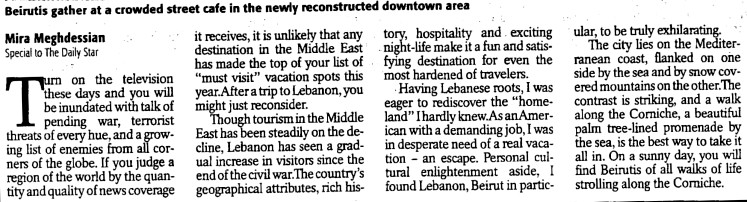
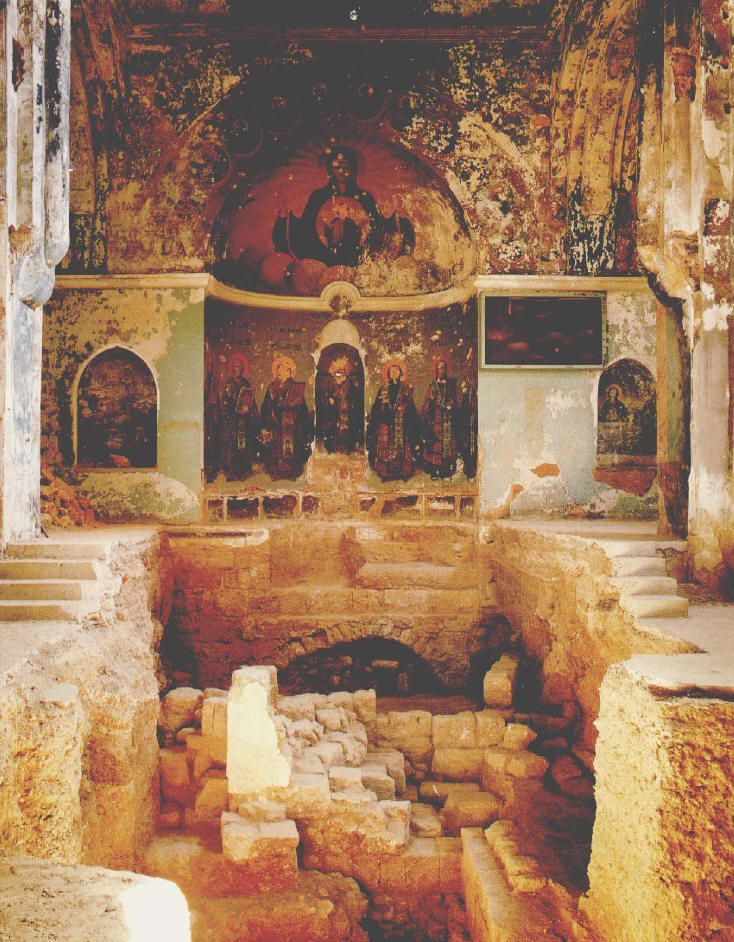


 posted 07-16-2002
10:59 AM
posted 07-16-2002
10:59 AM ![[Roll Eyes]](rolleyes.gif)
![[Country Flag of Lebanon]](http://www.cia.gov/cia/publications/factbook/flags/le-lgflag.jpg)







![[Country map of Lebanon]](images/le-map.jpg)