----- Original Message -----
From: Eddie Beshara [ sssrd at optusnet.com.au ]
Sent: Tuesday,
November 23, 2004 12:45 PM
Subject: Submission
from Australia
Dear Anwar
Please find
attached an article on Dr. Khalil Sa’adeh for
consideration on Shweir website. Regards
Dr. Adel
Beshara
Dr. Khalil Saadeh: A Nationalist
Crusader
By Adel Beshara
During the nineteenth century, a small group of writers, who were set apart
from those among whom they were living by education and experience, started a
literary revival in the Arab East. One of the leading intellectual figures in
this revival was Khalil Sa'adeh, whose ideas had a certain intrinsic inter-est.
but none of whom have been fully explored. Dr. Sa'adeh, as he is generally
known, belonged to that group of writers whose ideas served as forces in the
process of change which gave the Arab East a new lease on life. Born in 1857, in
the Lebanese mountain village of Shweir, Khalil Sa’adeh studied at the Syrian
Protestant College (currently the American University of Beirut). In those
years, young Sa’adeh gave two indications that he would not be motivated purely
by the desire for an average career. Firstly, he was elected as the official
spokesman for the "Student Movement" which formed in 1882 to persuade the
Ottoman authorities to recognize the medical degree offered by the university.
This was the first major indication of the rebellious tendency in Khalil
Sa’adeh's personality. Secondly, despite his academic specialization and work in
the field of medical science. Khalil Sa’adeh took a keen interest in the social
and intellectual issues of the day. Indeed, his first article. aptly entitled
"The backwardness of our Country and the Prospects for advancement," was
published in al-Jinan, the Beirut periodical issued by Butrus Bustani. When
political conditions in Syria suddenly turned sour under Hamid, Dr. Sa’adeh fled
to Egypt along with many other Syrian intellectuals adversely affected by
Hamid's repressive policies. At the time, the Syrians constituted a small but
highly influential community in Egypt. Many of them were successful
entrepreneurs and prominent thinkers who dominated the intel-lectual field.
Their psychology bore on Khalil Sa’adeh in several ways. First of all, it
enabled him to gain some sense of solidarity with other members of his
community. More importantly, it made him more aware and appreciative of his
national background. For, according to Thomas Philipp, Syrians who had arrived
in Egypt during the last two decades of the nineteenth century had to realize
that they would remain marginal and barely tolerated in Egyptian national
politics. As emigrants in a foreign surrounding, they had, indeed, been made
aware of their 'Syrianness.'" In Cairo, Dr. Sa’adeh led a life of intense
intellectual productivity and nationalist militancy. In addition to his medical
writings (his first medical book was entitled The Prevention of Pulmonary
Tuberculosis and its ways of Treatment), he was a novelist (in English his
novels included: Prince Murad, Ceasar and Cleopatra, and Anthony and Cleopatra),
a historian (he wrote two major studies. one on the Secrets of the Russian
Revolution of 1905 and the other on the French Revolution - Mystery of the
Bastille - which he described as a turning point in modern history), a linguist
(his was the first major English-Arabic dictionary) an editorialist (he
contributed to English and Arabic newspapers including The London Times and al-Ahram
in Cairo), and a translator. The writings of Dr. Sa’adeh was a fragment of the
autobiography of his age. It embodied both the force of nationalism and the
spirit of rational socialism. Strangely enough, the most interesting aspect of
it came from an unusual source. While he was in Cairo, Dr. Sa’adeh was appointed
as a correspondent to The London Times. This enhanced both his interest and
skills in the English language and. in the long run, motivated him to publish in
1919 a two-volume Arabic-English dictionary entitled Sa’adeh's Lexicon. Although
it took only two years to complete, the Lexicon was a fairly extensive work
which introduced into the Arabic language the current terminologies in Science
and the Humanities. In recognition of this outstanding achievement the Khedive
of Egypt bestowed upon him the title of Bey. Sa’adeh 's exile in Egypt was not
free from harassment and un-certainty; yet he always looked back on it with
nostalgia. The most controversial part of it occurred soon after the appearance
of the Gospel of Barnabus which he translated into Arabic. In the introduction
to Barnabus, Dr. Sa’adeh wrote:
I started translating this book which is called the Gospel of Barnabus well
aware of the responsibility that I had undertaken. My aim was to serve
historical studies and of course our language which is perhaps the most logical
medium into which this work should be translated. This is the first time that
this hook has come out in the Arabic language. It is a gospel about which
scholars and historians have differed sharply. In these closing comments,
though, I do have to stress that in this introduction all my discussions are
purely scientific and historical in orientation and that I have been scrupulous
to avoid all religious controversies which I left to those who are better
equipped to deal with them.
Despite this unequivocal explanation, the publication of Barnabus in Arabic
was met with some skepticism due largely to religious sensitivity. The late
Rashid Rida inflamed the public by prefacing the work with a preamble that took
its entire meaning out of context. The preamble was incorporated into the book
without Dr. Sa’adeh's prior knowledge. In 1908, the year that Abdul Hamid
revived the Midhat's constitution of 1976, Dr. Saadeh returned to his native
village in the Lebanon. The resurrection of the constitution was greeted with
enthusiasm, particularly in Syria where it was mistaken for real liberty. As for
Dr. Saadeh, he found himself embroiled in a serious dispute with the French
ambassador in Beirut. In the wake of this incident, he published an open letter
to the Ambassador in Lisan al-Hal denouncing in the sharpest of terms French
imperialist policy in Syria and France's claim to be the protector of the
Lebanese Christians. Both the French Ambassador and the Maronite Patriarch
reacted wrathfully. Realizing the serious-ness of the situation, the Governor of
Mount Lebanon, Mazfar Pasha, advised his friend Dr. Sa’adeh to leave the country
until the controversy dies down. Dr. Sa’adeh returned to Egypt only to find that
he was no longer welcomed there. He was ejected by the Egyptian monarch after
his intimate association with Egypt's top nationalist leaders (Arabi Pasha,
Mustapha Kamel and Sa'ad Zaghloul) came to light. At the same time as this was
taking place, his wife passed away in Shweir, and his children were left on
their own to survive in the famine-stricken town. Unable to return to Syria due
to the outbreak of the First World War, Dr. Sa’adeh elected to go to South
America where the Syrian community was flourishing. Dr. Sa’adeh's strength lay
in his gift to adjust to any kind of situation. Soon after arriving in
Argentina, he began the same arduous work which he became accustomed to back in
Egypt. He issued a periodical called al- Majallah and established The Syrian
Press Trade Union. In 1919, he organized the First Syrian Na-tional Democratic
Conference in a daring move to unite the Syrian community in Argentina around
the cause of national independence. After the Conference, Dr. Saadeh announced
the creation of the National Democratic Party which adopted the slogan ''An
independence that we must embark upon as virtual nomads is still better than
slavery that seems to offer a civilized life. In 1920, Dr. Sa’adeh went to
Brazil where he was reunited with his children. In Brazil, he quickly acquired
prominence and became a community leader in his own right. Assisted by his
dynamic son, Antun (founder of the Syrian Social National Party) he published
two newspapers, al-Majallah and al-Jaridah, and sponsored a number of important
activities such as the outstanding project to raise a statue in memory of the
late Youssef al-Azamah, who died in the Battle of Maysaloun in 1920. To this
very day, the statue stands in front of the Syrian parliament in Damascus. As a
community leader, Dr. Sa’adeh showed considerable personal courage in opposing
the disunity and intolerable rifts that divided the Syrian community abroad. If
one were to sum up the political and intellectual position of Khalil Sa’adeh,
the following picture would emerge: (1) He was a strong advocate of the secular
idea. Like others in the same capacity, he believed in the separation between
religion and politics and in the elimination of the factors that impede social
unity. (2) He regarded socialism as the ideal form of political organization. He
was not a Marxist but a practical socialist who believed in equality and human
dignity. (3) He was a nationalist crusader for the cause of Syrian unity.
Although he was a Christian from Mount Lebanon, the idea of a separate Lebanese
nationalism never appealed to him. In his last years in Brazil Dr. Sa’adeh was
appointed chairman of the Syrian National League and editor-in-charge of its
weekly periodical al-Rabitah (The League). He passed away on April 10. 1934
leaving behind him a legacy that time has never been able to completely erase.
Collected Works of Dr. Khalil
Saadeh
Novels:
- Prince Murad or the Syrian Prince: Published in London in 1893 (English)
- Ceasar and Cleopatra: Published in London in 1895 (English)
- Secrets of the Russian Revolution: Published in Cairo in 1905 (Arabic)
- Anthony and Cleopatra: Published in Brazil, n.d. (Arabic/English)
- Secrets of the Bastille: Published in Cairo in 1906 (Arabic)
- The Elegant Circusion: Published in Cairo in 1908 (Arabic)
Books:
- The Prevention of Pulmonary Tu-berculosis and its ways of Treatment:
Published in Cairo in 1905 (Arabic)
- Saadeh's Lexicon: Arabic-English lexicon published in Cairo in 1911.
- Nublah fi Kannana: Istanbul 1883 (Arabic)
- Arabic Literature: Published in Cairo in 1886 (Arabic - al-Rabittah: A
Collection of Articles published in Brazil in 1971.
Translations:
- The Gospel of Barnabus: Published in Cairo in 1908 - Appathia, Published in
Cairo, n.d.
Basic References
- Ali Hamie, Khalil Saadeh: L'homme et L'oeuvre 1857-1934, PhD Dissertation,
University of Paris, Sorbonne, 1986. - Nawaf Hardan, Al-Rabittah, Sao Paulo,
1971.
- A. Saadeh, Complete Works, Vol. 2, Beirut, 1982.
- Badr el-Hage, The Unknown Works of Khalil Saadeh, London, n.d. - Adel
Beshara, "Khalil Saadeh: Nationalist Crusader," Middle East Quarterly, Vol. 3,
Number 9, 1996.
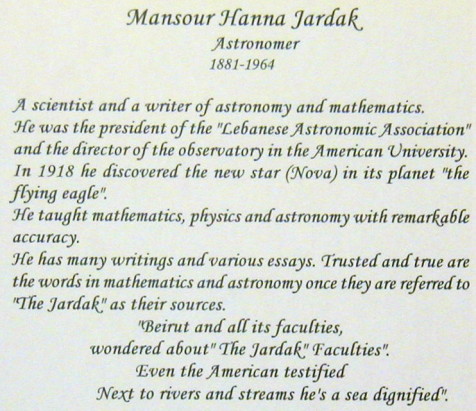
Mansur Jurdak
-----Original
Message-----
From: Samira Nawas-Plesman
Sent: Tuesday, September 02,
2003 9:52 AM
Subject: RE ANGELA JURDAK
KHOURY
Hi Anwar, I just received
a Bio prepared by Philip my cousin about his mom. I am sending it to you as an
attachment. Thanks,
Samira
ANGELA JURDAK
KHOURY:
LEBANON’S FIRST WOMAN DIPLOMAT
Angela Jurdak
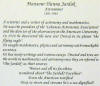
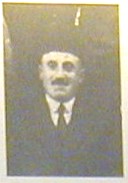
Khoury was Lebanon’s first woman diplomat. The eldest daughter of the late
Mansur H. Jurdak, a distinguished professor of mathematics and astronomy at the
American University of Beirut, Dr. Khoury was born in Choueir, Lebanon on
September 24, 1915. She began her career as an instructor of sociology and
administrator at the American University of Beirut in 1938. During World War
II, she was also assistant director of the Allied Powers Radio Poll for Lebanon,
Palestine and Syria.
In 1945, the newly
independent government of Lebanon appointed her as a delegate to the opening
General Assembly of the United Nations in San Francisco and assigned her to the
Lebanese Embassy in Washington, D.C. She was to represent Lebanon in the United
States for the next 21 years. In its early years, she also served as Lebanon's
representative and rapporteur to the U.N. Commission on the Status of Women.
After her resignation from the Lebanese Ministry of Foreign Affairs in 1966, she
resumed her teaching career, as a professor of government at George Mason
University in Virginia, until her retirement in 1982. A long-time resident of
Washington, Dr. Khoury was a prominent figure among Arab diplomats and in the
local Arab-American community.
Dr. Khoury was
educated at the American University of Beirut and the Geneva School of
International Studies in Switzerland, and she received her doctorate from the
American University in Washington. Her husband of 36 years, Shukry E. Khoury,
died in 1985. She has two sons Philip S. Khoury, Dean of Humanities, Arts, and
Social Sciences and Professor of History at the Massachusetts Institute of
Technology in Cambridge, Massachusetts, and George S. Khoury, a businessman in
Darien, Connecticut and two grandchildren. She also has a brother, George M.
Jurdak of Montreal, Canada, and two sisters: Salma M.Jurdak of Washington, D.C.
and Salwa Nawas of Atherton, California.
Thank you Phillip Khoury for writing
this and to Samira Nawas Plesman, Salwa's daughter, for sending this
information.
Courtesy of Riad Khuneisser & the staff at Nameh Jaffet Library
archives at AUB. Thanks to all who helped.
Great
writers & poets:
Amin Daher Khairallah, Najib &
Faris Mushraq, and Ibrahim Rahbani
**********************
From the book "Mushraquiat" by Najib Mushraq
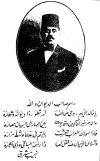
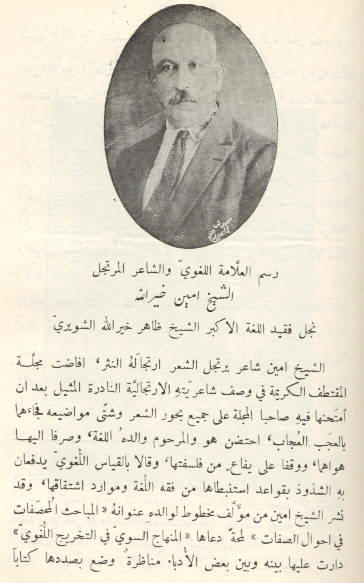
Another well-known Shweirieh. Amin Khairallah, the son of a
great Shweirieh Daher Khairallah. The wordings and the poem are for Najib
Mushraq.
Amin Khairallah
******************************
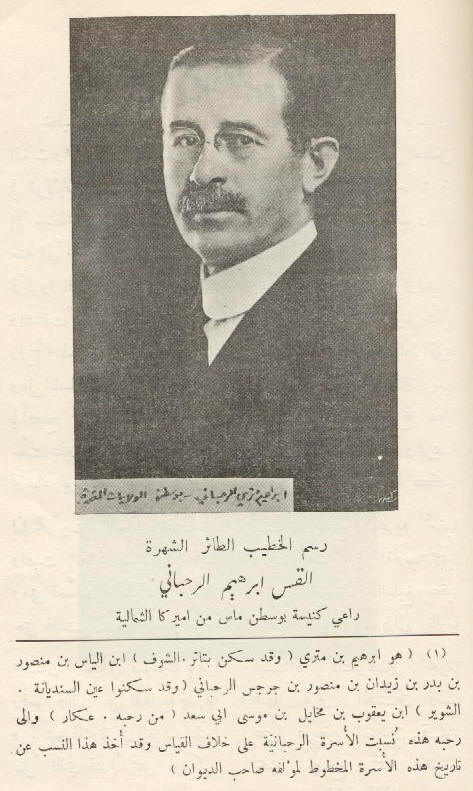
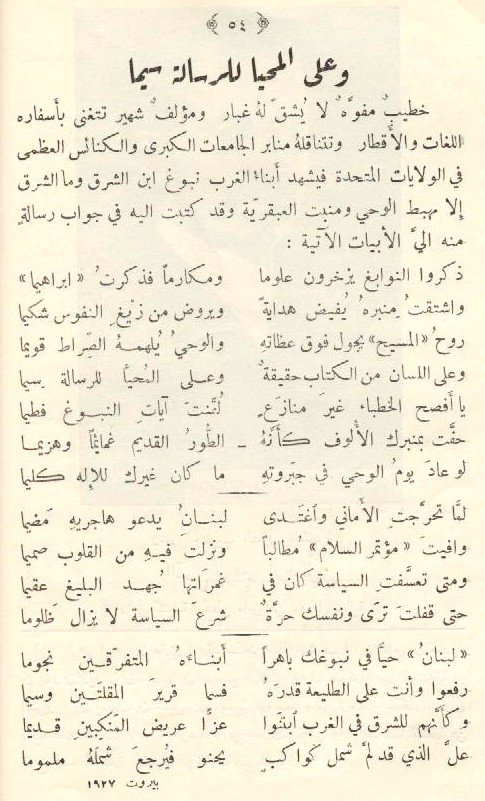
Ibrahim Rahbany
The attached are picture of Ibrahim Rahbany and the poem by
Najib Mushraq.
To read about Ibrahim
Rahbani's work, click on
Ibrahim's name to go to the "Books" section of Shweir.com
Thank you Riad Khuneisser for sending this info. 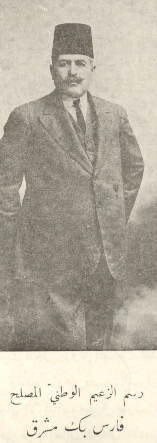
As you Know, the well known Shweirieh are more than can be
counted. From time to time I will send you pictures and info or poems for a
Shweiry or about him.
Faris Mushraq
 When
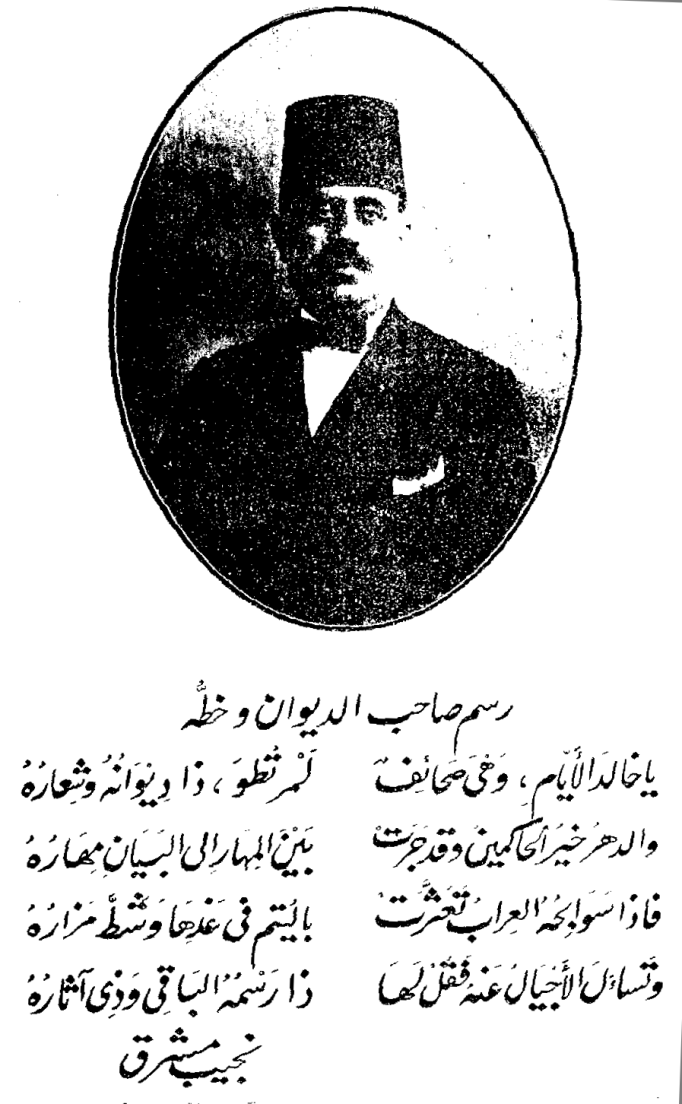
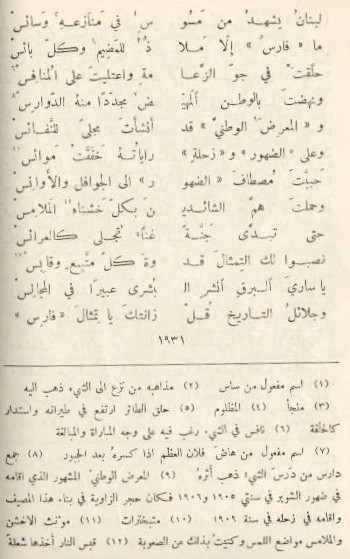
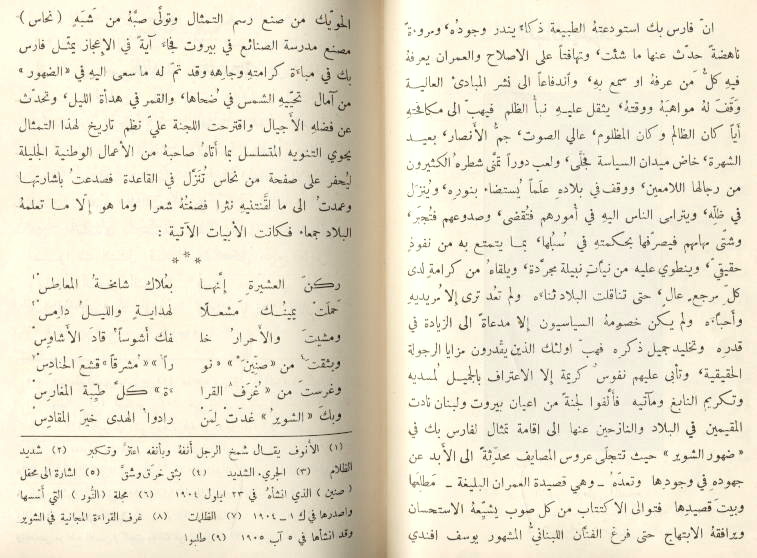
we talk about Dhour we shouldn't forget the name Faris Mushraq, (a
When
we talk about Dhour we shouldn't forget the name Faris Mushraq, (a
Shweiry from the Rahbani family).
If he is not the first, for sure he is between the first who founded Dhour.
The Dhour that your parents and some of you knew. I am not going to write
about Faris Mushraq but I am sending you three images, his picture, some
information and a poem (1931), by Najib Mushraq from his book "Meshrikiyat"
that might give you an idea about the man.
Riad
An email about Dr.
William Carslow
-----Original Message-----
From: rodosomer@shaw.net [mailto:rodosomer@shaw.net]
Sent: Saturday, February 16, 2002 2:14 AM
To: gematar@sbinfra.com
Subject: New Entry in Shweir Guestbook
------------------------------------------------------
Name: Ronald W. Somerville
Email: <rodosomer@shaw.net>
Location: Kelowna, B.C. Canada
Time: Saturday, February 16, 2002 at 02:14:05
Comments: My Father James's Uncle was Dr. William Carslaw. My fathers
Grandfather Richard came to the Lebanon in 1846, his daughter Isabella became
the wife of Dr. Carslaw. I was born in Broumana, but the 'family' home was
Carslaw House. Dr. Carslaw established a school there (from which Dad graduated
before attending AUB. Isabellas sister was Jeanette (Nettie to all)
Somerville,who later lived at 48 Rue Jeanne d'Arc,until her death in '52. Dad
married my mother, Sadeeca As'ad, in '21, worked in Iraq till '33 and Palestine
till '48, then moved to the Nazarian Bldg on Sidani St. He worked at rthe AUB
till his retirement.I emigrated to Canada in '54, revisiting several times until
I returned with Donna my wife and David and Richard my sons for nearly 3 years,
from Jan. '73 till Oct. '75. We naturally visited Shweir many times in drives
over the countryside. My Great Grandfather Richard was the engineer who in 1846
installed the first automatic weaving looms for the manufacture of silk brocades
in the Lebanon. My sister Agnes Shamma'a married Michel Shamma'a,who also taught
at the AUB, still lives in Beirut, on the 4th floor of the building on the
corner of Bliss and Jeanne d'Arc.
I travelled extensively for Carrier Int'l over Africa and the Middle East,
then Latin America and the Carribbean till ,84, then as a consultant in
Cleveland OH, Atlanta GA, New Orleans LA until I retired here in '94. My sons
are married, living in South Carolina and Tennessee respectively. My very good
friend here is As'ad Farrah, who was raised in Shweir,even to attending school
that Dr. Carslaw established. Agnes and my cousin Elizabeth had the Testimonial
Marble Plaque in front of Carslaw House ( damaged during the war) replaced (from
a picture that my cousin Carlene in Phoenix had, taken by her Father when he and
her Mother Olive spent their Honeymoon there. All in all, we have so many happy
memories of Shweir and Lebanon. If we can, we would like to return this summer
for Agnes' 50th Wedding Anniversary. 'In Allah Rad' Those who know of me or my
family, PLEASE e-mail me. Memories are made of this. A wonderful surprise
for me to find your website!! I read every entry!
------------------------------------------------------
Hello Ronald and Ahlan wa Sahlan to the Shweir.com Family. Sorry for the delay
in my response, I just returned from a business trip to Aruba, and now trying to
catch up on 207 emails in my in-box. I could not re4sist but answer yours as I
finished reading it. Wow, this is absolutely a great morning. Dr William
Carslaw who in Shweir could not know that name, I doubt any.
I visited the Center this summer and I tell your it is been beautifully
restored. The Carslaw Building is just breathtaking, I don't know if you notice
but there is a link on the front page called "Ain Assis" that will take you
there, and you can view many of the pictures, including the restored Testimonial
Marble Plaque.
So many Questioned to ask, and I could write for a long time but please forgive
my short message I have so much catch-up work to do. But I can't tell you how
happy and proud to welcome you to our Shweir.com Family, we
would be honored to have you consider us your hometown web page.
George Matar
A Chat
with Mansour Rahbani, courtesy of Arabia.com - Chat to read more go to
http://www.arabia.com/chat/transcripts/english/0,10384,57,00.html
Thanks ya Mukhtar bil Mahjar for the tip.
|
Home> Chat>
Transcripts |
| |
 |
Guest: Mansour
Rahbani
Date : Sat, Mar 10 2001 Time: 02:00
PM GMT
Place: Mansour Rahbani Room (mydsf Live)
In cooperation with Dubai Shopping Festival, we present a live
chat with Mansour Rahbani |
| |
Start time: 02:00 PM
End time : 03:05 PM |
|
Mansour Rahbani: I
am waiting for your questions. I hope we can be honest. I might
not be able to answer some but let's be very open & honest..
Feel free to ask.
Obscured
by clouds: We
heard that the idea of AL Mutanabbi was there 20 yrs ago why did
you have to wait that long?
Mansour Rahbani: Al
Mutanabbi wasn't old but there was a program on TV, which had
the idea of Al Mutanabbi. We used his poems in that program but
that wasn�t a Rahbani work. Rahbani had nothing in composing
that. But Mutannabi is a 5 months idea only I had to read & dig
in history, to avoid errors when making it.. I composed music
but some parts were by Elias & Ghady Rahbani & Osama Rahbani.
*katkot*: Some
people from Dhoor shweir say that you are from there while in
the booklet of Mutanabbi it said that u were born in Antileas..
where r u from?
Mansour Rahbani: The
Rahbani Family is very big, all are from Dhoor Shweir.. But my
brothers & I were born in Antileas. So I am from both Antileas &
Dhoor Shweir. With sorrow I say, Antileas has lost its beauty
Dhoor shweir Is more beautiful than Antileas I admit.
Bloody: That
work is Rahbani work.. u, Marwan, Elias, Ghady, & Osama R
involved.. That goes for most of ur plays.. Why Not Ziad?
Mansour Rahbani: We
are close to each other that is why we are working together. I
have worked with Ziad before in many programs. Those Rahbanis
are close to me, live next to my house and such work needs
hour-to-hour communication.
Dr: How
much time did it take to train all the team involved, find the
actors & actresses......Etc..
Mansour Rahbani: Al
Mutanabbi is an Exclusive work. We agreed to make this play. I
always ask for more time in my works except for this one. I had
to work with great effort and energy. The whole team was our
team we didn't need to seek any one. It took 5 to 6 months. we
worked really hard & our training was intensive on daily bases.
Saif
Al Dawla: Will
we c that play on TV?
Mansour Rahbani: That
Play needs a lot of time to be on TV and we maybe film it, but
after this play achieves its goal.
Masri: What
do u of Egyptian Screen plays?
Mansour Rahbani: I
don't give opinions except in Rahbani Works & I apologize to u
all. With all the respect to all of you here & all the directors
there's no stage except for Rahbani.
Lebneny: How�s
ur relation with Fairooz?
Mansour Rahbani: Fairooz
& I are very CLOSE friends. We always visit each other & nahna
ahl w mndal Ahl. (We are one family & we'll remain one family).
KIKI: HOW
MANY STORIES HAVE U MADE?
Mansour Rahbani: Asi
& I as Rahbani Brothers have made about 24 or 25. After Asi had
left us, with all the sorrow, we made 5.
Nataly: R
the actors in Al Mutanabbi Syrian & Lebanese only?
Mansour Rahbani: The
Actors in Al Mutanabbi were from Lebanon, Syria and the police
force were from Dubai. There was also quiet a good group from
Dubai backstage.
KIKI: WHAT
DO U THINK OF THE ACTORS THESE DAYS?
Mansour Rahbani: In
General the actors are very good. They are specialists because
nowadays they study Art. But there's always a talent, and this
talent is a gift from god, As well as a person�s presence. But
they should be educated as well.
KIKI: DO
U THINK THE MOVIES THESE DAYS HAVE NO MEANING?
Mansour Rahbani: Gladiator
& Titanic are great movies. They are meaningful and contain many
feelings & they are worthy movies.
Noor: do
you like GCC songs ?
Mansour Rahbani: Yes..
I do.
! !
Dragon.: Who
sponsored the Mutanabbi?
Mansour Rahbani: Dubai
Media City & Dubai Shopping Festival, under the Patronage of His
Highness Sheikh Mohammed Bin Rashid Al Maktoom & I thank his
highness a lot because if it wasn't for him we wouldn't have
succeeded that much.
Obscured
by clouds: Do
you have anything made for TV production?
Mansour Rahbani: Yes,
I had many when we were Rahbani Brothers, we had series & films.
But our works COST a lot & TV right now doesn't produce
expensive works. This is really sad because our TVs are
competing for going down the drain & so are their governments.
AlMutanabbi: How
old were you when you started your career as a composer?
Mansour Rahbani: I
think I was 14, or maybe 13 or maybe 12 I am really bad in
dates.
Rifraf: I
have ticket for your play tom nite but I am a non Arabic speaker
but I enjoy all plays will I need to understand or is the play
very visual?
Mansour Rahbani: We
might have translation in the future.. It's visual & clear but
you need to understand to hear the lovely poetry & words.
Obscured
by clouds: Who
inspires you most?
Mansour Rahbani: The
subject & the story inspires me.. A female might be one of the
reasons but she doesn't make a person a poet or talented.
Stink
Fist: Did
you choose Al-mutanabbi for your play because you personally
like his poetry, or do you think that he's an interesting person
who lived an interesting life?
Mansour Rahbani: Al
Mutanabbi is mentioned every day for 100 years now. We recite
his poems everyday He has an unusual personality. He has is a
knight, a poet, and an interesting character to dig into his
life. All these aspects drive us to be anxious to learn more
about that character & want to represent his person.
!!!
Al Malika: How
old are you?
Mansour Rahbani: I
am 75 years old.
UNDERTAKER: what
do u hate about your job and what do u like?
Mansour Rahbani: I
never hate I like.. & I like alllllllllllllllll about my work.
But I prefer some aspects like laziness. Laziness is the secret
of talent & falling in your dreams as well as enjoying them.
! !
Dragon.: How
did u feel when the Mutanabbi came live & all the people were
clapping the first day?
Mansour Rahbani: I
was really happy & proud of what we achieved. But that to be
afraid of the next work & that I have to come out with another
great work.
KIKI: WHO
IS YOUR FAVORITE ACTOR?
Mansour Rahbani: All
are great. But Fairooz & Nasry Shams Dein are special & unique
in presence, intelligence & talent.
UNDERTAKER: will
the play be aired on TV in the future?
Mansour Rahbani: After
it achieves its purposes & publicity yes maybe.
! !
Dragon.: do
u have to plans to direct for movies or cinema?
Mansour Rahbani: No
Not at all.. My son Marwan may do that & he is now preparing for
a Gibran Khalil Gibran Film.
AlMutanabbi: What
does Beirut mean to you?
Mansour Rahbani: Beirut
is my city & I love it. It has a presence in History & there are
presses, Universities, & many interesting things but I feel
afraid for Beirut to loose its Freedom from Beirut rulers who
may put limitations on freedom there. Freedom is easy we ask for
Freedom in work, life, family.... etc but since we are poisoned
by death, then our freedom is limited.
Mansour Rahbani: I
am sorry I have to leave now. Thank you all I hope we meet again
through Dubai Media City & with Arabia.com & all the others
here. Thank u all and good bye. |
| |
|
JAFET MEMORIAL LIBRARY at AUB
-----Original Message-----
From: Riad Khunieser [mailto:rk26@aub.edu.lb]
Sent: Monday, February 11, 2002 1:14 AM
To: A. G. Kenicer
Subject: AHLAN WA SAHLAN
Hello Cousin Anwar
It is nice to hear from you again. WAYNAK ? Of course we are waiting for you and
your mother and all the Shwierieh this summer.
As you know The American University of Beirut has, may be, the best library
available in the region. This "libary is dedicated to the memory of Nami Jafet
and presented by his wife and sons to the American University of Beirut 5 May
1952".
So the library is called JAFET
MEMORIAL LIBRARY. The department in the library where the archives are
stored and served is the Archives & Special collection Department. A file under
the name of the late Raymond S. Ghosn has the documents ,(which I gave to Joe to
scan and sent to you), you posted and others which Joe couldn"t scan.
I am sure you remember and of course you have pictures of the Baladieh and the
man standing infront of it. This man is the same man, the well known "Al
Mouialim Nami Jafet". Jafet build the Baladieh and the library at AUB who became
world-wide known, and Jafet is one of them.
I am sure you and Shwier.com. are making it your job to mention, praise and make
us proud of all the Shwierieh who are well known in defferent fields at
defferent times, Jafet is one of them and Ghosn of course and many many others.
Riad
************************
Thank you Riad for this very important bit of information.
It is wonderful to see how one great topic about the
dedication of a building honoring Raymond Ghosn at the AUB leads to another
topic about another great Shweiry who had a Library dedicated in his name at the
AUB and the information about Raymond Ghosn was obtained from the Jafet Memorial
Library and facilitated by Riad Khuniesser, scanned by Joe Naoum Sawaya, all
great Shweirys.
Anwar
|
Author |
Topic: Raymond
Ghosn |
Waleed Moujaes
Member |
 posted
11-02-2001 09:41 AM posted
11-02-2001 09:41 AM 
 
I found this article in today's Dailystar (dailystar.com.lb). Thought it
is interesting for the Shweiriyieh around the globe to share. I believe
a lot of us were at AUB (students or workers) when Dr. Ghosn was the
Dean. As you may know, he is the cousin of Dr. Nabil Ghosn, our
ex-mayor.
Waleed *******
AUB’s Ghosn remembered at
building-naming ceremony.
Politicians and academics
gathered Thursday to remember Raymond Ghosn earlier this week, with the
inauguration of a building named after the former dean of the Faculty of
Engineering and Architecture at the American University of Beirut.
Ghosn founded the department in
1951 but was assassinated 25 years later on the AUB campus.
The ceremony was
attended by a list of individuals which included MP Bahiya Hariri
representing Prime Minister Rafik Hariri, US Ambassador Vincent Battle,
John Brissler from the American Agency for International Development,
and AUB President John Waterbury.
******** IP: Logged |
Nabil E. Matar
Member |
 posted
11-02-2001 01:41 PM posted
11-02-2001 01:41 PM
Thank you Waleed!!!! Now, this is great news worth while posting in our
web site. Dr. Raymond Ghosn is another great Shweiri who contributed a
lot in the field of Engineering. The Shweirieh should consider honoring
him during Eid al Mughtaribeen and I suggest that the Baladieh should
name the street near his house after him.
Talking about terrorist!!!! Here a fantastic man who spent all his life
working to maintain a high standard of education in the field of
Engineering was murdered by a guy who don’t even worth ten cents.
I wish some body could send this web site a biography or an article
about Dr. Ghosn so we could post. IP: Logged |
Waleed Moujaes
Member |
 posted
11-07-2001 09:50 AM posted
11-07-2001 09:50 AM
Well guys, I thought this is something which we should be proud of.
However, never got except one reply from Nabil!!! Sorry but this reminds
me of the baladieh!!!  IP: Logged IP: Logged |
Habeeb M. Nacol
Member |
 posted
11-07-2001 10:05 AM posted
11-07-2001 10:05 AM
Ya Waleed, you are so right. We in Shweir have always taken each others
for granted. We have always exalted our distant past and generally
ignored the great individuals that are with us here and now. But I see a
new thing happening through you (plural) the young lions of Shweir. I am
so proud! IP: Logged |
George Matar
Administrator |
posted
11-07-2001 10:47 AM
MA Tizaal Ya Waleed. After your original post, I talked to Nabil and
asked him to contact Riad Kheneisser who happens to be working at the
AUB for additional information and hopefully a Biography on Mr. Ghosn.
It will be an honor to have something formal published on this web page. |
The above documents are found at the
Archives Dept. in Jafet Library of the AUB. Many thanks to those who work
behind the scenes at the AUB Archives Dept. that make such valuable info
accessible.
Thank you Joe Naoum Sawaya for scanning and
sending the above important information about a Shweiry pioneer...
***********************
-----Original Message-----
From: Soulaima Houcheime
Sent: Friday, November 30, 2001 10:41 AM
To: 'gmatar@aol.com'
Subject: About Dean Ghosn
Hi George ,
I was reading in Shweir news what Waleed has mentioned about Raymond Ghosn.
I was really very happy that The Daily star wrote about him I never knew him but
I could say that My husband Salemeh Houcheime is one of Raymond Ghosn's student
. They were very few students in Architecture . Salemeh always mentions him in
front of everybody in the engineering department as a reference in Lebanon . He
keeps tell them how that man was devoted to his work and how he used to stay
with his students in the architecture department at AUB even when they had "Nuit
Blanche" to finish their plans and projects .
My husband used to show me all the projects that
Raymond Ghosn did and he explained for me every detail in the construction and
how Raymond used to see things in an architectural point of view like being in
love with a beautiful woman !!!!! This is what I want to mention . I can not
talk about Raymond Ghosn more than the people who knew him .
after all , my family and I wish you all a
MERRY, MERRY XMAS AND A HAPPY NEW YEAR OF GOOD GATHERING ...!!!!!!!
SOULAIMA
Thank you Soulaima for sharing
with us what you know about Raymond Ghosn... we hope that some of his students
and others who knew him well will follow your example and add their
experiences...
***********************
The following is a copy of the Shweir Bulletin Board about Ibrahim
Mitri Rihbani
|
Author |
Topic:
Ibrahim Mitri Rihbani |
mohtaro
Member |
posted
11-27-2001 10:59 PM
Greetings to shweir community,
My name is Oussama Ajaj El-Mohtar. I have been privilaged to
translate into Arabic a great book by a great Shweiri indeed.
His name was Ibrahim Mitri Rihbani, (1869-1944) and the book
that he wrote -among others- was "The Syrian Christ". This book
was published in 1916 in the USA and was reprinted 11 times
between 1916 and 1922. Rihbany's family moved to Btater in 1875,
and he immigrated to the USA in 1891. He died in 1944 most
likely in the Boston area. I am seeking any information about
this great man, particularly about the last 20 years of his
life. If any one knows about any living descendants or relatives
of Ibrahim Rihbany I would be most greatful if they can help me
to make a contact. Furthermore, I have compiled a good deal of
information about him and his other books and I will be more
than happy to share this knowledge with anyone seeking it.
The Arabic translation of the Syrian Christ has just been
released in Beirut with an introduction and a biography about
Rihbany.
Thank you all in advance. |
George Matar
Administrator |
posted
11-28-2001 08:36 AM
Hello OussamaLove
to hear of such great writer. My Family is a branch of the
Rahbani but unfortunately I don't have any new information. I
will copy your message and send it to all the Rahbani on my
email and we both will cross our fingers. |
mohtaro
Member |
posted
11-28-2001 02:25 PM
Thank you George, I really appreciate this. I have made a
correction to my initial email. Ibrahim Mitri Rihbany was born
in 1869, and obviously not 1969. His life story, from what I
have gathered -which takes me up to 1924- is a most fascinating
one. - Out of curiosity, have you heard about him before? I am
trying to do justice to the memory of this man of wisdom and
love. I hope that with your help and others who will share the
admiration I have for him, we will succeed. |
George Matar
Administrator |
 posted
11-29-2001 07:43 AM posted
11-29-2001 07:43 AM
Thank you Oussama for such a nice email(below).
Check Jamil's book on this web page (Scroll towards the bottom
of the front page). His son Salim writes regularly on this BB.
I am sure Dr. Salim Moujais will be in touch soon.The
Shweirieh will really appreciate all that you are proposing to
do..... Thank you
The Message
Dear George,
Thank you very much for your trouble. I hope that our concerted
effort will be rewarded through restoring Rihbany to his
rightful place among the luminaries of our renessaince. You and
the readers of the BB or the Web site are going to be amazed at
this brilliant son of Shweir. Tomorrow, I will send you the
following:
1. bio on Rihbany, including all the titles that I have come
across.
2. His Picture, and that of his late parents (Allah yirhamon
Jami3an)
3. An informatin sheet about Arabic translation of “The Syrian
Christ”
Down the road, I will
scan the front pages of his books in English and send them to
you. My suggestion is that a section could be created for him
and his achievements on the Shweir web site.
Way down the road, I think that the Lebanese and Syrian
governments should be encouraged and lobbied to recognise
Rihbany and his achievements and add him to the great thinkers,
leaders and industrialists Shweir has given to the world. I will
be more than delighted to push with you in this direction.
I can go on and on but I will stop at this. I fell in love with
this man 20 years ago, and it took me five years to produce the
Arabic translation. I would like to ask you for two favours: I
need to contact Dr. Salim Moujaes, and Mr. Jamil Khnaiser in
Edmonton. Salim is an old friend with whom I have lost contact
and I want to appraise him about the Syrian Christ. Jamil I
believe visited us in Jal Ed-dib back in 1967-68. I recall two
Khnaiser brothers who came to our house and played such
beautiful Saif w Tirs. I hope he is the right person. I can
appreciate your reluctance in giving me their email addresses,
but you can forward this message to them and ask them to please
respond. Once again I thank you.
Oussama |
Waleed Moujaes
Member |
posted
11-29-2001 09:48 AM
Ousamma, thank you very much. This is what Shweir is in need
for, the recovery of our past. Unfortunately, our history and a
lot of our grandfathers work has been lost or forgotten. Your
post is one example of a great Shweiry who I, and many others
have never heard of (although one of my hobbies was to go around
and visit old people and listen to their stories). What Dr.
Salim Mujaes has done over the years in his researches about
Shweir's history is priceless. All of us Shweiriyieh,
appreciates your efforts to let us know about Ibrahim Rahbany.
I'll definitely be glad to help you (with my few resources) if
you need anything.
Waleed |
George Matar
Administrator |
posted
11-29-2001 11:10 AM
More info from Dr. Salim MoujaesDear George
Thank you for forwarding the information on Rihbani. I am
indeed aware of him and have read a few of his books. Indeed, in
an upcoming book that I have in press in Beirut (a biography of
Antun Saadeh in English) I mention Rihbani and his views on the
independence of Syria and Lebanon and his efforts in the US to
have the US government support the independence of Syria. He
published a book called “America Save the Near East” that is
filled with insights into the colonial interests and ambitions
of the great powers of the time (France and Great Britain) and
even discussed the issue of zionism. His views were very much
similar to those of Khalil Gibran and Dr Khalil Saadeh.
Below is a section of my book in which I mention this book:
“The goodwill that the Americans had gained by their various
activities in the Near East was unmatched. The desire of Syrians
to have their post-war fate linked to American intervention is
exemplified by their responses to the King-Crane commission
interviews and by various petitions at home and abroad. One such
petition is a small work published in 1918 by Abraham Mitrie
Rihbani titled “America Save the Near East”. An erudite and
articulate author, Rihbani presents cogent arguments on why the
United States should undertake to go further east than Europe
and assist the Syrians in their bid for independence and
progress. Of course, it was not to be, but the sentiments
expressed in this book, and in other media, help explain the
great disappointment that the Syrians had in the withdrawal of
the US from playing a role in the Near East and indeed its
acquiescence to the roles played by the French and British. “
Salim Mujais: This Man from Lebanon: The Youth of Antun Saadeh,
(in press)
The book in question is the following:
Abraham Mitrie Rihbany: America Save the Near East, The Beacon
Press,
Boston, 1918
Rihbani was a very enlightened and astute observer. In one
segment of the book he states:
““Among the memories of my early years in Syria the heated, but
intrinsically petty controversies on the subject of the
comparative virtues
of the European powers stand out as very conspicuous. No time
nor place was
unfit for such encounters. At neighborhood gatherings on those
long winter
evenings, when neither book nor periodicals were there to
beguile the hours
more profitably, in the market-place, at wedding and funeral
gatherings, at
religious festivals, and at any place where the differing clans
and sects
came in contact with one another. One could hear at a
considerable distance
from the place of meeting the proclaiming of the virtues of a
European
Power, and the denial of the same, by the contending partisans,
several
shouting their opinions at the same time. “Russia is the giant
Power in the
world’ says one. ‘Away with your Russia!’ shouts another; ‘Long
live France
and her fiery soldiers! France is the mother of civilization!’
‘England is
the most civilized nation’, speaks a lover of dignified Britons;
‘she is
the Mistress of the Seas and the richest country in the world’…”
It would be very nice to have some of this information on
Shweir.com
Warmest
Salim Mujais MD |
mohtaro
Member |
posted
11-29-2001 11:43 AM
Thank you George, Waleed and Dr. Salim. Here is the Biographical
summary that I promised. I am delighted that Dr. Salim mentions
Rihbany in his upcoming book. I hope more information will be
forthcoming about him.
Salim, please write to me at mohtaro@comnet.ca
Thanks.
Bio begings:"Abraham Mitri Rihabany, biographical summary
gathered from "The Far Journey" and from other books by Rihbany."
"When Abraham Mitrie
Rihbany bid farewell to his hometown of Shweir and his adopted
town of Btater both in Mt. Lebanon, to immigrate to America in
1891, he was leaving his native land Syria. When he died in 1944
that part of his homeland was the independent republic of
Lebanon. In between, this great man of literature, spirituality
and politics left his mark on generations of Americans and
Syrian-Lebanese Americans. He still guides believers all over
the world until this very day through one of his books "The
Syrian Christ."
Rihbany was born in 1869 to a poor but proud family headed by a
well-respected stone mason. In 1875, the family moved to the
town of Btater in the Alay part of Mt. Lebanon, where the father
was appointed as foreman in charge of the industrial concerns of
a French man, Monsieur Lafortune, who was known by his Arabised
name: Al-****ouni!
At age 9, and after a brief stint at school, Rihbany started
working for his father as a stone mason. He worked until the age
of 17, when he felt a deep desire to go back to school. He was
encouraged by of a friend of his who was attending the
Presbyterian school in Souk Al-Gharb, Mt. Lebanon.
Rihbany restarted school from grade one. He describes in vivid
detail the experience of "this giant" sitting with first grade
students. However, he advanced very quickly, and in two years,
he was at a school level commensurate with his age.
At age 19, his father informed him that he could not spend any
more money on his schooling. Things were bad, and the father had
many mouths to feed. So Rihbnay arranged to teach at the Souk
Al-Gharb school in exchange for his continuing education. As a
teacher he worked for three years, two of them at Souk Al-Gharb,
the third at Zahlah, in the Bekaa valley.
It was during that third year, 1891, that two of his friends who
were immigrating to the USA encouraged him to join them. He
agreed instantly, given the overall situation of Syria under the
Ottomans, and his personal lot of poverty and heartache at
seeing the foreigners better treated than the natives in his own
country. In a matter of days, he was able to obtain an exit
visa, and 3 "Napoleon" gold pieces, which his father borrowed
for him, and he journeyed from Beirut to Joppa, Alexandria,
Marseilles, and then to New York.
In New York, Rihbany headed immediately to the Syrian colony on
Washington Street. There he worked for a while as an assistant
storekeeper until he met with some educated Syrians with whom he
founded the Syrian Scientific and Literary Society. Later on,
one of his colleagues in the society started the first Arabic
newspaper in the New World, Kawkab America and asked Rihbany to
be editor. He worked in this capacity for one year at the end of
which the paper folded due to personal disagreements. But
Rihbany did not go back into the world of commerce like most of
his compatriots. Instead, he chose a very peculiar route, that
of talking about the "Holy Land" in American churches for
whatever contribution he could obtain. Thus, with broken
English, and with raw ideas translated directly from Arabic, he
embarked on a lengthy tour that took him to many cities in the
mid-west before he was officially invited, after a few years, to
become the permanent preacher in a town there.
In 1913, Rihbany wrote his first book, A Far Journey, in which
he chronicled his life until that point, and which he adorned
with pictures taken from Syria during a trip accompanied by his
American wife. Shortly thereafter, he started to write a monthly
article in the prestigious Atlantic Monthly under the heading
The Syrian Christ. Those articles were later collected in a book
bearing the same title. The Syrian Christ was reprinted 11 times
between 1916 and 1922.
In 1917, he published Militant America and Jesus Christ, a book
advocating the joining of the USA in WWI against the axis
powers. And in 1918 he followed it with America Save the Near
East. In this book, he presented a very tight argument as to why
America should take an active role in solving the "Syrian
Question" by advancing east in its campaign, liberating Syria,
and holding it under its protection, as a "benevolent power."
Obviously, in writing his book, he was countering the
Anglo-French designs on Syria that were calling for dividing
that country into spheres of influence under two mandates, one
British, the other French. His vision for solving the Syrian
Question could be outlined as such: Syrian independence and
unity under the protection of the USA; No Monarchy; A federal
national government in Syria seated in Damascus with state
legislatures in each of Mt. Lebanon, Aleppo, and Palestine. He
also rejected the creation of a Jewish state in Palestine in a
lengthy chapter of the book where he debunked all the Zionist
arguments presented in favor of such an endeavor at that time.
In 1919, Rihbany was elected by the American Syrian Associations
(We don't know at this time which ones) to be their
representative at the peace conference in Versailles. There, he
met with Prince Faisal, and spent three months with him. That
experience, and the political jockeying that he witnessed in
those turbulent times were do***ented in a book titled Great Men
from the East and the West. Other books that he also penned
include The Hidden Treasure of Rasmoula, Jesus Christ for Boys
and Girls, and Seven Days with God.
Rihbany died in 1944, most likely in Boston.
The Syrian Christ
This book is Rihbani's masterpiece. He will always be remembered
by it. In it, Rihbany was not trying to add a new theory about
Christ's divinity, but rather "taking the reader into the inner
chambers of Syrian life" without which, he felt that one cannot
understand the true meaning of the scriptures. He goes through
Syrian beliefs, modes of speech and way of life. He rejects the
notion of "The Chosen People" as a narrow and racist view.
Rihbany dedicates the book as an act of homage and love to "My
Master, the Syrian Christ."
This bio is taken from a book that I am preparing about Rihbany.
Regards.
Oussama |
|
Minister Bechara
Merhej
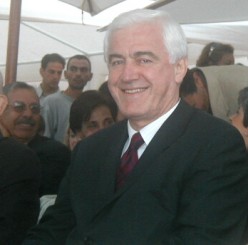
Please visit new web page for
Bechara Merhej
http://www.shweir.com/bechara_merhej.htm
Posted by Klee on
February 08, 2001 at 08:17:28:
I was overjoyed to find your web-site this week.
My great-grandparents Amin and Kammilie Abotomey came from Shweir to Adelaide,
South Australia, arriving in 1890. We think that their name would have been
something like Abou Toameh, Abu Tahmy, or Abou Taami in Lebanon. Their eldest
son Samir had arrived in 1887. My grandmother was born here in 1892. For decades
I have tried to learn about Shweir, since I found "Shweir, Mount Lebanon" listed
on my great-grandmother's death certificate as her place of birth, while
researching family history. I am still hoping to trace family records back
further if anyone from the Eastern Orthodox Church in Shweir can help, maybe to
find Amin and Kammilie's marriage records in the late 1860's, or their birth, or
further generations back.
Amin (born 1847) and Kammilie (born 1852) had
seven children. The company 'A. Abotomey and Sons', clothing manufacturers,
operated in South Australia from 1897 to 1972, run by three generations of the
family.
Amin's brother Bishara Abotomey (born around 1843) and his wife Labeebe (nee
Mabarrack) and their family also came here to South Australia. Although the
families' heritage was Greek Orthodox originally, Bishara was trained as a
Presbyterian Minister in Lebanon (by the American Mission). When he died here
aged 61, the newspaper reported that he had been "doing mission work for 35
years" and was "the only Protestant Minister in South Australia of Syrian birth.
His daughter Genevieve had a Diploma from the American College (University) in
Beirut (in the 19th Century) and was said to have helped to translate the Bible
into Arabic in Lebanon. She ran a music shop here for many years. The graves of
Amin and Kammilie Abotomey, and Bishara and Labeebe Abotomey are side by side.
They have had hundreds of descendants.
I was once told the meaning of three family names
was Abou Taami (a "cutting", maybe from Tomey i.e. Greek), Moujaes (a
"re-grafting") and Kiami or Keamy (a "rebirth", maybe from Quiyyamah, from
Arabic for resurrection), and these three were branches of the Helou family
which in the 1970's numbered over 10,000 persons in Lebanon. One original family
had split into these three branches and adopted these names after fleeing an
incident involving an Ottoman tax-collector, who after being given hospitality,
had demanded that the girls of the family be brought to him, which, as you might
imagine, was refused and severely punished, and led to the entire family packing
the mules and fleeing.
With such a fascinating Middle-eastern heritage
that seems so distant and hard to research, I can't tell you how much it means
to see the pictures of the village on the Internet and to read the items. I have
been told previously that Shweir means "rock or cliff" and Dhour means "heights"
so the newer area of Dhour Shweir means the "heights of the rock". How beautiful
Shweir is, nestled in a valley surrounded by rock and the dark green typical of
the mountains of Lebanon. The old name of Shweir was Mirrhatta after Prince
Hattem who governed the area once.
A cousin who has since died, visited the Kiami
family there in 1973 and Jamil Shakir Kiami (who has also since died) told
stories of our heritage which she passed on to us. He spoke in Aramaic (how
incredible) of our genealogy; that "many grandfathers ago" we had come from the
north and settled in Mount Lebanon in Shweir. He spoke of family names like
Boutrous, Faris, Kassab, Helou.
Apparently the old site of an Abotomey home still
had two solid timber doors over a large basement cellar with great floor joists
jutting out over the doors, and a grassy cover over what had been the floor. If
someone recognises this site in Shweir, let me know.
May the memory of many great emigrants from
Lebanon who gave their talents to the world give us pride and may this web-site
help us to learn about our history and remember our noble heritage. Thankyou
again for your web-site. I list it among my "favourites".
***********************************************
'Mount Lebanon' by
Colonel Churchill, 1853 book
Posted by Klee on
February 08, 2001 at 09:31:18:
For those who have never seen it, I have typed the following
extract from 'Mount Lebanon - a Ten Year's Residence from 1842 to 1852' by
Colonel Churchill:
"The village of Shweir, one of the most considerable in the Lebanon, consisting
of a mixed population of Greeks, Greek Catholics, and Maronites, but chiefly the
former, is famous for its artisans in every species of manufacture; so useful
and industrious indeed are they, that the Emir Bechir conferred on them the
singular privilege of being exempt from the forced labour which he used to
exact, as necessity required, from the surrounding population. Its iron smelting
furnaces are of wide repute, though not the only ones in the Lebanon. The Emir
Bechir used to make them a very lucrative monopoly. That of Shweir was farmed
out to the Jews of Deir-el-Kammar at eight hundred pounds a-year.
The masons of Shweir are in great demand. They work either by contract, or at an
average rate of from two to three shillings a-day. Their manner of building is
strong and substantial, but of symmetry and proportion they have not the
remotest idea. There is a spring of water here which dries up at the beginning
of summer, and reflows about the end of September, sometimes even before the
rains have commenced. This singular property is wholly unaccountable in the eyes
of the people. The spring has, therefore, been placed under a tutelary Saint,
who is supposed annually to trouble the waters.
On the day of their expected re-appearance, the whole village is in commotion;
the bells ring, the priests assemble in their different churches, from whence
leading forth a numerous and solemn procession, with uplifted crucifix and
floating banner, they go down to the cave which is by the side of the road, and
await the accomplishment of the miracle.
Should there be any delay, the saint is loudly invoked; hundreds of lighted
tapers flaunt about in all directions; clouds of incense ascend; votive
offerings are dedicated; supplications are poured out. Presently the water
begins to ooze - it bubbles - it flows. Frantic shouts of rejoicing fill the
air; bottles are speedily filled with the sacred element, to be corked up and
carefully preserved. At length, the crowd, pleased and gratified, disperses; the
priests assured of the efficacy of their prayers, the people congratulating
themselves on the strength of their faith...."
Extract from Volume 1 page 113-5:
Colonel Churchill (Staff Officer of the British Expedition to Syria). 'Mount
Lebanon - a Ten Years' Residence' from 1842 to 1852, describing the Manners,
Customs, and Religion of its Inhabitants with a Full and Correct Account of the
Druse Religion and Containing Historical Records of the Mountain Tribes from
Personal Intercourse with their Chiefs and Other Authentic Sources. Saunders and
Otley: London. 1853. (3 Volumes). I found a set stored away in the Library of
the University of Adelaide, South Australia. I know that some of the volumes
have been reprinted in recent years because of their historical value. If
interested check on Amazon.com booksellers.
Thank you so very much Klee. This information
is extremely valuable to the people of Shweir. Webmaster
Copy of an email sent by al Mukhtaar on Feb 8, 2001
Dear Klee
What wonderful articles you added to our
bulletin Board, I was overjoyed by both of them. By the way the Jamil Kiameh you
mention was married to my aunt Salma, and yes he knew a whole lot about history.
There is a picture of him in the section "Saif oo Terse" on the front page.
Click on the section and then scroll down almost to the end, when you start
seeing small pictures arranged vertically on the left side look for the one that
is titled "1930 Celebration in front of Ain Al Aboo". Click on the picture to
enlarge it... Jamil is the knight with sword on the right side.
Okay, Klee it would be nice to tell us
something about yourself, I don't think you mentioned your name, or maybe you
did and I missed it. Please go to the Guest book sign it. There are quite a few
of people that know the Abou Taameh.
I was surprised to hear that the Moujaes are
off shoot of the Helou Family. That, is going to open a lot of Eyes REAL WIDE.
Thank you and please write back, also tell us
how you found the site.
George Matar
**********************************
and an email from Hilda sent on Feb 9, 2001
Dear Dr. Klee,
I have enjoyed reading your entries on the bulliten board and I do respect
your curiosity about our heritage. I am a very curious person myself...maybe
genetic!
It is interesting to hear all the storiesyou related, that have been lost to
us, because so many of the elders have passed on and the war in Lebanon had
left people searching to meet their daily needs and having less opportunity
to leisurely relate to us the stories of long ago.
A lot of what you see on the site is a compilation of people from shweir who
are somewhere around the world yet willing -like you- to share something
about shweir with us.
Please feel free to contribute to our web-site and if we happen to be able to
answer any of your questions, we will surely let you know.
Welcome on board the shweir.com site...
Hilda
********************************************
Response by Dr. Klee on Feb 9, 2001
Dear George,
Thanks for the wonderful welcome I have
received from each of the three of you.
How amazing that you George are a relative
too, no matter how distant! I am stunned by all this; the Internet is
incredible. My mother's mother was Elizabeth Adelaide Abotomey, the youngest
child of Amin and Kammilie Abotomey, born here in Adelaide. My mother's cousin
Olive De Pinto (nee Abotomey) visited your aunt's family in Dhour Shweir in 1973
and continued to correspond with them from her home in Suffolk, England. She was
Jamil's cousin.
Her mother Naify Abotomey (nee Keamy) was
sister of Shakir Kiami, father of Jamil Shakir Kiami. Naify was born in
Mirrhairta (Shweir) in 1878, the daughter of Milhelm Kiami, eldest son of
Boutrous Fares Kiami, son of Fares Kiami, son of Kassab, son of Helou. After
being orphaned, Naify was brought to Australia in 1888 with her brother Naif
(born around 1877) and Khuttar (born 1873) by her aunt B'diah Boutrous Abomady
(nee Kiami), only daughter of Boutrous Fares Kiami. Naify married my great-uncle
Salim Amin Abotomey here in Australia. Olive returned here to visit a couple of
times in the 1980's before she died in 1991 and she traveled the world trying to
meet her relatives to record their existence. Regarding Jamil's family, it is
recorded that Jamil (1908-1986or7) was married to Salma, with four sons George
(married to Amal), Samir, Tannous (Tony) married to Loora Malouf from Zahle in
1973, and Shakir (an interpreter). These must be your cousins.
When Olive visited in 1973, Tannous had just
married Loora and they later had Samar, Nada, Randa and Zeina. After Olive's
death, Norma Holt, Olive's niece in New South Wales, Australia, continued to
write to them. Are they still living in Dhour Shweir? Jamil's grandfather
Boutrous Fares Kiami (a builder) married Nora Said Moujaes whose brother Antoun
Sa'adeh mentioned on the web-site was "Chief" and whose statue is in Dhour
Shweir. Olive taped Jamil Shakir Kiami reading in Aramaic and Arabic a Kiami
family genealogy document he prepared while she visited and in the conversations
around it you can hear the other family members, and probably it's your aunt
saying "Kifich?" (how are you) as they enter because there was fighting and guns
going off in Beirut. The war prevented her from visiting Shweir again. For some
years I have had a very poor microphone copy3 of a microphone copy2 taped as we
all listened to Olive's tape recorder copy1 in the 1970's. What is miraculous
about this website contact between us is that just a couple of weeks ago my Dad
finally found his copy2 and gave it to me to do a better direct copy and it has
been on my mind to get around to it. Many times there have been co-incidences in
this Lebanese family research; Olive really wanted the work on our heritage to
continue. She found that many of the later generations had no knowledge of their
Lebanese background. It is profound to me to remember that I am part of a very
long line of generations of Lebanese women, no matter where on earth that may
be. And we are still only 5 feet 1 in. tall, generation after assimilated
generation!!
That's all for now, but I will try to add some
detail on famous emigrants to the bulletin board when I can.
Thanks again for your welcome.
Klee.
Dr. Klee Benveniste
benvenik@optusnet.com.au
Baaklini & Kiamie members
survived the Titanic
The following copy of a newspaper
is courtesy of Nissrine Shehadeh Moujaes
Headlines about the rescue of
Adele Kiameh and Lateefeh Baaklini from the Titanic
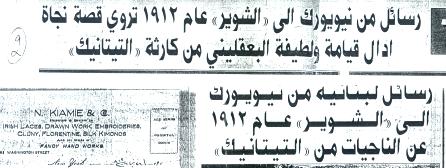
From Al Anwar Newspaper two
full pages...(March 8, 1998, pp 16 & 17). We do not have an original copy of
the paper... We would like to feature the entire article if someone can scan the
original newspaper or the original letters and documents... any volunteers???
***************************
-----Original Message-----
From: Almaza [mailto:almaza@almaza-beer.com]
<mailto:[mailto:almaza@almaza-beer.com]>
Sent: Friday, January 26, 2001 8:40 AM
To: gematar@sbinfra.com <mailto:gematar@sbinfra.com>
Dear Mr Matar,
Acording to your request , it is my pleasure
to write you about the Baaklini Family sailed on the Titanic.
The members of the Baaklini Family that sailed
on board the titanic were Latife Born on 1888 married to Suleiman Baaklini and
her three daughters Eugenie Born on 1909, Maria Born on 1906 Helene
Born on 1911. All the members of this familly arrived safely to new york. The
closest relative to Suleiman is Michel Baaklini 86 years old still living in
Shweir and her nephew, Bechara , Zeina, Alma , Micheline and Elias .
Herewith I am enclosing three pictures of
Suleiman his wife and her son, the house where we presently live in shweir and
photo of Michel Baaklini.
Michel Baaklini |
Suleiman Baaklini with wife & son |
Yours truly
Alma Baaklini
Shwairieh Bi Lebnan
*******************************************************
Excerpts of emails from and to Al Mukhtaar:
To Baaklini Family members:
Hey Guys, this is what Leila has sent. Apparently, there is a book coming up,
and your Family is going to be in it!
George
-----Original Message-----
From: Andalus2@cs.com <mailto:Andalus2@cs.com> [mailto:Andalus2@cs.com]
<mailto:[mailto:Andalus2@cs.com]>
Sent: Monday, January 15, 2001 12:29 PM
To: gematar@sbinfra.com <mailto:gematar@sbinfra.com>
Subject: Re: Baaklini Family Connection
Dear Mr. Matar:
Thank you so much for your help - hopefully the Baaklini family members who
boarded the Titanic will have their full coverage in this upcoming book. I thank
you again and all the anticipated assistance from the family. Regards,
Leila Salloum Elias
*****************************************
Sabah il Kheir Ya Leila
I just got this message from Alma Baaklini to
help you with your book. I did not have much luck with pic2, I can see the top
part only. Suleiman was really a good looking man.
The best part about this message is all the
connections you now have. Leila, Let us know when you are done, I am sure we
will love to write something about the book on our web page.....help the sales
you know.
Thanks to all the Baakilini on this effort,
And Alma Thank you very very much, when I go to Lebanon this summer, the Almaza
(The beer of course) is on me. What the Heck we'll but a full case and share it
with the others.
See you in August.
Best of Luck
George Matar
*****************************************
Thanks for this valuable information. I am
ashamed that I have no knowledge of that at all, it is so amazing how much he
looks like most of the Baaklini's I know, may be we are related some how. The
good news is that they made it safely.
Thanks George for sharing.
Suheil Baaklini
Many Thanks to Alma Baaklini, Leila Salloum Elias and
George Matar for bringing this bit of History to light!
Lebanese on the Titanic
Copy from the New Bulletin Board by Dr. Klee posted
02-18-2001 10:33 PM
I was surprised to learn from the old
Bulletin Board that there were Lebanese on the ship 'Titanic' when it struck an
iceberg and sank in 1912. So I have been searching on the Internet for details.
I found an archived letter from Daniel Nassif, Executive Director of the
American Lebanese Institute addressed to the Director of the Film 'Titanic'.
Nassif says that the multi-varied presence of Lebanese on the ship was
"unintentionally reduced in the film to a few seconds of a frightened woman of
nondescript appearance and origin shouting in Lebanese "yalla" (let's go!) to
her children". He emphasised that "one-hundred-and-twenty-five Lebanese were on
board of whom only twenty-nine survived who included twenty women, five
children, and four young men. Also during the voyage there were many parties
going on in third class, the largest and noisiest of which was a Lebanese
celebration of two recently married couples emigrating to the United States:
Hanna Touma, Antoine Yazbeck, and their wives. Much dancing and singing to the
tunes of Lebanese music could be heard throughout third class and passengers of
other nationalities also joined in the festivities. After tragedy struck and the
ship was sinking a group of Lebanese Christians huddled together on deck around
English Catholic priest, Father Thomas Roussel Byles, recited the "Our Father"
and other prayers. All of them perished along with the priest" (this letter was
found at http://generalaoun.simplenet.com/daniel3.jpg.
I also found an article by Ray Hanania "Arabs on the Titanic tale: we share the
pain but not the glory". He says: "All told there were only 706 survivors of the
2,223 passengers and crew...There were 79 passengers whose sur-names are of
obvious Arab heritage" and he quotes another source (Geller "Titanic: Women and
Children First" which said that officially there were 154 Syrians on board, and
29 were saved". Hanania says "All the Arab passengers were ticketed "Third
Class", except four who travelled "Second Class" " and he lists names and
details a few (5 page article at http://www.hanania.com/columns/col04088.htm).
The best information I have found so far is at the site 'Encyclopedia Titanica'
(http://www.encyclopedia-titanica.org/index.html). There are detailed
biographies of most of the passengers and crew. Because Lebanon had been part of
Syria, they are described as Syrians. Descendants and researchers have put
together what information is known about each. I am still searching for an item
cited there: Michel Karam 'The Lebanese in the Titanic', Beirut, 2000, which may
be a newspaper article. The Third Class passenger list and biographies can be
found at http://www.encyclopedia-titanica.org/listings/passenger_list_3rd_low.shtml. I
looked up the Baclini family from Shweir (mentioned on the old Bulletin Board):
Mrs. Solomon Baclini (Latifa Qurban), aged 24, and her three daughters Miss
Marie Catherine Baclini, Miss Eugenie Baclini, and Miss Helene Barbara Baclini.
There are biographies written about each of them with details of who they
married. When I read the page on Mrs. Baclini, I was surprised to read:
"Travelling with them was Miss Adele Jane Kiamie Najib who was going to the
United States to be married. Mrs. Baclini was serving as her chaperone since
Miss Najib was only in her teens.
When the collision occured Mrs Baclini knew something was wrong and somehow made
her way with her daughters and Miss Najib to the boat deck. Supposedly, when
they were boarding Collapsible C, the officer loading the boat would not let
Miss Najib on because she was not a "blood relative" of Mrs. Baclini. However,
Mrs. Baclini insisted that she could not arrive in America having saved herself
and her daughters and tell Miss Najib's family that she had to leave her behind.
They finally let Miss Najib on the boat". They all survived.
Having found the family name Kiamie, I looked up details for Adele Najib, and
yes, she was actually a Kiamie, 15 years old, the daughter of Najeeb Kiamie and
Merion Nasias. So her real name was Adele Najib Kiamie, known as "Jane" and in
America she married Naif A. Kiamie. Thankyou to the Baclini family for saving
her life! How many others from Shweir might there be in that list?
Dr. Klee
Wow!!!!! And I'll Second that too, WOW!!!!!Absolutely Fantastic information.
Well done
Where do you get all that Energy?
God Bless you
George
The following is from the
Attallah.org web site:
http://www.atallah.org/modules.php?name=News&file=article&sid=7
| |
General Information:
Atallahs and other Lebanese on The Titanic
Posted on Thursday, August
07 @ 19:24:45 EST by tony |
|
 |
|
 |
| |
A detailed account of
all the Lebanese who perished on the Titanic, including their villages
of origin and age.
There were officially were 66 Lebanese on board the Titanic, and 29 were
saved: four men, five children and 20 women. The small Roman Orthodox
Village of Kfar Mishki in the lower Bekaa Valley of Eastern Lebanon was
devasted by the loss of at least 8 of its inhabitants. Another village,
Hardeen, lost a 12 of its inhabitants whilst 8 others survived.
There were 2 passengers who
belonged to the Atallah family, one of them listed as Canadian
of Lebanese origins.
People whose country of residence was Lebanon:
|
Name |
Age at the time |
Originating |
Survived/Killed |
| ABRAHIM,
Mrs Mary Sophie Halaut |
18yo |
Ayn Arab |
S |
|
ALBIMONA, Mr Nassef Cassem |
26yo |
Shanai |
S |
| ASSAF,
Mrs Mariana |
45yo |
Kfar Mishki |
S |
| ATTALAH,
Miss Malake |
17yo |
Beirut |
K |
| AYOUB
DAHER, Miss Banoura |
15 yo |
Beirut |
S |
|
BACLINI, Mrs Latifa |
24yo |
El Shweir |
S |
|
BACLINI, Miss Marie Catherine |
6yo |
El Shweir |
S |
|
BACLINI, Miss Eugenie |
3yo |
El Shweir |
S |
|
BACLINI, Miss Helene Barbara |
1yo |
El Shweir |
S* |
| BADT,
Mr Mohamed |
40yo |
Tripoli |
K |
|
BARBARA, Mrs Catherine David |
45yo |
Kfar Mishki |
K |
|
BARBARA, Miss Saiide |
18yo |
Kfar Mishki |
K |
| BETROS,
Mr Tannous |
20yo |
Zgarta |
K |
| CARAM,
Mrs Maria Elias |
18yo |
Kfar Mishki |
K |
| CHEHAB/SHIHAB,
Mr Emir Farres |
29YO |
Beirut |
K |
| ELIAS,
Mr Joseph jr. |
15yo |
Kfar Mishki |
K |
| ELIAS
NASRALLAH, Mr Tannous |
22yo |
Kfar Mishki |
K |
| GERIOS
THAMAH, Mr Assaf |
21yo |
Kfar Mishki |
K |
| HANNA,
Mr Boulos |
18yo |
Hardeen |
K |
| HANNA,
Mr Mansour |
35yo |
Kfar Mishki |
K |
| HANNAH,
Mr Borak |
27yo |
Hardeen |
S |
| IBRAHIM
SHAWAH, Mr Yousseff |
33 yo |
Beirut |
K |
| JOSEPH
(SHAHIN), Mr Elias |
33yo |
Kfar Mishki |
K |
| KHALIL,
Mr Betros |
25yo |
Hardeen |
K |
| KHALIL,
Mrs Zahie "Maria" |
20YO |
Hardeen |
K |
| LAHOUD
ISHAQ MOWAD, Mr Sarkis |
30yo |
Zgarta |
K |
| LEENI,
Mr Fahim ("Philip Zenni") |
22YO |
Tula |
S |
| MAMEE,
Mr Hanna |
20yo |
Tripoli |
S |
|
MOUBAREK, Mrs Omine |
24yo |
Hardeen |
S |
|
MOUBAREK, Master Gerios ("George _") |
7yo |
Hardeen |
S |
|
MOUBAREK, Master Halim Gonios |
4yo |
Hardeen |
S |
| MOUSSA,
Mrs Mantoura Boulos |
35yo |
Hardeen |
S |
|
MOUSSELMANI, Mrs Fatima |
22yo |
Tibneen |
S |
| NAJIB KIAMIE,
Miss Adele "Jane" |
15yo |
El Shweir |
S |
| NAKHLI,
Mr Toufik |
17yo |
Hardeen |
K |
| NAKID,
Mr Sahid |
20yo |
Zgarta |
S |
| NAKID,
Mrs Waika "Mary" |
19yo |
Zgarta |
S |
| NAKID,
Miss Maria |
1yo |
Zgarta |
S* |
| NASR
ALMA, Mr Mustafa Farm |
20yo |
Tibneen |
K |
| NASSER,
Mrs Adele 2nd Class |
14yo |
Zahleh |
S |
| NASSR
RIZQ, Mr Saade |
20yo |
Ser’al |
K |
|
|
14yo |
Al Hakur |
S |
|
|
14yo |
Al Hakur |
S |
| NOFAL,
Mr Mansouer |
20yo |
Kfar Mishki |
K |
| PETER /
JOSEPH, Mrs Catherine (Rizk) |
24yo |
Ser’al |
S |
| PETER /
JOSEPH, Master Michael J. |
4yo |
Ser’al |
S |
| PETER /
JOSEPH, Miss Anna ("Mary Joseph") |
2yo |
Ser’al |
S |
| RAZI,
Mr Raihed |
30yo |
Tibneen |
K |
| SAAD,
Mr Amin |
30yo |
Tibneen |
K |
| SAAD,
Mr Khalil |
27yo |
Tibneen |
K |
| SAMAAN,
Mr Hanna |
40yo |
Hardeen |
K |
| SAMAAN,
Mr Elias |
17yo |
Hardeen |
K |
| SAMAAN,
Mr Youssef ("Joseph") |
15yo |
Hardeen |
K |
| SEMAN,
Master Betros |
10yo |
Hardeen |
K |
| THOMAS,
Mr Charles R'ad |
31yo |
Hardeen |
K |
| THOMAS,
Mrs Thamine "Thelma" |
16yo |
Hardeen |
S |
| THOMAS/TANNOUS,
Master Assad Alexander |
5months |
Hardeen |
S |
| TORFA,
Mr Assad |
20yo |
Tibneen |
K |
| TOUMA,
Mrs Hanna Youssef |
27 |
Tibneen |
S |
| TOUMA,
Miss Maria Youssef (Thomas) |
9yo |
Tibneen |
S |
| TOUMA,
Master Georges Youssef (Thomas) |
8yo |
Tibneen |
S |
| WAZLI,
Mr Yousif Ahmed |
25yo |
Tibneen |
K |
| YASBECK,
Mr Antoni |
27yo |
Hardeen |
K |
| YAZBECK,
Mrs Selini "Celiney" |
15yo |
Hardeen |
S |
|
YOUSSEFF (ABI SAAB), Mr Gerios |
45yo |
Hardeen |
K |
|
YOUSSIFF (SAM'AAN), Mr Gerios |
28yo |
Hardeen |
K |
* Babies who
died within a year of the tragedy.
Sleiman
Atallah (Attala) (listed as Canadian).
Mr Sleiman
Attala, 30, was a journalist from Ottawa, Canada. His native country was
Lebanon.
He boarded the Titanic at Cherbourg as a third class passenger. He
bought ticket No. 2694 for £7 4s 6d.
Mr Attala died in the sinking. His body, if recovered, was never
identified.
Miss Malake
Attalah passengers
When the Titanic
sank Miss Attalah was aged 17 years, she lived in Beirut Lebanon
She boarded the Titanic at Cherbourg on Wednesday 10th April 1912
(Ticket No. 2627) £14 9s 9d
Attalah died in the sinking. Her body was never recovered .
Travelling Companions (on same ticket) Mr Yousseff Ibrahim Shawah
Source: http://www.encyclopedia-titanica.org |
Information about a few of the notable Shweirieh
earlier in the Late 19th century and
early 20th
In the
late 19th century and early 20th,Shweir produced a large number of intellectuals
whose achievements involved literature, journalism, politics and science.
Many
thanks to Dr.
Salim Mujais for providing us
with some very valuable information below...
Dhaher Khairallah (1836-1916)
Dhaher
Elias Khairallah was born in 1836 and studied the elements of reading and
writing in the school of the monastery of Mar Elias which was limited to
religious texts. He was barely 14 when his father died and being the eldest had
to become the bread earner for the family. He apprenticed as a mason and worked
in this profession until he was 26 when he was asked to do some construction
work at the American missionary school in Abieh. While there, he convinced the
missionaries to accept him as a student in return for which he would care for
the building needs of the school. After graduation, he went to Beirut and
started a school for young men that counted the author Jerjy Zaydan among its
graduates. Dhaher then joined the Orthodox College of al-Thalath Aqmar (The
Three Luminaries) where he taught mostly Arabic language and literature. After
brief stints of teaching in Damascus, Tripoli and Kayfun, he joined the Orthodox
Patriarchal Monastery of al-Balamand and taught seminary students many of whom
were later to become leaders in the church. He also studied law late in life and
practiced his new profession briefly in Beirut. He was a prolific writer in
linguistics and had several books on the details of Arabic grammar and syntax. In
addition, he wrote a couple mathematics textbooks and two works on Orthodox
theology. He died in 1916 and was buried in Beirut.
Jerjes Hammam (1857-1921)
Jerjes
Hammam was born in 1857 and being sickly, his parents sent him to the English
primary school in Shweir. He excelled to such a degree that an English
inspection team in 1870 recommended he be transferred to the high school in Souk
al-Gharb where he met Reverend Ray in 1872. In 1873, he became the Reverend's
translator and he focused his efforts on translating geometry and algebra books
to Arabic. When in 1874, Reverend Ray transferred his post to Shweir and founded
its high school he brought Jerjes Hammam with him and appointed him as a
teacher. Hammam was appalled by the then available books for teaching Arabic and
devised a modern educational method with a series of graded books, which
revolutionized teaching methods in the Near East. Jerjes Hammam later went to
the UK were he studied advanced mathematics. In 1887, he published in
association with Salim Kassab an Arabic-English dictionary. In the introduction
they write: Being the first handbook on the subject we have spared no pains in
studying the best authorities in both languages, so as to produce the exact
translation of the Arabic words, and in making it inclusive of all the words
that are in general use, in both spoken and written Arabic, together with
scientific, industrial, commercial, and political terms? In the Arabic
introduction to this dictionary, the authors state that they intended to follow
this work with a larger and more comprehensive one covering all the Arabic
vocabulary. They state that they had already finished a large part of this
larger sequel, but the need for a practical medium size work led them to publish
the abbreviated opus I have been unable to ascertain whether the longer work was
ever published. In 1908,
Jerjes Hammam published an Arabic-Arabic dictionary for students He called it
Mu?jam at-Taleb (A Student’s Dictionary). It was printed by the al-Matba? Ah al-Uthmaniyah
(Ottoman Press) in Baabda in 1907. The dictionary reflects his concern and
ongoing crusade to improve the teaching methods and standards and his efforts to
provide the tools for such improvements. At its publication, the dictionary had
a long and learned introduction on issues of Arabic grammar written by another
philologist and grammarian from Shweir called Dhaher Khairallah (see
above). Two other Shweireh
contributed financially to the production of the dictionary: father Moussa
Merhej and Nehmeh Jafet. In 1907, Jirjis was invited to participate in the
design and later the administration of the Orthodox high school in Homs where in
addition to his administrative duties he taught mathematics. After many years of
teaching in the most important schools in Lebanon and Syria, Jirjis Hamman died
on the 22nd of June 1921.
Ni’mah Yafith (1860-1923)
Ni’mah
Yafith was born in Shweir on
October 28th of 1860. He
Received
his early education at the hands of his father who was teaching at the school of
the Mar Elias monastery. He
completed his studies at the Protestant high school in Shweir while helping his
own father in teaching at the Mar Elias monastery school.
In 1878
he joined the Syrian Protestant College from which he graduated in 1882 with a
bachelor’s degree in Sciences. Among his teachers at the College were Daniel
Bliss, George Post, John Wortabet, Yakoub Sarrouf, and Faris Nimr. Ni’mah Yafith had
a particular interest and skill in mathematics and in 1886 he published a
textbook on the subject, followed in 1890 by a shorter version of the original
tome. Around the same time, he
joined the teaching staff at the Orthodox College of al-Thalath Aqmar (The Three
Luminaries). Ne?meh was actively involved in the scientific and literary revival
activities of the time. Soon after
his graduation from College, he became a member of the al-Majma? Al-Ilmi
al-Sharqee (the Oriental Scientific
Association), a learned society that counted among its members the elite
scientists, physicians and educators of the time.
In 1893,
Ni’mah emigrated to Brazil where he was very successful
In trade
and industry. In 1907, he built the
largest textile factory in the country and by 1913 he was heading the Syrian
Chamber of Commerce in Brazil. With
the rapid development of the commercial activities of the Syrian communities in
Brazil, Ni’mah Yafith organized,
in 1913, a special chamber of commerce to serve the interests of the immigrants.
In 1917, the newly organized al-Jam’iyah al-Wataniya al-Souriya al-Lubnania (The
Syrian Lebanese Patriotic Association), a group that lobbied for Syrian
independence under French patronage invited him to become its first president.
Likewise he was elected, during the First World War, head of the Brazilian Red
Cross Society in Sao Paulo. His services in this and other philanthropies were
recognized by both the immigrants and the Brazilians alike, and the Sao Paulo
Republican Party, named him, in recognition of those services, head of its
Ypiranga branch. The State government also bestowed upon him the rank of
honorary colonel for his many services to the country, and the French government
recognized his services to the Allied cause by decorating him with the Legion of
Honor. During the First World War, he spearheaded the effort to send financial
support to Syria to help
Alleviate the famine. He died on
December 26, 1923. In 1952,
a commemorative statue was erected in his honor in front of the new city hall
built in Dhour-el-Shweir with money donated by his family. A large donation to
his alma mater the American University of Beirut (previously the Syrian
Protestant College) helped establishes the Yafith Library,
the premier library in the Near East.
As’aad Rustum Mujais (1878-1969)
As’aad
Rustum was a prolific and humorous poet whose poems and limericks
have withstood the test of time with
their vigor and relevance.
His
poetry was focused on social and political criticism and he spared no one from
his barbs were they politicians, clergy or fellow writers and poets. He
had a penchant to parody the classical poems of yesteryears, particularly the
inflated poetry of Antar and others, with a very successful humorous outcome
that ridiculed the withered traditions of classical themes. He was born in 1878,
studied at the Protestant school in Shweir, and subsequently at the Syrian
Protestant College. By the turn of the century, he immigrated to the United
States and undertook a successful commercial venture in the import of Persian
carpets. This did not prevent him, however, from pursuing a literary career and
contributing to the various Syrian periodicals published in New York.
He
gained the praise of young Gibran Khalil Gibran when the two of
them were the major contributors to the periodical al-Muhajer published in New
York by Ameen al-Ghurayeb. Gibran frequently referred to the three of them as
the? Trinity? And when Ameen and As’aad visited Egypt and Syria in 1908, Gibran
wrote to them of his longing to be in their company. The relationship between
Gibran and As'aad Rustum was not, however, without its occasional tensions.
As’aad was offended by a wholesale criticism of Syrian poets in the Americas
that Gibran expressed in an article published in al-Muhajer. Gibran
rectified his faux pas in a letter to Ghurayeb praising a wonderful poem by
Ass?ad on the topic of the national flag, and Ghurayeb managed to smooth the relationship between the two. In
1908, As’aad published a collection of his poems in a book titled Diwan As’aad
Rustum.
Another
collection of poetry was later published as al-Rustumiyat. Ass?ad may have had
a lapse in his publications during the First World War so in 1918 Gibran writes
to him .:
Dear
Brother As’aad: Peace upon your soul. Your return to us
After
such a long absence, carried on the wings of poetry, is an event worthy of
celebration and rejoicing. I told you yesterday verbally and now I repeat my
words in writing that your withdrawal from literature was a crime and a form of
blasphemy and rebellion against the laws of God. I read yesterday your poem on
the beauty of ugliness and was delighted with it as I am with all your poetry? I
sent you today a copy of my English books The Madman with the hope that you will
find in it what would please you. Do write a word about it if you find it worthy
or toss it in the immense great abyss we call silence?
As’aad
Rustum lived for most of his life in the United States and left a large legacy
of poems only a small portion of which was published in collections.
Mansour Jurdak (1881-1964)
Mansour
Jurdak was a famous mathematician, physicist and Astronomer.
He
directed the observatory of AUB and in June of 1918 he discovered a new nova.
Daoud
Fouad Mujais (1886-1960)
Daoud
Fouad Mujais studied in the Protestant school in Shweir
And
became a teacher in it and in other schools in the region. In June 1904, he
started a magazine called al-Nour in Alexandria (published until 1918) and in
1909 the daily al-Hurryat (closed in 1910). He had a long conflict with the
Governor of Lebanon Youssef Pasha, which fills the pages of his newspaper. He
was sentenced to 6 months in jail, but escaped before his arrest and would not
accept a "dishonorable pardon". As the authorities could not silence him by
bribery and offers of government position, they continued to persecute him (with
an occasional attempt at his life) until he left to South America where he
collaborated with Dr George Sawaya (1882-1959, also from Shweir) in publishing
the periodical al-Islah (Reform) in Buenos Aires. In Chili, he later issued the
periodical al-Aresh (The Throne) between 1920 and 1925. He
is also known to have started several political and literary societies and to
have been a member of the founding group that wrote the bylaws of the Reporters
Union. Daoud Fouad Mujais was a fierce anti-clerical, a reformer of newspaper
writing attacking lies and false pretenses rampant in the newspapers of the
time.
The
political-literary career of Daoud Fouad Mujais did not end in Chili.
He moved
to Germany in the late twenties, married and brought his children to Shweir
where they stayed for several years learning Arabic. In the late thirties, he
was involved in supporting and helping plan the uprising of Keilani in Iraq
against the British rule. In later years, he continued to espouse nationalist
ideology and issues.
Thank you Dr.
Salim Mujais for these insightful information which is part of Shweir's History
The Road to Baskinta
Posted by Waleed
Moujaes on October 31, 2000 at
21:39:12:
The road linking the town of Baskinta to Bteghrine was
engineered and constructed under the supervision of the late Wadih Tanious
Baaklini. It is said that he has rided a donkey from Bteghrine, and gave him the
freedom to go up the hill towards Baskinta. He has followed the exact steps of
that donkey, and contructed the road accordingly. Funny!!! Isn't it? Waleed
Webmaster's Note: When one of our team members conducted a search on the
Word "Shweir" on the internet, the following was one of the articles we found.
We consider this information to be part of the history of Shweir. This is in no
way an endorsement of a political belief. We adhere to our Mission Statement
and are presenting what we believe to be a well researched historical article or
rather thesis about some very important people from Shweir who had significant
impact upon the community and the region. However, we do not and cannot
guarantee its accuracy. Most of us from Shweir were/are unaware of the depth
of information contained herein. This is an excellent example and a model of
presenting information and biographies about important Shweirieh. We will be
happy to feature similarly researched information on any Shweiry regardless of
political or religious affiliation. What we can do is to provide you with as
reliable and unbiased information as we can. You draw your own conclusions and
you are the final judge on how to perceive and process such information.
The
Works Of Dr. Khalil Saadeh
Novels:
- Prince Murad or the Syrian Prince: Published in London in 1893 (English)
- Ceasar and Cleopatra: Published in London in 1895 (English)
- Secrets of the Russian Revolution: Published in Cairo in 1905 (Arabic)
- Anthony and Cleopatra: Published in Brazil, n.d. (Arabic/English)
- Secrets of the Bastille: Published in Cairo in 1906 (Arabic)
- The Elegant Circusion: Published in Cairo in 1908 (Arabic)
Books:
- The Prevention of Pulmonary Tu-berculosis and its ways of Treatment: Published
in Cairo in 1905 (Arabic)
- Saadeh's Lexicon: Arabic-English lexicon published in Cairo in 1911.
- Nublah fi Kannana: Istanbul 1883 (Arabic)
- Arabic Literature: Published in Cairo in 1886 (Arabic - al-Rabittah: A
Collection of Articles published in Brazil in 1971.
Translations:
- The Gospel of Barnabus: Published in Cairo in 1908 - Appathia, Published in
Cairo, n.d.
Basic References
- Ali Hamie, Khalil Saadeh: L'homme et L'oeuvre 1857-1934, PhD Dissertation,
University of Paris, Sorbonne, 1986. - Nawaf Hardan, Al-Rabittah, Sao Paulo,
1971.
- A. Saadeh, Complete Works, Vol. 2, Beirut, 1982.
- Badr el-Hage, The Unknown Works of Khalil Saadeh, London, n.d. - Adel Beshara,
"Khalil Saadeh: Nationalist Crusader," Middle East Quarterly, Vol. 3, Number 9,
1996.
Dr. Khalil Saadeh: A Nationalist Crusader
By Adel Beshara
During the nineteenth century, a small group of writers, who were set apart from
those among whom they were living by education and experience, started a
literary re-vival in the Arab East. One of the leading intellectual figures in
this revival was Khalil Sa'adeh. whose ideas had a certain intrinsic inter-est.
but none of whom have been fully explored.
Dr. Sa'adeh, as he is generally known, belonged
to that group of writers whose ideas served as forces in the process of change
which gave the Arab East a new lease on life. Born in 1857, in the Leba-nese
mountain village of Shweir. Khalil Saadeh studied at the Syr-ian Protestant
College (currently the American University of Bei-rut). In those years, young
Saadeh gave two indications that he would not be motivated purely by the desire
for an average career.
Firstly, he was elected as the official spokesman
for the "Student Movement" which formed in 1882 to persuade the Ottoman
authorities to recog-nize the medical degree offered by the university. This was
the first major indication of the rebellious tendency in Khalil Saadeh's per-sonality.
Secondly, despite his academic specialization and
work in the field of medical science. Khalil Saadeh took a keen interest in the
social and intellectual issues of the day. Indeed, his first article. aptly
entitled "The backwardness of our Country and the Prospects for advancement,"
was published in al-Jinan, the Beirut periodical issued by Butrus Bustani. When
political conditions in Syria suddenly turned sour under Hamid, Dr. Saadeh fled
to Egypt along with many other Syrian in-tellectuals adversely affected by
Hamid's repressive policies. At the time, the Syrians constituted a small but
highly influential community in Egypt. Many of them were suc-cessful
entrepreneurs and prominent thinkers who dominated the intel-lectual field.
Their psychology bore on Khalil Saadeh in several ways. First of all. it enabled
him to gain some sense of solidarity with other members of his community. More
importantly. it made him more aware and appreciative of his na-tional
background. For, according to Thomas Philipp, Syrians who had arrived in Egypt
during the last two decades of the nineteenth century had to realize that they
would remain marginal and barely tolerated in Egyptian national poli-tics. As
emigrants in a foreign surrounding, they had, indeed, been made aware of their 'Syrianness.'"
In Cairo, Dr. Saadeh led a life of intense intellectual produc-tivity and
nationalist militancy.
In addition to his medical writings (his first
medical book was entitled The Prevention of Pulmonary Tu-berculosis and its ways
of Treatment), he was a novelist (in English his novels included: Prince Murad,
Ceasar and Cleopatra, and Anthony and Cleopatra), a histo-rian (he wrote two
major studies. one on the Secrets of the Russian Revolution of 1905 and the
other on the French Revolution - Mys-tery of the Bastille - which he described
as a turning point in modern history), a linguist (his was the first major
English-Arabic dic-tionary) an editorialist (he contributed to English and
Arabic newspapers including The London Time.s and al-Ahram in Cairo), and a
translator.
The writings of Dr. Saadeh was a fragment of the
autobiogra-phy of his age. It embodied both the force of nationalism and the
spirit of rational socialism. Strangely enough, the most interesting aspect of
it came from an unusual source. While he was in Cairo, Dr. Saadeh was appointed
as a correspondent to The London Times. This en-hanced both his interest and
skills in the English language and. in the long run, motivated him to publish.
in 1919 a two-volume Arabic-Eng-lish dictionary entitled Saadeh's Lexicon.
Although it took only two years to complete, the Lexicon was a fairly extensive
work which in-troduced into the Arabic language the current terminologies in
Sci-ence and the Humanities. In recognition of this outstanding achievement the
Khedive of Egypt bestowed upon him the title of Bey. Saadeh 's exile in Egypt
was not free from harassment and un-certainty; yet he always looked back on it
with nostalgia.
The most con-troversial part of it occurred soon
after the appearance of the Gospel of Barnabus which he translated into Arabic.
In the introduction to Barnabus, Dr. Saadeh wrote: I started translating this
book which is called the Gospel of Barnabus well aware of the re-sponsibility
that I had undertook. My aim was to serve historical studies and of course our
lan-guage which is perhaps the most logical medium into which this work should
be translated This is the first time that this hook has come out in the Arabic
language. It is a gospel about which schol-ars and historians have differed
sharply. In thses closing comments. though. I do have to stress that in this
introduction all my discus-sions are purely scientific and historical in
orientation and that I have been scrupulous to avoid all religious controversies
which I left to those who are better equipped to deal with them.
Despite this unequivocal explanation. the publication of Barnabus in Arabic was
met with some scepticism due largely to re-ligious sensitivity. The late Rashid
Rida inflamed the public by pref-acing the work with a preamble that took its
entire meaning out of context. The preamble was incor-porated into the book
without Dr. Saadeh's prior knowledge. In 1908, the year that Abdul Hamid revived
the Midhat's con-stitution of 1976. Dr. Saadeh returned to his native village in
the Lebanon. The resurrection of the constitution was greeted with en-thusiasm.
particularly in Syria where it was mistaken for real lib-erty.
As for Dr. Saadeh. he found himself embroiled in a serious dispute with the
French ambassa-dor in Beirut. In the wake of this incident, he published an open
let-ter to the Ambassador in Lisan al-Hal denouncing in the sharpest of terms
French imperialist policy in Syria and France's claim to be the protector of the
Lebanese Chris-tians. Both the French Ambassador and the Maronite Patriarch
reacted wrathfully. Realizing the serious-ness of the situation, the Governor of
Mount Lebanon, Mazfar Pasha, advised his friend Dr. Saadeh to leave the country
until the contro-versy dies down. Dr. Saadeh returned to Egypt only to find that
he was no longer welcomed there. He was ejected by the Egyptian monarch after
his intimate association with Egypt's top nationalist leaders (Arabi Pasha,
Mustapha Kamel and Sa'ad Zaghloul). came to light.
At the same time as this was taking place. his
wife passed away in Shweir, and his children were left on their own to survive
in the fam-ine-stricken town. Unable to return to Syria due to the outbreak of
the First World War. Dr. Saadeh elected to go to South America where the Syrian
community was flourishing. Dr. Saadeh's strength lay in his gift to adjust to
any kind of situation. Soon after arriving in Argentina, he began the same
ar-duous work which he became accustomed to back in Egypt. He issued a
periodical called al- Majallah and established The Syrian Press Trade Union. In
1919. he organized the First Syrian Na-tional Democratic Conference in a daring
move to unite the Syrian community in Argentina around the cause of national
independence.
After the Conference. Dr. Saadeh announced the
creation of the Na-tional Democratic Party which adopted the slogan ''An
independ-ence that we must embark upon as virtual nomads is still better than
slavery that seems to offer a civi-lized life. In 1920, Dr. Saadeh went to
Brazil where he was reunited with his children. In Brazil, he quickly acquired
prominence and became a community leader in his own right.
Assisted by his dynamic son, Antun (founder of the Syrian Social National Party)
he published two newspapers, al-Majallah and al-Jaridah, and sponsored a number
of important activities such as the outstanding project to raise a statue in
memory of the late Youssef al-Azamah who died in the Battle of Maysaloun in
1920. To this very day, the statue stands in front of the Syrian parliament in
Damascus. As a community leader, Dr. Saadeh showed considerable per-sonal
courage in opposing the disunity and intolerable rifts that divided the Syrian
community abroad.
If one were to sum up the political and
intellectual position of Khalil Saadeh, the following picture would emerge: (1)
He was a strong advocate of the secular idea. Like others in the same capacity,
he believed in the separation between religion and politics and in the
elimination of the factors that impede social unity. (2) He regarded socialism
as the ideal form of political organiza-tion. He was not a Marxist but a
practical socialist who believed in equality and human dignity. (3) He was a
nationalist crusader for the cause of Syrian unity. Although he was a Christian
from Mount Lebanon, the idea of a separate Lebanese nationalism never appealed
to him. In his last years in Brazil Dr. Saadeh was appointed honary chairman of
the Syrian National League and editor-in-charge of its weekly periodical. al-Rabitah
(The League). He passed away on April 10, 1934 leaving behind him a legacy that
time has never been able to completely erase.
In accordance with Webmaster's note above, the
following is submitted by Michael Sawaya, Dhour Shweir. This again appears to
be a well researched, informative and historical article about another important
person from Shweir. We encourage our readers to submit to us similarly
researched articles about important Shweirieh like Salwa Nassar, Asad Rousom
Moujaes, Khalil Hawie, Rahbani Brothers, Nimeh Yafet, and many others.
ANTOUN SA'ADEH
(March 1, 1904 - July 8, 1949)
A WAY OF LIFE AND STRUGGLE
Leader-Founder of the Syrian Social Nationalist Party (SSNP), author of numerous
books and treatises on social, philosophic, intellectual, political and literary
subjects; also founder of several newspapers at home and overseas, originator of
a philosophic outlook on life, the universe and art, and a distinctive Social
Nationalist doctrine.
BACKGROUND:
On March 1, 1904, in Showeir, Metn District, Mount Lebanon,
Antoun Sa'adeh was born to two Lebanese parents, natives of the same town. His
father, Dr. Khalil Sa'adeh, was a noted physician, scholar, man of letters and
one of the few most prominent national leaders, at home, in Egypt, and in Brasil
which teems with Lebanese emigrants. He also founded several overseas
patriotic and national societies and parties as well as the two publications,
"al - Majallah" (the magazine) and "al - Jaridah" (the Newspaper) in Sao Paulo,
Brasil.
Antoun Khalil Sa'adeh got his elementary education in the
Showeir School and continued his secondary education in the "Frères Institute"
in Cairo, where his father was an émigré. Then he moved back to Lebanon and
joined the Brummana High School (a flourishing institution, run by the Quakers)
where, on a special occasion, staged for the reception of Jamal Pasha, Supreme
Commander of the eastern flank of the Ottoman forces in the Near East, young
Antoun rejected to bear the Ottoman flag in the reception. Late in 1919, i.e. in
the aftermath of World War 1, he left the country for the United States of
America profoundly grieved at the indescribable famine plague which overwhelmed
his country and people especially the Lebanese, and of which he was eyewitness.
Then in February 1921 he moved to Brasil where he participated with his father,
Dr. Khalil Sa'adeh, in editing the "Jaridah" and "Majallah". Dr. Sa'adeh is also
noted for being the author of the first English-Arabic dictionary referred to as
Sa'adeh's Dictionary (1911).
For many reasons Sa'adeh, the son, did not continue his
academic studies, but relied on self-education; so in addition to Arabic, he
mastered English, French, Spanish, Portuguese, German and Russian. This opened
the door wide before him to utilize these living languages in carrying further
his penetration of human knowledge and thought in numerous specializations,
comprising history, philosophy, the social sciences, anthropology and
literature. This achievement furnished him with expansive, all-round knowledge,
evidenced in his repeated reference in his writings, to reliable sources and
authorities. Sa'adeh was endowed with a masterly analytical mind and a superior
creative potence, profusely manifest in his works and thinking.
In 1924, in Brasil, he formed a secret society to work for
liberating the homeland from the mandate; he also joined several societies for
the same purpose, but soon found out that struggle, to be effective, must be
launched in the homeland on the spot and not from the land of emigration
overseas. So he returned home in July 1930. He wrote the story "Faji'at Hubb"
(a love tragedy) which was printed with the story, "Eid Sayyedat Saydnaya" (The
Feast of the Saydnaya Madonna) in one volume for the first time in Beirut in
1931. In the same year Antoun Sa'adeh moved to Damascus where he participated
in editing the Damascene daily newspaper "al Ayyam" (Days; The Times).
The next year, he returned to Beirut determined to establish
the Syrian Social Nationalist Party, preferring start in the most convenient
medium, that of the students at the American University of Beirut, where he. had
previously taught the German language. On November 16, 1932, Sa'adeh founded the
SSNP with a membership of five A.U.B. students, among them was George Abdul
Masseh. From such a humble milieu, his call resounded in the region far and
wide, bringing together one thousand members in the lapse of three years of
underground action. Then, on its third anniversary, November 16, 1935, the Party
was detected by the mandate. Sa'adeh and a number of his aides were detained and
sentenced to various periods, the longest being six months for Sa'adeh himself,
pursuant to decree 115 L.R. which prohibited the founding of societies and
political parties in the territories under the French mandate.
In his letter from detention, dated December 15, 1935, to his
lawyer (the late) Mr. Hameed Franjiyeh, titled "On What Motivated Me to found
the Syrian Social Nationalist Party", Sa'adeh says. "I was only a child when
the Great War broke out in 1914, but I had already begun to perceive and
comprehend. The first thing that suddenly occurred to me, having witnessed, felt
and actually experienced the affliction of my people, was this question: (What
brought this woe on my people?) - Since the war ended, I began to look for an
answer to this question, and a solution for the chronic political problem which
drives my people from one distress to another, constantly delivering it from a
lesser evil to make it an easy prey for a greater one. It then happened that I
left the country, in 1920, while dormant sectarian rancors were wide awake, and
the nation had not yet buried its corpses. Among the emigrants overseas the case
was only a little
better". This portrayal of the plight of our nation, with all the distress and
misery brought in by World War I and the aftermath, was profoundly impressed on
the mind and conscience of Sa'adeh to be reproduced in his first writings (1921)
in "al-Majallah" and "al-Jaridah" in Brasil, with a distinctive tone indicating
the exhausting labour of mind he was sustaining, and the painstaking search for
a prescription which would save his nation from it chronic illnesses. The
resurging nation he anticipated should start with a model of his own shaping --
a party that will save his country and people from sectarian feuds and
fragmentation. He sensed in the depth of his soul that a formula must be devised
to help them out of subjection to a relentless, unbroken chain of catastrophies.
As Ottoman oppression shrank away, he found the country succumb to French and
British colonialism, which in the Sykes-Picot agreement, stabbed our homeland
with the knife of partitioning in order to prepare, under the Balfour
Declaration, a foothold for the Zionist, racist settlement colonialism in
Palestine. He witnessed all that happened and, conversely, witnessed the Great
Syrian Conference held in Damascus in 1919 and in 1920 declaring the integrity
of the Syrian lands, to be later trodden down by the hoofs of the French horses
at the ennobling battle of Maisaloun, though ending in victory for the
colonialist army and the stretching of General Gouraud's grips to Northern
Syria. Sa'adeh also witnessed the fall of Palestine, through the British
mandate dedicated to the policy of the Balfour Declaration, into the clasp of
the Zionist designs.
All that national suffering is pronounced in Sa'adeh's early
writings in the overseas press between 1921 and 1925, the period in which the
idea of founding the Party was being conceived. During World War I, while still
a youngster, Sa'adeh saw how his people died from starvation without having to
do with the fighting, and their fate exclusively determined by foreign
interests. At that stage Gibran Kahlil Gibran wrote his touching, "My People
Died", lamenting his countrymen and their fate. This article rang throughout the
intellectual Arab world; yet Sa'adeh who had eyewitnessed how his people died of
hunger and disease went much further than lamentation from a distance. The seeds
of revolution and change were stirring in the depth of his being and so he began
to contemplate a plan to be drawn up later on for relieving his people from
their misery and subjugation. That was the distinction between the creative
leader who treasures in his soul a historic stage and proceeds to lay out the
foundation of change and salvation, and poet who is overwhelmed by agony which
he pours forth from the tip of his pen in translucent literature.
Reference : http://leb.net/fchp/lead1.htm
Nora Matar
Moujaes
One of the earliest Shweiry
Women Pioneers are Dr. Nostas Barakat and Zahia Barakat a
pharmacist. These two have served
the Shweirieh for a long time around the early middle of the 20th century. Many
of the old folks remember their contribution to keep the Shweirieh healthy.
 Lebanon's
beauty is illuminated by its geography (see
interactive map under Tourism.)
-- its narrow coastal plane and two parallel north/south mountains (the
mountains of Lebanon and anti-Lebanon). The fertile Bekaa valley, with its
Litani and Orontes Rivers, separates these mountains and nourishes the terrain.
Residing majestically over the valley, Qournet Assaouda in the north of Mount
Lebanon (altitude 3,083 meters or 10,112 feet) and Jabal al-Sheikh in the south
of the anti-Lebanon range (altitude 2,814 meters or 9,230 feet) remain the
highest peaks in the country.
Lebanon's
beauty is illuminated by its geography (see
interactive map under Tourism.)
-- its narrow coastal plane and two parallel north/south mountains (the
mountains of Lebanon and anti-Lebanon). The fertile Bekaa valley, with its
Litani and Orontes Rivers, separates these mountains and nourishes the terrain.
Residing majestically over the valley, Qournet Assaouda in the north of Mount
Lebanon (altitude 3,083 meters or 10,112 feet) and Jabal al-Sheikh in the south
of the anti-Lebanon range (altitude 2,814 meters or 9,230 feet) remain the
highest peaks in the country.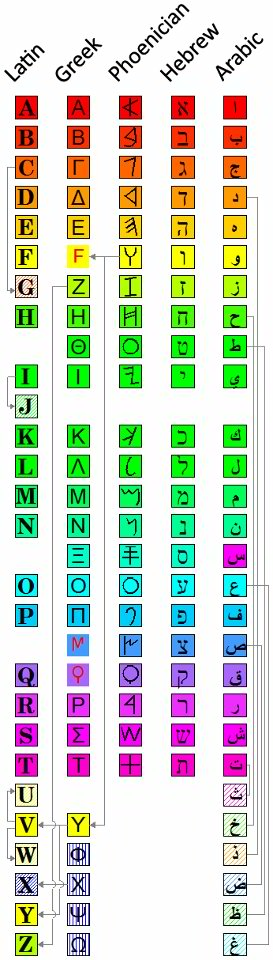
 Top
World Banker Riad Salamé on a Brief USA
Visit to Silicon Valley
Top
World Banker Riad Salamé on a Brief USA
Visit to Silicon Valley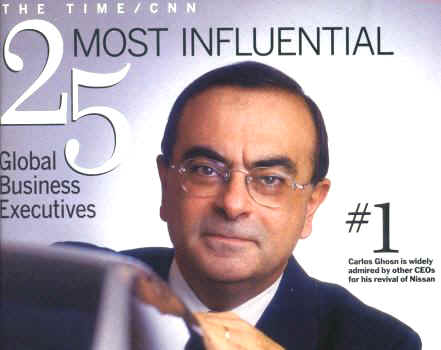
 Carlos
Ghosn is flat out the hottest automotive talent on the planet right now, and
he enjoys the kind of street cred that execs from Detroit to Stuttgart can
only dream about. In Japan, a full five years after arriving from France's
Renault to run Nissan Motor Co. (
Carlos
Ghosn is flat out the hottest automotive talent on the planet right now, and
he enjoys the kind of street cred that execs from Detroit to Stuttgart can
only dream about. In Japan, a full five years after arriving from France's
Renault to run Nissan Motor Co. (